Does Uber Offer Health Insurance? Options for Uber, DoorDash & Lyft Drivers (2027)
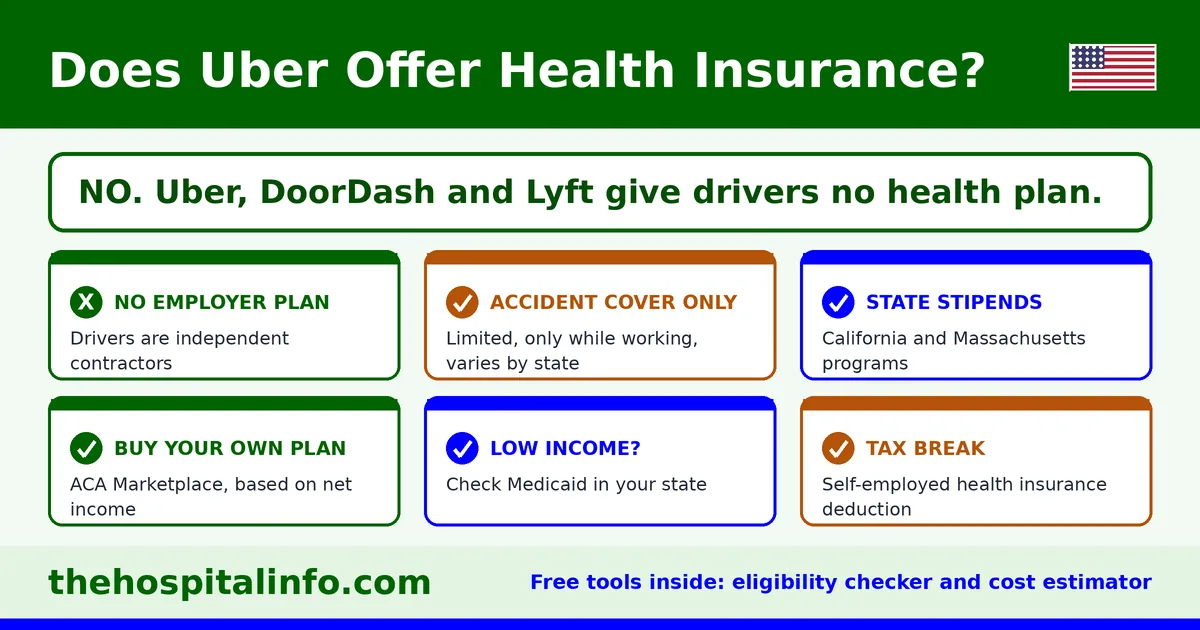
Does Uber Offer Health Insurance?
Last updated: October 26, 2026
Eligibility Checker |
|---|
| 2027 coverage is calculated based on the 2026 poverty guidelines. It cannot consider your age, state-specific exceptions or immigration details. HealthCare.gov, your state exchange or your Medicaid agency makes the final decision. |
Table of Contents
Tap to open the table of contents
- Does Uber Offer Health Insurance?
- Eligibility Checker
- Open Enrollment Dates for Gig Drivers: 2027
- Does DoorDash Offer Health Insurance? Uber, DoorDash and Lyft Compared
- California and Massachusetts Health Stipends
- Marketplace Coverage Changes: 2026–2027 Updates
- Net Income, MAGI and Proof of Income
- 2027 Income Thresholds
- Plans, Costs and the Bronze vs. Silver Estimator
- Major Insurance Companies Selling ACA Plans
- HSA-Eligible Plans and HSA vs HMO
- Medicaid and the 2027 Work Requirement
- State Guides and Exchanges
- Self-Employed Health Insurance Deduction
- Uber Supplemental Insurance
- 5 Hypothetical Examples
- Hypothetical Driver Walkthrough
- 7 Steps to Choose a Plan
- Common Driver Problems and Quick Fixes
- Official Support Channels and Helplines
- FAQ
- How the Tools and Numbers Were Checked
- Official Sources
Open Enrollment Dates for Gig Drivers: 2027
2027 Open Enrollment at a Glance
- November 1, 2026: Open Enrollment starts on HealthCare.gov.
- December 15, 2026: last day to enroll or change plans for coverage starting January 1, 2027.
- December 16, 2026 to January 15, 2027: coverage starts February 1, 2027; January 15 is the last day.
- After that, you need a Special Enrollment Period. Medicaid and CHIP can be applied for any time.
Which Plan Window Is Open Today? |
|---|
| Uses your device’s date and the dates published for the 2027 coverage year. Exchange cutoff times can vary, so confirm the exact deadline on your exchange. |
| Where you enroll | What to know |
|---|---|
| HealthCare.gov states | The dates in the yellow box apply. |
| Massachusetts Health Connector | Reported window: October 23, 2026 to January 23, 2027, with December 23 as the reported cutoff for a January 1 start. Confirm on mahealthconnector.org. |
| Other state-run exchanges | Each sets its own schedule. Check your exchange before you plan around January 15. |
Gig Income EstimatorNet Profit and Poverty-Level Percentage |
|---|
| This is a Preliminary estimate. It applies one mileage rate to all miles, does not compute every tax adjustment and is not your final MAGI. Mileage and expenses must be documented to be deductible. |
Does DoorDash Offer Health Insurance? What Uber, DoorDash and Lyft Provide
Benefits vary by app and state. None of them count as a health insurance plan.
| App | Health plan? | Work-injury protection | Health stipend |
|---|---|---|---|
| Uber | No | Uber pays occupational accident insurance in California, for Massachusetts Rides drivers and for eligible Minnesota Rides drivers. Washington Rides drivers may use workers’ compensation while on a trip. Optional Injury Protection is sold in 42 states and D.C. at $0.024 per mile. | California Prop 22 (confirm your app’s amount); Massachusetts settlement |
| DoorDash | No | Automatic occupational accident coverage during an active delivery: medical expenses up to $1,000,000 and disability payments of 50% of average weekly earnings up to $500 a week; California benefits may differ. | California Prop 22 |
| Lyft | No | The Massachusetts settlement requires Uber and Lyft to pay occupational accident insurance up to $1 million. Check Lyft’s in-app insurance page for other states. | Massachusetts settlement |
Stride Health, a third party, appears in these programs: the Massachusetts Attorney General says Stride calculates active hours and pays stipends, and DoorDash says it partnered with Stride to help California Dashers find coverage. Stride is not your insurer.
Read the fine print: what these accident policies do not do
- Uber states that auto liability coverage may not cover a driver’s own medical expenses, and that its optional injury product is separate from the rideshare insurance it maintains for third-party injuries.
- DoorDash says occupational accident coverage applies only while making a DoorDash delivery and does not repair your vehicle.
California Prop 22 and Massachusetts Health Stipends for Rideshare and Delivery Drivers
In California, a DoorDash Dasher who averages 15 to 24.9 active hours a week in a quarter and holds a qualifying plan can receive $868.38; at 25 or more hours the amount is $1,736.76 (DoorDash’s 2026 figures, calculated from the bronze premium rate published by the California Department of Insurance).
In Massachusetts, Uber and Lyft drivers averaging 25+ hours a week can receive $405 a month ($1,215 per quarter), and those between 15 and 25 hours $202.50 a month ($607.50 per quarter); hours from both apps are pooled. Our guides on the DoorDash health stipend in California and the Massachusetts rideshare health stipend explain each step.
Stipend Estimator(DoorDash California and Massachusetts Uber/Lyft) |
|---|
| California amounts are DoorDash’s published 2026 figures; other platforms should confirm their own amount in the driver app. Massachusetts amounts come from the Attorney General FAQ. Your platform confirms eligibility. |
Application windows and plan rules
- California (DoorDash): invitations arrive on January 5, April 5, July 5 and October 5, and each application window runs about two weeks (for example April 5 to 21). The plan must be bought through Covered California or be an individual plan meeting minimum essential coverage, and you must be the primary subscriber. Employer and government plans do not qualify.
- Massachusetts: a qualifying plan is one you subscribe to, not paid for in whole or part by an employer, and not Medicare or Medicaid. Documentation windows are quarterly (for example July 1 to 31 and October 1 to 31 for the Q2 and Q3 stipends).
- Amounts were checked on October 26, 2026 against the sources linked above. Confirm the current amount in your driver app before you rely on a stipend.
Marketplace Coverage Changes: 2026–2027 Updates
| Rule | Details |
|---|---|
| Enhanced credits expired | Premium tax credits are back to the standard 100%–400% of FPL range, after the enhanced credits expired at the end of 2025. Other eligibility rules also apply. |
| Poverty level used | 2027 coverage uses the 2026 guidelines: $15,960 for one person plus $5,680 per extra person (higher in Alaska and Hawaii). |
| No repayment cap | From tax year 2026, excess advance credits must be repaid in full. |
| Immigration limits | From Jan 1, 2027, tax credits and cost-sharing reductions are limited to citizens, green-card holders, certain Cuban/Haitian entrants and COFA migrants. |
| Medicaid work rule | States must generally require expansion adults 19–64 to meet 80 hours a month of qualifying activity by Jan 1, 2027. |
| Employer coverage affordability | For 2027, employer coverage counts as affordable when the employee’s self-only cost is no more than 10.22% of household income (9.96% in 2026) and the plan meets minimum value. |
| Out-of-pocket cap | The ACA maximum rises from $10,600 / $21,200 in 2026 to $12,000 / $24,000 in 2027. |
Why the repayment rule matters more for gig income
Monthly advance credit payments are made based on your estimate. If your actual MAGI turns out higher, the difference is settled on Form 8962 when you file, and for tax years after 2025 the IRS says there is no cap on that repayment. Update your Marketplace application when your driving income changes, and keep your mileage log current.
Net Income, MAGI and Proof of Income for Gig Workers
Marketplace subsidies use MAGI, a household figure built from your tax-return numbers, not your gross payouts. For a driver that starts with Schedule C net profit (payouts minus documented business expenses), then adds other household income and applies adjustments such as half of self-employment tax, HSA and retirement contributions. Use the estimator above for a starting number. IRS standard mileage was 72.5 cents for 2026 and was raised to 76 cents from July 1; see the IRS mileage page for the current rate. Our Uber driver health insurance deduction guide shows how Schedule C feeds the rest.
Standard mileage vs. actual expenses: do not double count
Drivers generally choose either the standard mileage rate or actual vehicle expenses for the same car. The standard rate is meant to cover gas, oil, repairs and depreciation, so do not also deduct those; tolls and parking fees can be deducted separately. A tax professional can confirm which method fits you.
Documents that prove gig income
- Latest Schedule C for returning drivers.
- New drivers: 2–3 months of earnings statements plus Form 1099-K or a profit-and-loss log, as described in HealthCare.gov income guidance.
- Keep a trip and mileage log. If the Marketplace flags a mismatch it usually sets a deadline to send proof.
2027 Income Thresholds (48 States and D.C., 2026 Poverty Guidelines)
| Household | 100% | 138% | 150% | 200% | 250% | 400% |
|---|---|---|---|---|---|---|
| 1 | $15,960 | $22,025 | $23,940 | $31,920 | $39,900 | $63,840 |
| 2 | $21,640 | $29,863 | $32,460 | $43,280 | $54,100 | $86,560 |
| 3 | $27,320 | $37,702 | $40,980 | $54,640 | $68,300 | $109,280 |
| 4 | $33,000 | $45,540 | $49,500 | $66,000 | $82,500 | $132,000 |
Alaska (one person: $19,950 at 100%) and Hawaii ($18,360) use higher guidelines. Percentages are calculated from the published guideline; 138% is the Medicaid expansion line, 250% is the top of cost-sharing reductions and 400% is the top of premium tax credits.
Health Insurance Plans for Gig Drivers: Bronze, Silver, Gold, Platinum and Catastrophic
Metal tiers describe how costs are shared, not quality: every Marketplace plan covers the essential health benefits and cannot turn you away for a pre-existing condition. Bronze plans pay about 60% of costs on average, Silver about 70%, Gold about 80% and Platinum about 90%.
| Income (% of FPL) | Silver plan with cost-sharing reductions |
|---|---|
| Up to 150% | 94% actuarial value |
| Over 150% to 200% | 87% |
| Over 200% to 250% | 73% |
| Over 250% | No cost-sharing reductions |
Cost-sharing reductions exist only on Silver plans. Enter two real plans from HealthCare.gov’s plan preview into the estimator below to see the yearly trade-off.
| Bronze vs. Silver Simplified Yearly Cost Estimator |
|---|
| This is a simplified scenario estimate, not a plan recommendation. It uses deductible, coinsurance and out-of-pocket maximum only. Copays, drug tiers, network limits and HSA tax savings are not modeled. Use the numbers in each plan’s summary of benefits. |
| Out-of-pocket maximum | Individual | Family |
|---|---|---|
| 2026 | $10,600 | $21,200 |
| 2027 | $12,000 | $24,000 |
These are federal ceilings; many plans set lower limits, and premiums never count toward them. If a big bill arrives anyway, read how to negotiate hospital bills with health insurance.
Major Health Insurance Companies Selling ACA Plans (2027 Snapshot)
Company availability varies by state and county. Preview real plans and prices at HealthCare.gov or your state exchange. DoorDash’s California page lists Anthem Blue Cross, Blue Shield of California, Health Net, Kaiser Permanente, Molina and Oscar among plans that may qualify for the Prop 22 stipend.
HSA-Eligible Health Plans for Self-Employed Drivers (HSA vs HMO)
Since 2026, Bronze and Catastrophic Marketplace plans count as HSA-eligible. HSA contributions lower taxable income, and IRS limits rise in 2027.
| HSA limit | 2026 | 2027 |
|---|---|---|
| Self-only coverage | $4,400 | $4,500 |
| Family coverage | $8,750 | $9,000 |
| Catch-up (age 55+) | $1,000 | $1,000 |
| HSA-qualified plan out-of-pocket maximum | $8,500 / $17,000 | $8,700 / $17,400 |
Difference Between HSA and HMO
| Term | Description |
|---|---|
| HSA | A tax-advantaged savings account used with an HSA-eligible plan. |
| HMO | A network plan type: pick a primary doctor, referrals often required. |
| PPO | A network plan type with more freedom to see out-of-network doctors at higher cost. |
Direct Primary Care and HSAs
A qualifying Direct Primary Care arrangement no longer automatically blocks HSA eligibility, but fee limits apply. Read IRS Notice 2026-5 before you assume yours qualifies.
Medicaid and CHIP for Gig Drivers
In expansion states, adults up to 138% of FPL may qualify for Medicaid. After mileage and other deductions your net income can be far below your gross payouts, so check before assuming you earn too much.
2027 Medicaid work requirement: what drivers should know
- CMS says states must generally implement the 80-hour monthly requirement no later than January 1, 2027; some states started earlier.
- It applies to certain adults aged 19 to 64 in the expansion group, with exemptions, such as for medically frail people. Your state Medicaid agency explains who is exempt and how to report.
- Self-employment can count as work, but state rules and start dates vary. Keep monthly trip logs and earnings records.
Gig Driver Health Insurance by State: Local Guides and Exchanges
Local rules change the price and the paperwork. Texas drivers should start with our Texas 1099 health insurance guide, Florida drivers with the Florida gig worker health insurance guide, and New York drivers with our New York gig worker health insurance cost breakdown. Illinois readers can follow the Illinois 1099 health insurance guide, and Washington drivers who want to know about time off when sick can read our Washington gig worker paid sick leave guide.
Texas 1099 Health Insurance Marketplace and Florida Gig Worker Health Insurance
Texas and Florida drivers enroll through HealthCare.gov. Neither state is a Medicaid expansion state, so a household below 100% of FPL may fall in a coverage gap, while income from 100% up can qualify for tax credits; confirm each state’s current Medicaid rules with the agency. Florida Blue says it still sells ACA plans in all 67 Florida counties.
California Drivers: Covered California and Prop 22
Enroll through Covered California. A qualifying individual plan plus enough weekly hours can qualify you for the Prop 22 stipend shown above.
New York and Massachusetts Drivers
New York drivers shop on NY State of Health; Massachusetts drivers use the Health Connector and may also qualify for the settlement stipend. The state-run driver stipends verified for this guide are California’s and Massachusetts’s only.
| State | Where to enroll |
|---|---|
| California | Covered California |
| Massachusetts | Massachusetts Health Connector |
| New York | NY State of Health |
| Illinois | Get Covered Illinois |
| Washington | Washington Healthplanfinder |
| Pennsylvania | Pennie |
| New Jersey | Get Covered New Jersey |
| Texas, Florida and other HealthCare.gov states | HealthCare.gov |
| Not sure? | Enter your ZIP code on HealthCare.gov; it redirects you if your state runs its own exchange. |
Self-Employed Health Insurance Deduction (Form 7206) for Gig Drivers
Self-employed drivers may be able to deduct premiums they pay using Form 7206, claimed on Schedule 1 of Form 1040. The deduction is not automatic: it is limited by your net profit and is not allowed for months you could have joined an employer-subsidized plan, including through a spouse. It lowers income tax, not self-employment tax. Our 1099 health insurance guide covers more 1099 tax deductions.
How the deduction interacts with advance premium tax credits
If you receive advance credits, the premiums you may deduct are generally those you actually paid after the credit, so the two calculations affect each other. The Form 7206 instructions and a tax professional can walk you through your numbers.
Uber Supplemental Insurance
After a crash, auto coverage and health insurance work together, and our guides on who pays medical bills after a car accident and, for Texans, what happens without PIP in Texas explain the order. Cash-benefit policies can fill some gaps, as our supplemental insurance guide for Uber and DoorDash drivers explains. If you are uninsured after a hospital stay, see emergency medical insurance after a hospital visit. For low-cost care, find a HRSA health center that charges on a sliding scale.
5 Hypothetical Examples: What Drivers Might Qualify For in 2027
All examples calculate 2027 healthcare subsidies based on 2026 poverty guidelines.
| Example | The math | What it suggests |
|---|---|---|
| Single driver, $20,000 net | $20,000 divided by $15,960 = 125% of FPL | Medicaid may apply in an expansion state; elsewhere, Silver with 94% cost-sharing reductions. State agency decides. |
| Family of 4, $60,000 net | $60,000 divided by $33,000 = 182% of FPL | Premium tax credit and Silver with 87% cost-sharing reductions to compare first. |
| DoorDash driver in California, 18 hours a week | Quarterly amount times 4 | $868.38 times 4 = $3,473.52 a year if the hours and plan tests are met every quarter. |
| Uber/Lyft driver in Massachusetts, 26 hours a week | Monthly amount times 12 | $405 times 12 = $4,860 a year if every quarter qualifies. |
| Single driver, $66,000 net | $66,000 is $2,160 above the $63,840 line (413% of FPL) | No premium tax credit; compare HSA-eligible Bronze and ask a tax professional about legitimate deductions. |
Hypothetical Walkthrough: A California Driver Estimates 2027 Income
Assume one person, gross app payouts of $52,000, 28,000 business miles at an illustrative 72 cents a mile ($20,160), and $3,000 of other documented expenses. Net profit is $28,840, about 181% of the $15,960 poverty guideline, which falls in the 150%–200% band where Silver cost-sharing reductions are 87% actuarial value. If the same driver averaged 27 active hours a week with a qualifying individual plan, the 2026 Prop 22 amount would be $1,736.76 per quarter. Real premiums appear only after you preview plans on HealthCare.gov or Covered California.
7 Steps to Choose the Best Health Insurance Plan as a Gig Driver
- Estimate net income and MAGI with the estimator above.
- Gather proof: Schedule C or earnings statements and a mileage log.
- Use HealthCare.gov or your state exchange.
- If income is up to 250% of FPL, compare Silver with cost-sharing reductions first.
- Above 250%, compare HSA-eligible Bronze with Silver and Gold.
- Check doctors, drugs and the out-of-pocket maximum, not just the premium.
- Claim your stipend and tax deduction, and update income when it changes.
Common mistakes to avoid
- Choosing the lowest premium without checking the deductible.
- Ignoring Silver cost-sharing reductions.
- Guessing income instead of estimating net profit and MAGI.
- Skipping the doctor and drug check.
- Treating a stipend or accident policy as full insurance.
- Forgetting to update income during the year.
Common Gig Driver Problems
| Problem | Why it happens | Where it gets fixed |
|---|---|---|
| Wrong income entered | Gross payouts or a rough guess went into the application instead of expected net income (MAGI), or income changed after sign-up. | Update your application online, by phone or with local help; changes should be reported within 30 days. |
| Missed Open Enrollment | The window closed before a plan was selected. | Check for a Special Enrollment Period; Medicaid and CHIP accept applications any time. |
| Income proof requested | The income you reported did not match the data the Marketplace checks. | Upload the documents listed in your notice before its deadline; in most cases you have at least 90 days. |
| Tax credit repayment | Advance credits were based on a lower estimate than your final MAGI, and the repayment limit no longer applies from tax year 2026. | Reconcile on Form 8962 with your return; see the IRS premium tax credit Q&A. |
| Stipend late or missing | Average hours below 15, a plan that does not qualify, or a missed application or documentation window. | Check the program rules for California (DoorDash) or Massachusetts, then contact the platform or administrator. |
Pick Your Problem for a Quick Fix |
|---|
| This is general guidance, not personal advice. Your exchange, the IRS, your state agency or your platform makes the final decision. |
Official Support Channels and Helplines for Gig Drivers
| Need | Official channel | How to reach it |
|---|---|---|
| Marketplace application, income changes, plan questions | HealthCare.gov Marketplace Call Center | 1-800-318-2596 (TTY 1-855-889-4325); you can also report changes online. |
| Free in-person or phone help | Certified application counselors | Find local help |
| Income proof request | HealthCare.gov | When the Marketplace needs more information |
| Tax credit repayment and Form 8962 | Internal Revenue Service | IRS phone assistance; individual line 1-800-829-1040. |
| Medicaid or CHIP | State Medicaid agency | How to apply for Medicaid and CHIP |
| Massachusetts plans | Massachusetts Health Connector | 1-877-623-6765; mahealthconnector.org. |
| Massachusetts stipend questions | Stride support and the Attorney General’s Fair Labor Division | Stride support request; Fair Labor hotline (617) 727-3465 per the Attorney General FAQ. |
| California stipend and Dasher account | DoorDash Dasher help | DoorDash Dasher Help |
| California plans | Covered California | coveredca.com |
| Work-injury coverage | Platform insurance pages | Uber injury protection; DoorDash insurance. |
| Low-cost care while uninsured | Health Resources and Services Administration | Find a health center |
Frequently Asked Questions About Health Insurance for Uber, DoorDash and Lyft Drivers
Does DoorDash offer health insurance to Dashers?
Show answer
No health plan. DoorDash provides occupational accident coverage during active deliveries and, for California Dashers, the Prop 22 stipend if the hours and plan rules are met. See the comparison table above.
How much does health insurance cost for an Uber driver, and how do I find the cheapest plan?
Show answer
There is no single price. Cost depends on ZIP code, age, household income and plan tier. Use the plan preview on HealthCare.gov or your state exchange, enter your ZIP code, household size and estimated income, then compare premium, deductible, out-of-pocket maximum, doctors and drugs. Exact prices appear after you apply.
Can self-employed drivers deduct health insurance premiums?
Show answer
Often yes, through Form 7206, if you have net profit and were not eligible for an employer-subsidized plan for those months. It lowers income tax, not self-employment tax.
Can I get Medicaid if I make under $20,000 as an Uber driver?
Show answer
Possibly. For one person, $20,000 is about 125% of the 2026 poverty guideline, below the 138% Medicaid expansion line, so you may qualify in an expansion state. In states without expansion you may instead qualify for premium tax credits. From 2027, many expansion adults must meet a work requirement; self-employment can count. Your state agency decides.
How do I report Uber net profit on HealthCare.gov?
Show answer
Enter the self-employment income you expect for the coverage year as net profit: payouts minus documented business expenses such as mileage, plus any other household income. Do not enter gross payouts. Update it if your driving changes.
Does Lyft offer health insurance?
Show answer
No. Lyft does not provide a health plan. Massachusetts drivers may qualify for the settlement stipend, and injury coverage varies by state, so check Lyft’s in-app insurance information.
Can Uber drivers get free health insurance or a $0 premium plan?
Show answer
Some can. Low net income may qualify you for Medicaid in an expansion state, and tax credits can reduce some Marketplace premiums to $0 depending on income, age and plan. A $0 premium does not mean a $0 deductible, so compare the deductible and out-of-pocket maximum before you choose.
How do I count income from several gig apps?
Show answer
Add net profit from all apps and any other income into one household estimate. Stipend hours work app by app or program by program, so check the rules for each.
Does Uber offer health insurance to drivers?
Show answer
No. See the short answer at the top and the app comparison table for what each platform provides.
Does Uber offer health insurance through Stride?
Show answer
Stride Health is a third-party company that administers the Massachusetts stipend and helps California Dashers find coverage. It is not an insurer; you still choose and pay for your own plan.
Can part-time drivers working under 15 hours a week get subsidies?
Show answer
Yes. Premium tax credits depend on household income, other coverage and eligibility, not on driving hours. The 15-hour rule applies only to the California and Massachusetts stipends.
Does Uber health coverage cover my spouse or children?
Show answer
Accident protection is for the driver. Family coverage comes from a plan you enroll them in.
Does Uber’s accident insurance pay for regular doctor visits or prescriptions?
Show answer
No. Accident coverage applies to covered work-related accidents; read the policy for limits and exclusions. Regular visits, prescriptions and illness are handled by health insurance.
What happens if I underestimate my income?
Show answer
There is no flat penalty, but from tax year 2026 you must repay the full excess advance credit when you file. Update your application when income changes.
Can I get an HSA as a gig driver in 2027?
Show answer
Yes, with an HSA-eligible plan, including Bronze and Catastrophic plans. The 2027 limit is $4,500 self-only and $9,000 family.
Is an HSA the same as an HMO?
Show answer
No. An HSA is an account; an HMO is a network type.
What if I miss open enrollment?
Show answer
You need a qualifying life event for a Special Enrollment Period, unless you qualify for Medicaid or CHIP, which you can apply for any time. Income or driving-hour changes alone generally do not count, so update your application when your income changes.
How the Tools and Numbers Were Checked
Methodology, assumptions and correction policy
- Poverty guideline: $15,960 plus $5,680 per extra person (48 states and D.C.); Alaska $19,950 plus $7,100; Hawaii $18,360 plus $6,530. 2026 guidelines apply to 2027 coverage.
- Eligibility checker bands: Medicaid line 138%, Silver cost-sharing reductions up to and including 150%, 200% and 250% (94%, 87%, 73%), premium tax credit up to 400%.
- Income estimator: net profit = gross payouts minus miles times rate minus other expenses, plus other household income. It is a preliminary estimate and not a full MAGI calculation.
- Cost estimator: out-of-pocket = deductible, then coinsurance on the rest, capped at the out-of-pocket maximum; total adds 12 months of premiums.
- Stipend estimator uses the 2026 amounts published by DoorDash (California) and the Massachusetts Attorney General.
- Plan-window tool compares your device date with the published enrollment dates for the 2027 coverage year; the quick-fix tool shows general guidance only.
- Last verified: October 26, 2026. If you spot an outdated figure, tell us through the site’s contact page and we will review and correct it.
Official Sources Used in This Guide
| Topic | Source |
|---|---|
| Enrollment dates | HealthCare.gov |
| Poverty guidelines | HHS/ASPE |
| Repayment of excess credits | IRS |
| 2027 HSA limits | IRS Rev. Proc. 2026-24 |
| 2027 out-of-pocket maximum | CMS |
| Medicaid work requirement | CMS |
| Marketplace and immigration changes | Public Law 119-21 |
| California Prop 22 stipend | DoorDash |
| Massachusetts stipend | Mass.gov |
| Uber injury protection | Uber |
| DoorDash accident coverage | DoorDash |
| Employer coverage affordability (2027) | IRS Rev. Proc. 2026-26 |
| Reporting income changes | HealthCare.gov |
| Income proof requests | HealthCare.gov |
About the Author and Fact-Checker
Nurul Islam Chowdhury, ACMA
Associate Member, Institute of Cost and Management Accountants of Bangladesh (ICMAB, Associate Member No. A-1607). He holds a BBA and an MBA from the University of Chittagong. He specializes in financial modeling, cost analysis, tax structures, insurance and policy analysis.
Figures and rules in this guide were checked against the sources linked above on October 26, 2026. Rules change, so confirm current details before you enroll or file.
Disclaimer: This article is general information, not personalized financial, tax, legal or insurance advice, and the author is not a licensed insurance agent. Verify details with HealthCare.gov, the IRS, your state Marketplace or your platform before you enroll or file.

Hi, I’m Nurul Islam Chowdhury (Imran) — the person behind HospitalInfo.
Associate Member, Institute of Cost and Management Accountants of Bangladesh (ICMAB – Associate Member No: A-1607)
Nurul Islam Chowdhury (Imran) holds a Bachelor of Business Administration (BBA) and a Master of Business Administration (MBA) from the University of Chittagong. As a qualified Cost and Management Accountant (CMA), he specializes in financial analysis, cost management, and tax structures. Every piece of tax and financial data in this article has been personally reviewed and fact-checked by him to ensure technical and calculation accuracy based on standard IRS guidelines and 2026 regulations.
My background is in finance and cost management, but for the past few years my real focus has been something more personal: helping everyday Americans make sense of health insurance and hospital bills.
Here’s the thing about healthcare costs in the US — they’re confusing on purpose, or at least it feels that way. A single ER visit can turn into a stack of paperwork nobody explains clearly. That’s the gap I try to fill on this site. I dig into how PIP and MedPay actually work, what happens when health insurance and auto insurance both claim to cover the same bill, how to negotiate a hospital statement instead of just paying it, and how coverage options change year to year.
I’m not a doctor, and I don’t pretend to be. What I bring is a finance-and-numbers lens — reading policy documents, tracking CMS and state-level rules, and translating them into something you can actually use before you’re stuck on the phone with an insurance rep. Every guide here starts from a real question people are Googling at 11 PM with a bill in front of them, and that’s still how I decide what to write next.