Who Pays Medical Bills After a Car Accident in Texas Without PIP in 2026?
Who Pays medical bills after a car accident in Texas Without PIP in 2026?
Last updated: August 2026
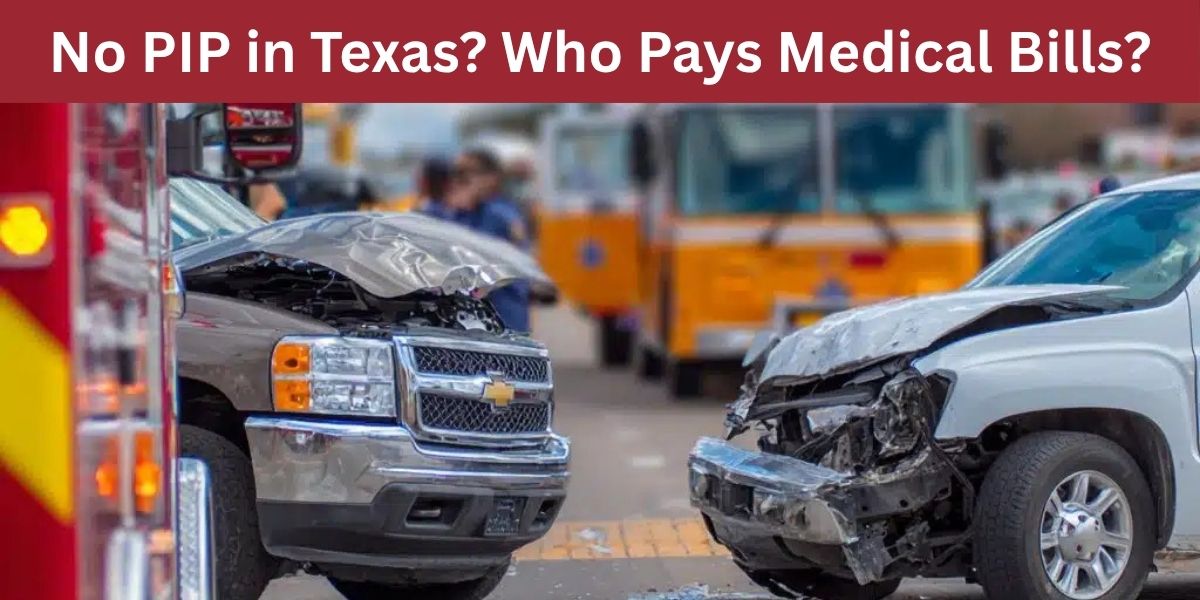
No PIP in Texas? You still have options to cover your medical bills
Got into a car accident in Texas without PIP? Don’t panic—you’re not completely stranded. While Texas allows you to waive PIP in writing, other coverage options like health insurance, MedPay, and UM/UIM can still cover your hospital bills. Terms like ‘full coverage’ can be misleading. In reality, each insurance type handles a specific part of your expenses. Here is how it works under the 2026 rules.
Texas Auto Insurance Coverage vs. Claim Scenarios in 2026
| Crash Scenario | Primary Paying Coverage | How Texas Claims Function | Official Legal / Regulatory Source |
| Hit by 100% At-Fault Insured Driver | At-Fault Driver’s Bodily Injury Liability | Files third-party claim. Insurance pays medical bills, lost income, and pain/suffering in one lump-sum settlement after care ends. | Texas Transportation Code §601.072 establishes mandatory 30/60/25 liability minimums. |
| You Caused the Wreck | Your Health Insurance or MedPay | Your liability policy covers the other driver, never you. Your treatment goes directly to health insurance or MedPay. | TDI Consumer Auto Guide mandates liability strictly covers third-party damages. |
| Hit by Uninsured / Hit-and-Run Driver | Your Uninsured Motorist (UM) Coverage | Your insurer steps in to cover ER bills, ongoing care, lost wages, and auto repairs up to policy limits. | Texas Insurance Code §1952.101 mandates UM/UIM offers on all auto policies. |
| At-Fault Driver’s Policy Limits Run Out | Your Underinsured Motorist (UIM) Coverage | At-fault carrier pays its maximum policy limit first; your UIM covers remaining unpaid medical balances. | Texas Insurance Code Ch. 1952 Subch. C regulates underinsured gap coverage. |
| No PIP, MedPay, or Health Insurance | Letter of Protection (LOP) / Settlement | Attorneys issue an LOP to freeze hospital collections until a final liability settlement or trial verdict resolves. | Texas Property Code Ch. 55 governs hospital liens on third-party settlements. |
| Partially At Fault for the Crash | Comparative Fault Reduction / MedPay | Settlement payout drops by your exact fault %; MedPay pays covered medical bills regardless of who caused it. | Texas Civil Practice & Remedies Code Ch. 33 enforces the 51% bar rule on financial recovery. |
A Quick, Honest Take
Rejecting PIP doesn’t mean you’re completely unprotected. The biggest mistake drivers make is not checking if they still have unused MedPay on their policy. Always check your declarations page first.
Common Expert Guidance
Navigating the gap between health insurance and auto insurance claims often trips injured drivers up.
Expert Commentary:
“The biggest mistake Texas drivers make after rejecting PIP is handing auto insurance adjusters their health information without billing health insurance first. Auto liability insurers do not pay hospital bills as they arrive on your kitchen table—they only issue one final settlement check at the very end. If you don’t route your bills through health insurance or MedPay immediately, providers will send your account to collections long before the auto insurer finishes investigating liability.”
Texas Does Not Require You to Carry PIP
Under Texas Insurance Code Chapter 1952, insurers must offer at least $2,500 in PIP coverage, but you can reject it in writing. If you opted out, you cannot open a PIP claim later—that door is closed. However, you can still rely on MedPay, health insurance, UM/UIM, or the at-fault driver’s liability coverage.
Shopping for coverage? Check Our guide to cheap auto insurance for new drivers in Texas to see what add-ons are actually worth keeping.
When the Other Driver Caused the Accident
Does that mean you are stuck with the ER bill? Not necessarily. Your health plan handles your immediate medical treatment while you separately pursue a bodily injury claim against the at-fault driver’s insurer for the final payout. TDI specifically advises drivers in a not-at-fault crash to file directly with the other driver’s insurer, which is supposed to cover medical bills, vehicle repairs, and other losses that driver caused.
Why Texas Auto Liability Payments Take Time
When another driver hits you, their insurance company isn’t going to send a check the next morning. Before paying out a single dollar, liability adjusters must investigate:
- Fault Determination: Assigning percentage of fault under Texas proportionate responsibility rules.
- Policy Verification: Confirming the policy was active and premiums were paid up.
- Medical Necessity: Reviewing if your hospital visit, MRI, or therapy was directly caused by the accident.
While this 30-to-90-day investigation plays out, medical bills keep accumulating. Failing to manage these bills actively can ruin your credit score.
When You Caused the Accident
This is the flip side, and it surprises people who assume “full coverage” means their own injuries are covered too. Texas liability insurance protects other people — not you. Under Texas Transportation Code §601.072, the state minimum is $30,000 per injured person, $60,000 per accident for bodily injury, and $25,000 for property damage — commonly written as 30/60/25. That figure held steady heading into 2026, despite a 2025 legislative proposal (SB 1674) that would have raised it; the bill never became law, so 30/60/25 remains the operative minimum. If you rejected PIP and caused the wreck, your first stops are your health insurance and MedPay, if you have it — not your liability policy.
Example
Say you cause a crash and your treatment runs $18,000. Your policy carries $30,000/$60,000 bodily injury liability, no PIP, and $5,000 in MedPay. Your liability coverage is there for the other driver’s damages, not yours — that part doesn’t change. MedPay, though, can pay up to its $5,000 limit toward your own bills, and your health insurance can pick up the covered remainder under its normal terms. The exact split always comes down to your specific policy and the facts of the crash.
What If the Other Driver Has No Insurance?
If you get hit by an uninsured or hit-and-run driver, Uninsured Motorist (UM) coverage steps in to pay your medical bills. Underinsured Motorist (UIM) coverage pays when the at-fault driver’s limits aren’t enough to cover your total damages. Texas requires insurers to offer UM/UIM unless you opt out in writing. Without it, you are left suing the at-fault driver personally—which rarely yields results.
Comparing options? See our roundup of cheap car insurance across the USA to find providers with strong UM/UIM coverage.
Why Did My Insurance Deny or Delay a Bill?
A denial letter feels final, but it usually isn’t the whole story. Most denials trace back to one of a handful of ordinary reasons:
- Deductible — the amount you owe out of pocket before your plan starts paying.
- Copayment or coinsurance — a flat fee or a percentage you’re responsible for on covered care.
- Out-of-network care — a provider outside your plan’s network can shift your cost significantly; emergency-care rules can differ from scheduled treatment, so check the specifics rather than assume.
- Prior authorization — some non-emergency follow-up care needs sign-off before your plan will pay.
- Policy exclusions — a treatment can be medically necessary and still fall outside what your specific plan covers.
- Pending accident information — your health insurer may be waiting on details about the other driver’s coverage before it finalizes anything.
If a bill is stuck in that kind of limbo, it’s worth pushing back rather than paying it outright. Our step-by-step walkthrough on negotiating hospital bills with health insurance covers how to actually do that.
Filing a Complaint If Your Insurer Won’t Cooperate
If an insurer is unnecessarily delaying or dragging its feet on your claim, you can file a free complaint with the Texas Department of Insurance (TDI). While it won’t resolve genuinely disputed claims, TDI forces insurers to justify unreasonable delays or unclear denials.
Hospital Cost Benchmark in 2026
While there is no single “average accident bill,” KFF reports that Texas hospital expenses hover around $3,277 per inpatient day—matching the U.S. national average. These costs are constantly rising, and a short hospital stay can quickly exhaust low coverage limits.
Common Mistakes to Avoid
1. Assuming “no PIP” means you pay everything — other coverage and legal recovery options usually still exist.
2. Confusing liability insurance with medical insurance — liability protects other people, not your own injuries, full stop.
3. Overlooking MedPay — people reject PIP and forget MedPay might still be sitting on the same policy, unused.
4. Expecting instant payment — a liability claim needs investigation before any money actually moves.
5. Ignoring UM/UIM — it can end up being your single most important protection against an uninsured driver.
6. Stopping treatment over a billing dispute — base medical decisions on medical advice, not on uncertainty about who’s going to pay.
Actionable Checklist: What to Do After a Texas Accident Without PIP
If you were injured in Texas and carry no PIP coverage, follow this step-by-step checklist to protect your health and finances:
Step 1: Seek Medical Care Immediately
Never skip or delay emergency care over billing confusion. Tell hospital staff the treatment is due to an auto accident.
Step 2: Provide Your Health Insurance Information First
Give the medical billing department your primary health insurance card right away so they can bill in-network rates within their required filing windows.
Step 3: Review Your Auto Insurance Declarations Page
Pull up your auto policy online. Verify whether you carry MedPay, Uninsured Motorist (UM), or Underinsured Motorist (UIM) coverage.
Step 4: Report the Crash to Both Insurance Companies
Notify your auto insurer and file a claim with the at-fault driver’s insurance company.
Step 5: Track Every Document in a Central File
Store every Explanation of Benefits (EOB), ambulance invoice, prescription receipt, and wage-loss statement in one physical folder or digital drive.
Step 6: Never Sign a Pre-Mature Liability Release
Do not sign a settlement release from the other driver’s insurer until your doctor officially clears your treatment plan.
Step 7: Watch the Texas Statute of Limitations Clock
Under Texas Civil Practice and Remedies Code §16.003, In most cases, you have two years from the date of the accident to file a personal injury lawsuit in Texas.
Bottom Line for Texas Drivers
Waiving PIP saves money on your monthly auto premium, but it requires you to be proactive if an accident occurs: (1) If hit by an uninsured driver: Rely on your UM/UIM policy. (2) If you caused the crash: Use MedPay and health insurance.
Check your auto policy Declarations Page today—before a crash happens—to ensure you aren’t leaving critical coverage gaps exposed.
Real Texas Crash Stories: How Claims Actually Play Out in 2026
Case Study 1: Rear-Ended on I-45 (Houston)
Scenario: Sarah’s $14,200 ER bill was delayed because the at-fault driver’s insurer refused to pay ongoing treatment. Under Texas personal injury claim rules, the at-fault driver’s insurer may offer a settlement that includes accident-related medical bills, rather than paying each medical bill as it comes due.
Fix: She billed her private health insurance first for in-network rates. Her attorney later recovered a lump-sum liability settlement, fully reimbursing her health plan and covering her out-of-pocket costs.
Case 2: The Dallas Intersection T-Bone Crash
Case Study 2: T-Boned in Dallas (Uninsured Driver)
Scenario: Marcus was hit by an uninsured driver running a red light. He had no PIP or health insurance.
Fix: He checked his auto policy and used his Uninsured Motorist (UM) coverage ($30,000 limit), which paid his $18,000 hospital invoice directly.
Frequently Asked Questions
1. Who pays medical bills after a car accident in Texas without PIP?
If another driver caused the crash, you can pursue their bodily injury liability insurance. Your own health insurance or MedPay can also help, depending on your policy and the specific circumstances.
2. Is PIP required in Texas in 2026?
No. Insurers must generally offer it, but a named insured can reject PIP in writing — and that rule hasn’t changed heading into 2026.
3. Does Texas liability insurance pay my own medical bills if I caused the accident?
Generally, no. Liability insurance covers injuries and property damage you cause to other people, subject to your policy’s limits — not your own recovery.
4. Can health insurance pay after a car accident?
Yes, potentially. Covered treatment can be processed under your health plan, subject to deductibles, copays, and network rules. If you’re between plans or need coverage fast after an ER visit, see our guide on getting emergency medical insurance after a hospital visit.
5. What if the other driver is uninsured?
Your UM coverage, if you carry it, can step in — Texas requires insurers to offer UM/UIM unless you reject it in writing.
6. What if the other driver’s insurance isn’t enough?
UIM coverage can help close that gap, subject to your policy terms and Texas law.
7. Can I still recover money if I was partly at fault?
Possibly. Texas uses a proportionate-responsibility system — your percentage of fault reduces what you recover, and bars it entirely if you’re found more than 50% responsible.
8. How long do I have to file a Texas car accident injury lawsuit?
Generally two years from the accident date, with some exceptions. Confirm the specifics of your situation rather than assuming a blanket rule applies.
Related Insurance Guides from TheHospitalInfo.com
- Car Accident Medical Bills 2026: Health Insurance or Auto Insurance First?
- How Can New Drivers in Texas Get Cheap Auto Insurance in 2026?
- USA Cheap Car Insurance 2026 — Compare Coverage and Rates
- Best Health Insurance in USA 2026 — Medicare, Medicaid, HSA and HMO Options
- How to Negotiate Hospital Bills with Health Insurance in 2026
- How to Get Emergency Medical Insurance After a Hospital Visit in 2026
- Supplemental Insurance for Gig Drivers in 2026: Why & How
Author & Editorial Review
Author: TheHospitalInfo Editorial Team. Reviewed against Texas Department of Insurance guidance and current Texas statutory sources for this August 2026 update. This article does not claim to be written by a licensed Texas insurance agent, health insurance advisor, or attorney.
Disclaimer
This article is for general educational purposes only and is not legal, medical, insurance, or financial advice. It does not create an attorney-client, advisor-client, or insurer-insured relationship. Individual claims depend on policy language, accident facts, and applicable law. For a serious injury, disputed liability, or denied claim, consult a qualified Texas insurance professional or attorney.
Sources
- Texas Department of Insurance — Automobile Insurance Guide
- Texas Department of Insurance — Auto Insurance FAQ
- Texas Department of Insurance — Accident Not Your Fault?
- Texas Department of Insurance — Uninsured/Underinsured Motorist Coverage
- Texas Insurance Code Chapter 1952 — PIP and UM/UIM Provisions
- Texas Civil Practice and Remedies Code §16.003 — Two-Year Limitations Period
- KFF State Health Facts — Hospital Expenses per Adjusted Inpatient Day
- Texas Senate Bill 1674 (89th Legislature, introduced) — proposed liability minimum increase, not enacted

Hi, I’m Nurul Islam Chowdhury (Imran) — the person behind HospitalInfo.
Associate Member, Institute of Cost and Management Accountants of Bangladesh (ICMAB – Associate Member No: A-1607)
Nurul Islam Chowdhury (Imran) holds a Bachelor of Business Administration (BBA) and a Master of Business Administration (MBA) from the University of Chittagong. As a qualified Cost and Management Accountant (CMA), he specializes in financial analysis, cost management, and tax structures. Every piece of tax and financial data in this article has been personally reviewed and fact-checked by him to ensure technical and calculation accuracy based on standard IRS guidelines and 2026 regulations.
My background is in finance and cost management, but for the past few years my real focus has been something more personal: helping everyday Americans make sense of health insurance and hospital bills.
Here’s the thing about healthcare costs in the US — they’re confusing on purpose, or at least it feels that way. A single ER visit can turn into a stack of paperwork nobody explains clearly. That’s the gap I try to fill on this site. I dig into how PIP and MedPay actually work, what happens when health insurance and auto insurance both claim to cover the same bill, how to negotiate a hospital statement instead of just paying it, and how coverage options change year to year.
I’m not a doctor, and I don’t pretend to be. What I bring is a finance-and-numbers lens — reading policy documents, tracking CMS and state-level rules, and translating them into something you can actually use before you’re stuck on the phone with an insurance rep. Every guide here starts from a real question people are Googling at 11 PM with a bill in front of them, and that’s still how I decide what to write next.