Best Health Insurance for Uber, DoorDash & Lyft Drivers in 2026
Last updated: September 3, 2026
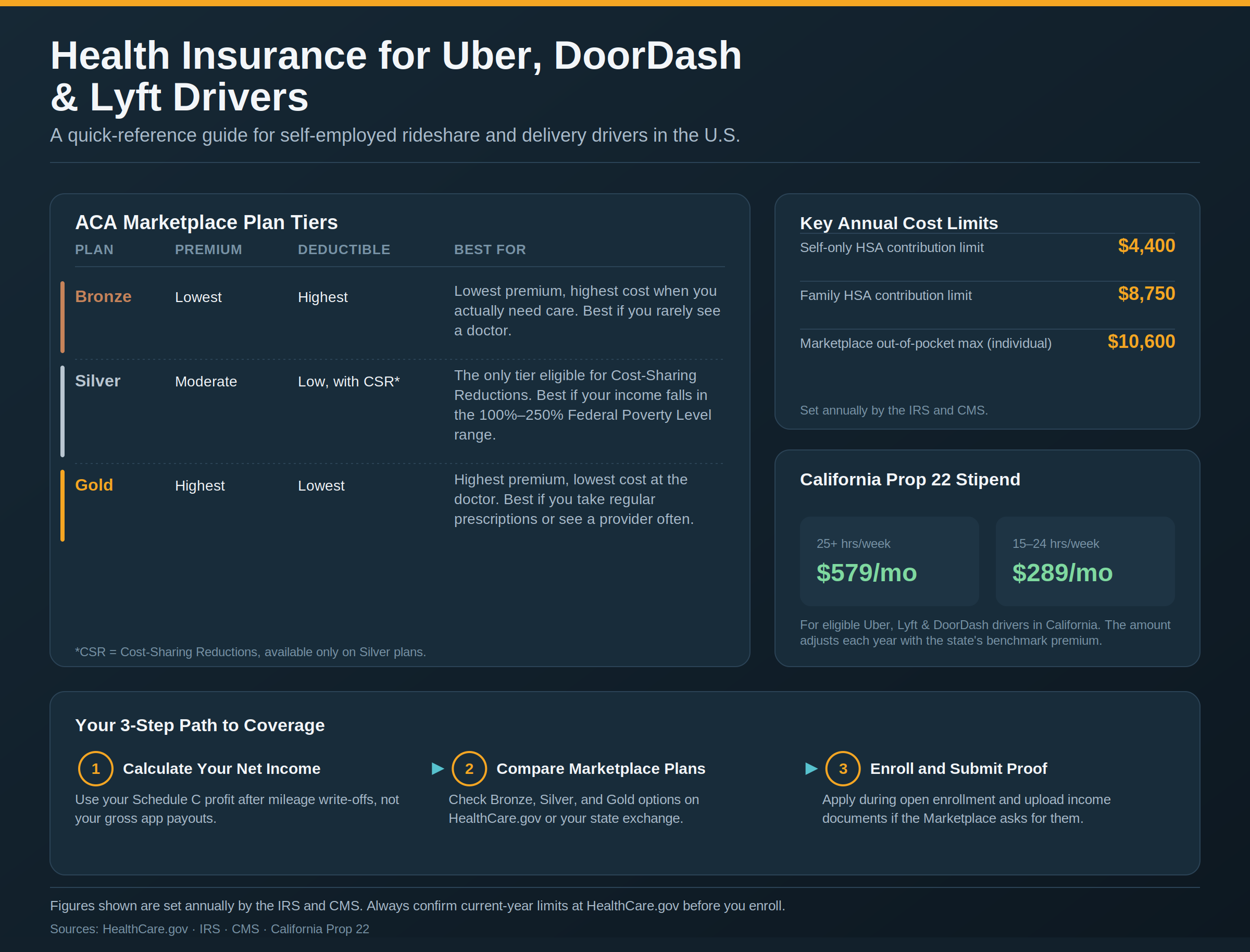
With unpredictable gas prices, constant wear and tear on your car, and long hours behind the wheel, figuring out the best health insurance plan after a 10-hour shift is exhausting. This guide breaks down the 2026 rules so you don’t miss out on thousands in subsidies.
Hidden Health Cost of a Gig Worker
When you spend eight to ten hours a day driving, negotiating congested roads, and striving to fulfilll delivery targets, It silently damages your body. Back stiffness, chronic posture pain, stress, and skipping meals just to hit a daily earnings target are realities every Uber driver and DoorDash Dasher knows all too well. Yet, the biggest risk isn’t just the day-to-day physical fatigue—it is the uncertainty. A sudden road accident, an unexpected illness, or an ER visit can instantly wipe out weeks of hard-earned income, leaving gig workers with overwhelming medical bills and no safety net to fall back on.
Unlike traditional W-2 employment, driving for apps means operating without employer-sponsored healthcare, paid sick leave, or disability coverage. You are completely on your own when health emergencies strike. That is why having a flexible, budget-friendly health insurance plan isn’t a luxury for gig drivers—it is an essential business investment that keeps both your health and your livelihood protected.
Easy Solution
Every gig driver should shop around ACA Health Insurance Marketplace for selecting the best coverage.
Silver — If you are eligible for Cost-Sharing Reductions (CSR), which are exclusive to Silver plans, you should prioritize the plan tier. (Source: gov — Cost-Sharing Reductions)
Bronze — the lowest monthly premium, but higher costs when you actually need care.
Gold — worth considering if you see doctors regularly and don’t qualify for CSR.
Platinum — the highest premium and the lowest costs at the point of care.
HSA – eligible Bronze or Catastrophic — newly HSA-compatible starting in 2026.
Medicaid or CHIP — free or low-cost coverage depending on your state and net income. (Source: gov)
The coverage and premium depends on your income, prescriptions, preferred doctors, and budget — not just the sticker price on the premium.
Health Insurance Options for Gig Drivers
Your weekly income swings, which makes the Marketplace application a little trickier than a standard W-2 job. You need a realistic, full-year income estimate — not just your best week or your worst one. (Source: HealthCare.gov — Self-Employed Coverage)
If your income changes significantly during the year, update your Marketplace application right away. This keeps your subsidy accurate and helps you avoid owing money back at tax time.
One detail that surprises many drivers: Marketplace eligibility is based on your net income — after mileage and other business deductions — not your gross app payouts. That is exactly why many gig drivers qualify for more financial help than they initially expect.
Verify Your Gig Income Without Delays
Gig income fluctuates time to time. So, Marketplace applications may ask you to confirm your eligibility with documentation. Upload your most recent IRS Schedule C (Form 1040) to show your net profit after mileage write-offs. If you’re new to driving, combine your last two to three months of app earnings statements with your IRS Form 1099-K or a self-employed profit-and-loss log to meet HealthCare.gov’s income verification guidelines.
Your State Might Not Use HealthCare.gov
Before you start entering personal details anywhere, check which exchange actually serves your state. About 30 states rely on the federal HealthCare.gov platform, while more than 20 states run their own state-based exchange. Enrolling on the wrong site means you won’t see your real, local subsidy amount.
When you enter your zip code on HealthCare.gov, it will automatically redirect you to your state’s official exchange if your state runs its own system.
State Marketplace Portals for Gig Drivers in 2026
| State / Region | Official Marketplace Portal | Exchange Type | Key Driver Rules & Special Benefits in 2026 |
|---|---|---|---|
| California | Covered California | State-Based Exchange (SBE) | Prop 22 Stipend Available: Qualifying Uber, Lyft, and DoorDash drivers get up to $579/mo ($1,736/qtr) for 25+ weekly engaged hours based on the 2026 $706/mo benchmark premium. Verified via Covered CA. |
| New York | NY State of Health | State-Based Exchange (SBE) | Offers the Essential Plan ($0 monthly premium for eligible low-income drivers earning up to 250% FPL) with zero deductibles and comprehensive vision/dental coverage. Managed via NY State of Health. |
| Massachusetts | MA Health Connector | State-Based Exchange (SBE) | Portable Health Fund Stipend: Under the AG settlement, drivers averaging 25+ hrs/week earn $405/mo (or $202.50/mo for 15–25 hrs). Hours combine across driving apps. Apply via MA Health Connector. |
| Pennsylvania | Pennie | State-Based Exchange (SBE) | State-specific financial assistance lowers out-of-pocket costs beyond federal subsidies. Drivers must register through Pennie instead of the federal portal to claim local savings. |
| Texas, Florida & 30+ States | HealthCare.gov | Federal Exchange (FFE) | Standard ACA subsidies apply (100%–400% FPL). Drivers in non-expansion states (e.g., TX, FL) must ensure net income after Schedule C mileage write-offs exceeds 100% FPL ($15,650 for single filers) to avoid the coverage gap. Rules via HealthCare.gov. |
Subsidy Rules in 2026 Important for You
Temporary, pandemic-era enhanced subsidies expired at the end of 2025. For 2026, Premium Tax Credits are back to the standard rule: generally available between 100% and 400% of the Federal Poverty Level (FPL). Earn more than that, and you likely won’t qualify for a credit.
One quirk worth knowing: your 2026 Marketplace eligibility is calculated using the 2025 FPL figures, not the newer 2026 numbers. (Source: CMS.gov — Agent/Broker FAQ)
Marketplace Income Thresholds in 2026 (Based on 2025 FPL)
| Household Size | 100% FPL | 400% FPL |
|---|---|---|
| 1 | $15,650 | $62,600 |
| 2 | $21,150 | $84,600 |
| 3 | $26,650 | $106,600 |
| 4 | $32,150 | $128,600 |
Marketplace Plans, Explained
Bronze, Silver, Gold, and Platinum don’t describe the quality of care — they describe how costs are split between you and the insurer.
Every Marketplace plan covers the same 10 essential health benefits, including ER visits, hospital stays, prescriptions, mental health care, and maternity care. (Source: HealthCare.gov — What Marketplace Plans Cover)
Dental and Vision Coverage
Good vision matters for staying safe on the road, but adult dental and vision benefits generally aren’t bundled into standard Marketplace health plans. Depending on your state, you may be able to add separate dental or vision coverage during enrollment.
Pre-existing condition? It doesn’t matter — insurers cannot reject you or charge you more because of it.
Silver Plans and Cost-Sharing Reductions (CSR)
If your income qualifies, CSR can significantly lower your deductible and copays — but it only applies to Silver plans. Choose Bronze instead, and you lose access to CSR even if your income would otherwise qualify. For 2026, CSR levels are set at 73%, 87%, or 94% actuarial value, based on income.
Bronze Plans
Bronze plans cover roughly 60% of costs on average, leaving you responsible for the rest. (Source: HealthCare.gov — Plan Categories) Bronze is a solid fit if a low premium is your top priority — just check the deductible carefully before you commit.
Gold and Platinum Plans
These carry a higher monthly premium but lower costs at the point of care. They’re worth considering if you’re managing an ongoing condition or regular prescriptions.
HSA Plans: What’s New in 2026
| HSA Coverage | 2026 Contribution Limit |
|---|---|
| Self-only | $4,400 |
| Family | $8,750 |
Direct Primary Care and HSAs
As of 2026, joining a qualifying Direct Primary Care (DPC) arrangement no longer automatically disqualifies you from HSA eligibility. (Source: IRS Notice 2026-05) Not every DPC membership qualifies, so review the fee structure before you assume yours does.
Medicaid and CHIP for Gig Drivers
In states that expanded Medicaid, adults earning up to 138% of the FPL may qualify. (Source: Medicaid.gov — Eligibility) Don’t rule yourself out because your gross app earnings look high — after mileage deductions, your net income may land well under the cutoff.
Out-of-Pocket Maximum in 2026
The federal cap for 2026 is $10,600 for an individual and $21,200 for a family. (Source: HealthCare.gov — Out-of-Pocket Maximum) Your premium never counts toward this cap. Once you hit it, your plan covers 100% of in-network care for the rest of the year — which is why a cheap premium can still leave you exposed to a large bill in a bad year. Weigh both numbers together, not just the monthly cost. If you’re hit with a large bill before you reach your deductible, our guide on how to negotiate hospital bills with health insurance walks through the process step by step.
What Uber, DoorDash, and Lyft Actually Offer
None of these platforms replace real health insurance — but in a few states, they do offer a stipend that can help offset your Marketplace premium.
California: Prop 22 Health Stipend (2026 Rates)
California drivers—don’t leave thousands on the table. The state’s app-based stipend is benchmarked against the 2026 average Bronze premium ($706/mo).
- 25+ Weekly Engaged Hours (Full Stipend): $579/month (~$1,736.76/quarter)
- 15–24.9 Weekly Engaged Hours (Half Stipend): $289/month (~$868.38/quarter)
Action Step: Payouts are distributed at the end of each quarter. Upload your qualifying proof of Marketplace coverage within 15 days of quarter-end to claim your check.
Massachusetts: Uber and Lyft Driver Stipend
Since April 2025, eligible Massachusetts Uber and Lyft drivers can receive a health insurance stipend under a settlement with the state. For 2026, drivers averaging 25+ hours per week may qualify for $405 per month, while those averaging 15–25 hours may qualify for $202.50 per month. Hours from both apps combine and are evaluated quarterly. (Source: Massachusetts Attorney General — Uber and Lyft Settlement)
If you drive in more than one state or on more than one platform, check each program separately — the rules aren’t identical.
Bronze vs. Silver: A Side-by-Side Example
Assume a driver qualifies for CSR. Here’s how the tradeoff typically looks for the same income and coverage year:
| Feature | Bronze | Silver + CSR |
|---|---|---|
| Monthly premium | Lower | Higher |
| Deductible | Higher | Lower |
| Primary care cost | Higher | Lower |
| CSR eligible | No | Yes |
| Best for | Premium priority | CSR-eligible drivers |
Bronze vs. Silver: Buy Bronze for financial backup; buy Silver for actual care. If you qualify for CSR, Silver is hands-down the highest-value option for gig workers.
Real-World Example: Driving on $30,000 Net Income
Say you drive full-time for Uber in Texas or California, and after mileage deductions your net taxable income lands at $30,000 as a single filer — roughly 191% of the 2025 FPL used for 2026 eligibility. That falls squarely inside the 100%–250% FPL range where Silver CSR eligibility typically applies, which can make Silver a strong value. Your exact premium still depends on your age, location, tobacco use, and household size — HealthCare.gov won’t show real numbers until you apply. If you qualify for CSR, compare Silver first, then check it against Bronze and Gold before deciding.
7 Steps: How to Pick the Best Health Insurance Plan
- Know your real net income: Use your Schedule C net profit after mileage write-offs, not your gross app payouts. This number drives your entire subsidy calculation.
- Gather proof of income: Keep your 1099-K or 1099-NEC, Schedule C, and your last two to three months of earnings statements handy, or a profit-and-loss log if you’re new to driving.
- Apply on the right Marketplace: Use HealthCare.gov or your state exchange (see the table above).
- Check Silver CSR eligibility: If your income falls between 100% and 250% FPL, choose Silver to unlock Cost-Sharing Reductions.
- Above 250% FPL? Compare HSA-eligible Bronze against Silver and Gold: You generally won’t qualify for CSR above that threshold. An HSA-eligible Bronze plan may offer a lower premium plus tax-advantaged savings, but Silver or Gold could fit better if you expect to use more care.
- Confirm coverage details first: Check that your doctors are in-network, your prescriptions are covered, and look at total yearly cost — not just the premium.
- Claim your stipend: California or Massachusetts driver? Submit proof of coverage to your platform for the quarterly payout.
Many Drivers Miss Tax Deduction
Self-employed drivers may qualify for the Self-Employed Health Insurance Deduction, calculated on IRS Form 7206 and claimed on Schedule 1 of Form 1040. The deduction is capped by your net self-employment earnings.
Important distinction: this deduction lowers your income tax, not your self-employment tax — they’re calculated separately. For a deeper walkthrough of this deduction and other 1099 tax moves, see our 1099 Health Insurance Guide.
Common Mistakes
1. Don’t fall for the lowest premium: A cheap Bronze plan can backfire with a $9,000 deductible if you get sick.
2. Never ignore Silver CSR: You could be throwing away thousands in reduced copays and deductibles.
3. Don’t guess your income: Base your estimate on Schedule C net profit, not gross app earnings, to avoid IRS clawbacks on your tax credit.
4. Never skip the network check: Always verify your primary doctor and hospital are in-network before signing up.
5. Check your drugs first: Make sure your exact medications are on the plan’s covered formulary list.
6. Don’t rely solely on stipends: Treating a platform stipend as a substitute for full insurance leaves you unprotected.
7. Claiming the Form 7206 tax deduction without confirming you actually qualify
Uninsured or Facing High Deductibles? Two Government-Backed Options
1.Direct Primary Care (DPC): A flat monthly membership fee covers primary care and basic lab work outside of insurance. Per IRS guidance on HSAs and DPC, qualifying DPC fees under certain monthly thresholds can remain HSA-compatible.
2. Community Health Centers: Federally funded centers offer primary care, vision, and dental services on an income-based sliding fee scale. Find one through the HRSA Health Center Portal. If you end up uninsured after a hospital visit, our guide on getting emergency medical insurance after a hospital visit covers your options.
What Happens If You Get Into a Car Accident While driving a Vehicle
Gig driving means more time on the road, which raises the odds you’ll eventually deal with a collision. Health insurance and auto insurance interact in specific ways after a crash — including which policy pays first and how PIP or MedPay fits in. See our guides on who pays medical bills after a car accident and, if you drive in Texas, what happens without PIP after a Texas car accident for a full breakdown.
When Can You Enroll? Key Deadlines in 2026
For 2026 coverage, Open Enrollment on HealthCare.gov ran from November 1, 2025, through January 15, 2026. (Source: CMS — 2026 Marketplace Open Enrollment Report)
- Enroll by December 15: Coverage starts January 1, 2026 — the ideal deadline for a seamless start to the new year.
- Enroll between December 16 and January 15: Coverage starts February 1, 2026.
- State deadlines vary: Some state-based Marketplaces set their own cutoff dates, so confirm the exact deadline through your state exchange.
Missed the window? You may still qualify for a Special Enrollment Period (SEP) after a qualifying life event — marriage, a new baby, losing existing coverage, moving to a new zip code, or becoming eligible for a platform stipend. Details are available through HealthCare.gov’s enrollment deadlines page. Medicaid and CHIP enrollment remains open year-round for anyone whose income qualifies.
Frequently Asked Questions (FAQ)
Does this guide apply to DoorDash and Lyft drivers, or just Uber?
It applies to all gig drivers. Whether you drive for Uber, Lyft, or deliver for DoorDash, you are classified as self-employed under the same tax rules. Your primary option is the ACA Marketplace. The main difference lies in state-specific platform stipends—like California’s Prop 22 or Massachusetts’ Lyft/Uber settlement—which vary by platform and location.
Can gig workers get insurance without an employer?
Yes — the Marketplace is built for self-employed people and freelancers. (Source: HealthCare.gov — Self-Employed)
Can I get an HSA as a gig driver in 2026?
Yes, if you’re enrolled in a qualifying HDHP. Bronze and Catastrophic plans now count toward HSA eligibility.
Is Silver always better than Bronze?
Not always. Silver is generally the stronger choice if you qualify for CSR. Otherwise, compare the actual premium, deductible, and out-of-pocket numbers rather than the metal name alone.
Can I deduct my premiums as a 1099 driver?
Possibly, through IRS Form 7206, capped by your net self-employment income.
Does that deduction lower my self-employment tax?
No — it only lowers your income tax.
What if my driving income changes mid-year?
Update your Marketplace application right away. It keeps your subsidy accurate and helps you avoid a surprise bill later.
Note: For most gig workers, the best health insurance for Uber drivers, DoorDash Dashers, and Lyft drivers starts with the ACA Marketplace. Check what you qualify for, compare Silver CSR against Bronze before deciding, and take advantage of the new 2026 HSA options for Bronze and Catastrophic plans. California and Massachusetts drivers have extra stipend options worth claiming. Don’t chase the lowest premium blindly — look at the full picture: premium, deductible, network, prescriptions, and the out-of-pocket maximum.
Ready to Secure Coverage? Take These 3 Steps Today
1. Mark your dates: Review the gov enrollment deadlines (enroll by December 15 for January 1 coverage). 2.Grab your tax form: Download 3. Find your official portal
Related Reading
- 1099 Health Insurance in 2026: Best Plans, Costs & Tax Deduction Guide
- How to Negotiate Hospital Bills With Health Insurance
- Best Health Insurance in USA 2026
- Car Accident Medical Bills: Does Health Insurance or Auto Insurance Pay First?
- Who Pays Medical Bills After a Car Accident in Texas Without PIP
- Supplemental Insurance for Gig Drivers in 2026: Why & How
About the Author and Fact-Checker
Nurul Islam Chowdhury, ACMA
Associate Member, Institute of Cost and Management Accountants of Bangladesh (ICMAB — Associate Member No. A-1607). He holds a Bachelor’s (BBA) and Master’s (MBA) in Business Administration from the University of Chittagong. As a Certified Cost and Management Accountant (CMA), he specializes in financial modeling, cost analysis, and tax strategy.
Every financial calculation and tax guideline in this article was reviewed and fact-checked against current federal and state government sources, including HealthCare.gov, the IRS, CMS.gov, Medicaid.gov, and official state exchanges.
Verified for: Technical Accuracy, Financial Calculations & 2026 Government Guidelines
Disclaimer: This article is general information, not personalized financial, tax, or insurance advice. Verify details with HealthCare.gov, the IRS, your state Marketplace, or your platform before you enroll or file.
Frequently Asked Questions About 2026 Gig Worker Health Insurance
How much does ACA health insurance actually cost for an Uber or DoorDash driver in 2026?
There is no single price tag because it completely depends on your net income after mileage write-offs and where you live[cite: 1]. However, thanks to ACA subsidies, many full-time gig drivers qualify for Silver plans with extremely low monthly premiums—sometimes even $0 to $50 a month[cite: 1]. If you qualify for Cost-Sharing Reductions (CSR), you get both lower monthly payments and reduced deductibles[cite: 1].
Should I report my gross earnings or my net Schedule C income on HealthCare.gov?
Always use your net self-employment profit (what remains after deducting mileage, gas, and vehicle maintenance on Schedule C), not your gross app payouts[cite: 1]. Reporting gross income is a common mistake that causes drivers to overestimate their earnings, missing out on thousands of dollars in subsidies[cite: 1].
Can I get an HSA (Health Savings Account) as a self-employed driver in 2026?
Yes! Starting in 2026, Bronze and Catastrophic plans on the Marketplace qualify as High-Deductible Health Plans (HDHPs) for HSA eligibility[cite: 1]. This allows you to set aside pre-tax money—up to $4,400 for individuals or $8,750 for families—to pay for doctor visits, prescriptions, and dental care tax-free[cite: 1].
Do Uber, Lyft, or DoorDash pay for my health insurance directly?
No, gig apps do not provide traditional employer-sponsored health coverage[cite: 1]. However, if you drive in specific states like California (under Prop 22) or Massachusetts, you can earn a quarterly health insurance stipend to cover your Marketplace plan premiums if you hit the required weekly engaged hours[cite: 1].
What happens if my driving income changes significantly during the middle of the year?
You should log into HealthCare.gov (or your state marketplace portal) and update your income estimate as soon as possible[cite: 1]. Adjusting your profile mid-year ensures your monthly subsidy stays accurate so you don’t end up owing money back to the IRS when filing your taxes[cite: 1].
Is a cheap Bronze plan better than a Silver plan for full-time drivers?
If you rarely go to the doctor and just want emergency protection, a low-premium Bronze plan works well[cite: 1]. But if your net income falls between 100% and 250% of the Federal Poverty Level, a Silver plan is almost always the smarter choice because it unlocks Cost-Sharing Reductions (CSR) that drastically lower your out-of-pocket deductible[cite: 1].
Can I deduct my health insurance premiums on my tax return as a 1099 driver?
Yes, self-employed drivers can usually claim the Self-Employed Health Insurance Deduction using IRS Form 7206 on Schedule 1 (Form 1040)[cite: 1]. Keep in mind that this deduction reduces your income tax liability, though it does not lower your self-employment tax[cite: 1].
What documents do I need to prove my income on HealthCare.gov?
You can upload your most recent IRS Schedule C from your tax return[cite: 1]. If you recently started driving, you can submit your 1099-K/1099-NEC forms along with 2–3 months of app earnings statements or a self-employed profit-and-loss log[cite: 1].
Does health insurance cover me if I get injured in a car accident while delivering or driving?
Health insurance covers your medical treatment, but auto insurance (your personal policy, app liability coverage, or PIP/MedPay) usually acts as primary coverage after a crash[cite: 1]. Once auto limits are exhausted, your health insurance kicks in according to your plan terms[cite: 1].
What if I missed the Open Enrollment deadline? Can I still get covered?
You can still enroll if you experience a Qualifying Life Event (QLE)—such as losing job-based insurance, getting married, having a baby, moving to a new ZIP code, or qualifying for a state platform stipend[cite: 1]. Additionally, Medicaid and CHIP enrollment remains open all year for eligible drivers[cite: 1].

Hi, I’m Nurul Islam Chowdhury (Imran) — the person behind HospitalInfo.
Associate Member, Institute of Cost and Management Accountants of Bangladesh (ICMAB – Associate Member No: A-1607)
Nurul Islam Chowdhury (Imran) holds a Bachelor of Business Administration (BBA) and a Master of Business Administration (MBA) from the University of Chittagong. As a qualified Cost and Management Accountant (CMA), he specializes in financial analysis, cost management, and tax structures. Every piece of tax and financial data in this article has been personally reviewed and fact-checked by him to ensure technical and calculation accuracy based on standard IRS guidelines and 2026 regulations.
My background is in finance and cost management, but for the past few years my real focus has been something more personal: helping everyday Americans make sense of health insurance and hospital bills.
Here’s the thing about healthcare costs in the US — they’re confusing on purpose, or at least it feels that way. A single ER visit can turn into a stack of paperwork nobody explains clearly. That’s the gap I try to fill on this site. I dig into how PIP and MedPay actually work, what happens when health insurance and auto insurance both claim to cover the same bill, how to negotiate a hospital statement instead of just paying it, and how coverage options change year to year.
I’m not a doctor, and I don’t pretend to be. What I bring is a finance-and-numbers lens — reading policy documents, tracking CMS and state-level rules, and translating them into something you can actually use before you’re stuck on the phone with an insurance rep. Every guide here starts from a real question people are Googling at 11 PM with a bill in front of them, and that’s still how I decide what to write next.