Supplemental Insurance for Gig Drivers in 2026: Why & How
Last updated: September 2026
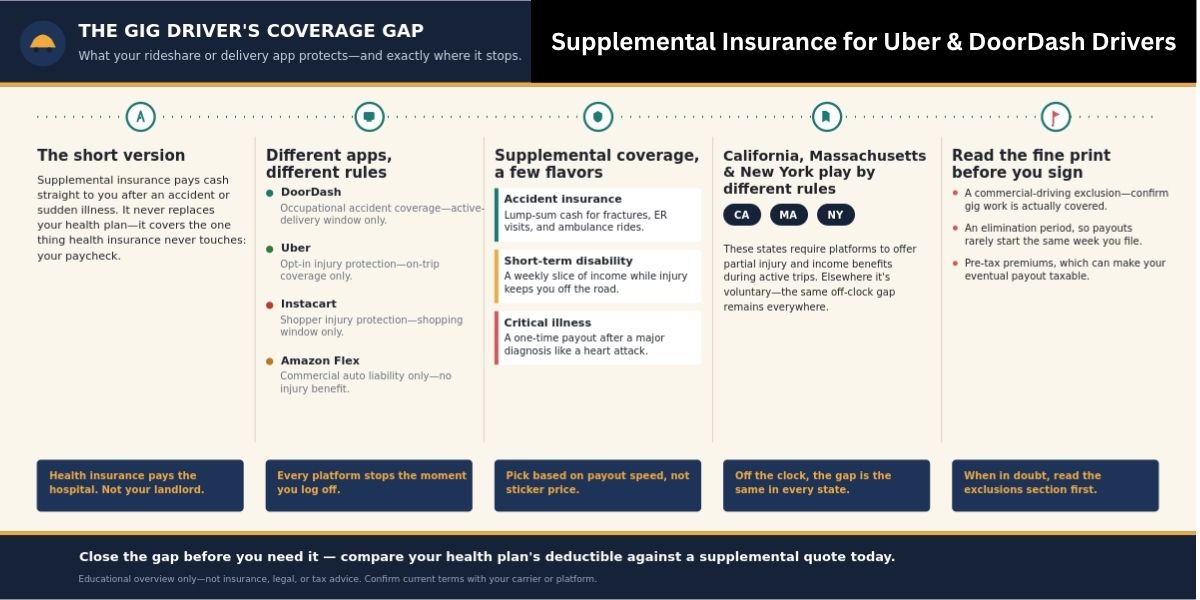
Real-Life Scenario: What Happens When the App Logs Off?
Last spring, Jack—a full-time gig driver from Ohio—While traveling home, He got struck hard from the side and breaking his ankle. Because he had logged off his delivery app just five minutes earlier, neither Uber nor DoorDash covered a single dollar.
Facing a 6-week recovery with zero earnings and a $7,500 ACA deductible, Jack had to pay out-of-pocket for everything. A basic supplemental plan would have sent cash directly to his bank account to cover rent while he healed.
Quick Answer
Supplemental insurance meets your emergency cash requirements by paying cash straight to you when an accident, injury, or serious illness pulls you off the road. It doesn’t replace your health insurance.
Your health plan pays the hospital, not your landlord. A broken wrist heals eventually, but your rent doesn’t wait for it.
Uber’s and DoorDash’s injury protection only kicks in while you’re actively on a trip or delivery. Once you log off, that specific coverage goes away.
I’ve heard from drivers who found out mid-recovery, staring at a stack of bills instead of resting like their doctor told them to. That’s the moment this guide is meant to help you avoid.
Hidden Gap: Why Standard Health Insurance Isn’t Enough for Gig Drivers
You probably assumed your health plan had your back. Most drivers do. Here’s the part nobody explains at sign-up: your health insurer settles the hospital bill, but it never sends you a check to replace lost income. In other words, a bad accident lets you go for a month. But your car payment and your grocery bill don’t pause with you. On top of that, the deductible alone can wipe out your savings. It is explained in the following table
| Risk Area | Key Figure | Source |
|---|---|---|
| ACA Bronze deductible | $7,500 individual deductible on the "Expanded Bronze" standardized plan for 2026 | CMS Plan Year 2026 Standardized Plan Designs |
| Out-of-pocket ceiling | $10,600 max out-of-pocket for self-only coverage in 2026 before the plan pays 100% | HealthCare.gov — Out-of-Pocket Maximum/Limit |
| Workers' comp eligibility | Built around a formal employer-employee relationship — independent contractors like rideshare/delivery drivers fall outside it | Washington State Dept. of Labor & Industries |
| Short-term disability access, small employers | Only 31% of private-sector workers at companies with under 100 employees have it | U.S. Bureau of Labor Statistics |
| Short-term disability access, large employers | Rises to 68% at companies with 500+ employees — and gig drivers have no employer at all providing this | U.S. Bureau of Labor Statistics |
For a full plan-by-plan breakdown, see our guide to the best health insurance for Uber, DoorDash, and Lyft drivers.
Major Types of Supplemental Insurance
Not every policy solves the same problem. There are three major types:
| Type | What It Pays For | Best For | Key Thing to Keep in Mind |
|---|---|---|---|
| Accident Insurance | A lump-sum cash payout for fractures, ER visits, ambulance rides, and stitches | Drivers who want fast cash after a wreck, no matter who caused it | Pays a fixed amount per covered event — it doesn't care whether your health plan carries a low deductible or a high one |
| Short-Term Disability | A weekly percentage of your reported income if injury or illness keeps you off the road | Drivers whose household budget can't absorb even two weeks without pay | Usually comes with a short waiting period (an elimination period) before benefits start — read that part closely |
| Critical Illness Insurance | A one-time cash payout after a diagnosis like a heart attack, stroke, or invasive cancer | Drivers over 40, or anyone with a family history of serious illness | Payouts arrive as cash, so you decide how to spend them — rent, childcare, groceries, anything |
What Actually Covers Each Platform Protection
This is where most drivers get burned. They assume the app fully covers them. It doesn’t come close. Every platform makes the same sharp line: coverage exists only while you’re actively working. Log off, and you’re back on your own. Here’s how the four biggest platforms actually stack up, straight from each company’s own policy pages.
| Platform | Coverage Type | Automatic / Opt‑In | Medical Cap | Weekly Payment | Coverage Window |
|---|---|---|---|---|---|
| DoorDash | Occupational Accident Insurance | Automatic, no enrollment or premium | Up to $1,000,000 | 50% of average weekly earnings, capped at $500 | Only from delivery acceptance to completion |
| Uber | Optional Injury Protection (automatic in CA & MA) | Opt-in, per-mile fee in most states | Up to $1,000,000, no deductible | Capped at $500 | Only while on-trip |
| Instacart | Shopper Injury Protection | Automatic for full-service shoppers | Up to $1,000,000 combined | Included in the $1M benefit | Only while shopping or delivering |
| Amazon Flex | Commercial Auto Insurance (Liability, UM/UIM & Contingent Collision) | Automatic (during active delivery blocks) | $0 for Driver Medical (Covers 3rd-party injuries & vehicle damage up to $1,000,000) | None | Active delivery block only |
Key Takeaways for You:
Weak Income Replacement: Weekly payouts from DoorDash and Uber are capped at $500—which hardly pays for a car loan in major U.S. cities.
Zero Off-Clock Protection:The moment you log off, all injury coverage stops completely.Zero Personal Medical Benefit for Amazon Flex: Amazon Flex sets you up with a solid $1 million commercial auto liability policy while you’re delivering, but here’s the kicker: it’s strictly built for vehicle damage and third-party liabilities. It doesn’t pay out a single dime toward your personal medical bills or lost earnings if you get hurt behind the wheel. Once your block ends or if you’re injured without another vehicle being at fault, your personal out-of-pocket expenses fall entirely on you
State-Specific Nuances: CA, MA & NY
While most states leave 1099 drivers on their own, California, Massachusetts, and New York mandate partial platform benefits—though major off-clock gaps remain:
| State | Mandatory Platform Coverage | Hidden Gap |
|---|---|---|
| CA | Prop 22: Up to $1M medical + 66% wage replacement during active trip time. | Zero coverage when logged off or waiting for requests. |
| MA | Uber MA Benefits: Automatic $1M injury coverage + 1 hr paid sick leave per 30 active hours. | Sick leave and injury protection apply strictly on-trip, not for off-clock illness. |
| NY | Black Car Fund: Workers' Comp-style benefits + death benefit funded via passenger fees. | Strictly covers dispatch accidents; personal illnesses or non-work injuries are excluded. |
Note: Platform insurance stops the second you log off. A standalone policy is the only way to get 24/7 coverage.
Top Supplemental Insurance Providers for Independent Contractors in 2026
Fortunately, a handful of carriers build products specifically for self-employed and 1099 workers like you:
- Aflac sells standalone accident, critical illness, and hospital indemnity policies you can buy individually, without going through an employer. As a result, it fits naturally if you drive full-time or pick up shifts on the side.
- Stride Health, on the other hand, doesn’t sell insurance itself. Instead, it lets you compare ACA health plans next to supplemental options from multiple carriers in one place. That way, you can see exactly how a Bronze plan plus an accident policy stacks up against a pricier Silver plan alone.
- MetLife offers individual disability income policies that replace a percentage of your self-reported income, which is useful if you want protection that outlasts a single accident.
- Similarly, Combined Insurance, a Chubb company, builds accident and disability products for people who don’t have access to employer-sponsored benefits, independent contractors included.
Before you sign anything, first confirm the policy qualifies as guaranteed-issue or simplified-issue for your age and health. Then, check the elimination period on any disability product too, since a short delay in benefits can still sting when bills arrive on time.
Of course, none of these carriers can promise you’ll never get hurt. What they can promise, however, is that you won’t face the bill completely alone.
How Much Does Supplemental Insurance Cost for Gig Workers?
Your price depends on your age, your health, your coverage amount, and the carrier you choose. The only reliable number ultimately comes from a real quote.
Estimated Cost of Supplemental Coverage in 2026
While standalone supplemental policies aren’t tracked in a federal database like ACA plans, private carrier benchmarks show what independent drivers typically pay:
| Policy Type | Monthly Cost Range | What It Pays For | Key Takeaway for Gig Drivers |
|---|---|---|---|
| Accident Insurance | $18 – $35 / mo | Cash payouts ($500–$2,000+) for ER visits, ambulance, or injuries. | Best value. Pays regardless of who caused the crash or your health plan deductible. |
| Short-Term Disability | $30 – $75 / mo | Replaces 50%–70% of weekly gig income during medical off-time. | Essential if your household can't survive 2+ weeks without earnings. |
| Critical Illness | $15 – $40 / mo | One-time cash ($10,000–$30,000+) for stroke, heart attack, or cancer. | Ideal for drivers over 35 or those with family health history. |
| Full Coverage Bundle | $45 – $90 / mo | Combined Accident + Income Replacement protection. | Total peace of mind for less than the cost of one tank of gas per month. |
Note: Pair an affordable Bronze ACA Plan with a $20/mo Accident Policy to cover high deductibles without paying high Silver or Gold health plan premiums.
A Word on Taxes — What the IRS Actually Allows
A lot of gig blogs get this wrong, so let’s keep it simple:
Health Insurance vs. Supplemental Plans: You can deduct standard ACA health insurance premiums as a self-employed health insurance deduction (reported via Schedule 1, Form 1040—not Schedule C). The IRS spells this out in IRS Publication 535. However, standalone accident and disability policies generally do not qualify as a business tax deduction.
The Silver Lining (Tax-Free Cash): Because you pay supplemental insurance premiums with after-tax dollars out of your own pocket, your cash payouts after an injury or illness are usually 100% tax-free. According to IRS Publication 525, the IRS won’t tax those benefit checks.
Note: Policy setups can vary, so always confirm your plan details with a tax pro. For a complete look at write-offs, check our [1099 Health Insurance Guide].
Common Mistakes You Should Avoid
Even smart, careful drivers fall into the same traps. Here’s a quick-scan look at what trips up gig drivers most, and what to do instead.
| Mistake | Why It Hurts You | Do This Instead |
|---|---|---|
| Assuming the app covers you 24/7 | Platform coverage only applies during an active delivery or trip, as the table above shows | Treat every off-app minute as uninsured, and plan accordingly |
| Dropping health insurance for platform coverage | Occupational accident insurance never pays for illness, only specific accidents | Keep a real ACA or private health plan running underneath it |
| Ignoring the elimination period | Many disability policies delay payouts by a week or two after you file | Match your emergency fund to that waiting period, not just the premium |
| Assuming the premium is tax-deductible | The IRS treats most standalone accident and disability premiums as nondeductible | Confirm the tax treatment with a professional before you buy, not after |
| Picking the cheapest plan by price alone | Rock-bottom premiums often come with rock-bottom payout caps | Compare the payout amount against the premium, not just the sticker price |
| Never updating coverage as income grows | A policy sized for part-time driving won't protect a full-time income | Revisit your coverage every year, ideally at tax time |
Avoid these six, and you’re already ahead of most drivers on the road. The goal is to buy the right insurance.
5 Policy Trapdoors to Check Before You Buy
Buying supplemental insurance without reading the fine print can leave you stranded when you actually file a claim. Watch out for these 5 critical exclusions hidden in policy agreements. Don’t let policy exclusions void your payout when you need cash most.
| Policy Trap | Why It Hurts You | Official Rule / Source |
|---|---|---|
| Commercial Driving Exclusion | Personal accident plans often reject claims if you were driving for pay. Verify 1099 commercial activity is covered. | NAIC Standards |
| Pre-Existing Conditions | Health issues you already have are usually excluded for the first 6–12 months. | NAIC Policy Rules |
| Long Waiting Periods | Disability payouts often carry a 7 to 30-day delay before cash benefits start. | Healthcare.gov |
| Strict Disability Rules | "Total Disability" requires you to be unable to work any job. Look for "Own Occupation" terms instead. | U.S. Dept of Labor |
| Taxable Benefits | Paying premiums pre-tax makes your cash payouts taxable. Pay with after-tax dollars for tax-free benefits. | IRS Pub 525 |
Note: Always review the policy’s “Exclusions” section before signing up.
Real Driver Story: Reality of 1099 Work
A full-time driver from Florida recently shared a cautionary experience on Reddit after spending nearly a year on Uber and DoorDash. After relentless miles destroyed their personal car’s turbo, brakes, and tires. When I had to stop driving, I applied for unemployment assistance—only to discover that as an independent 1099 contractor. But they weren’t covered under traditional state unemployment compensation—leaving them with massive repair bills, unpaid taxes on gas expenses, and zero financial safety net.
This is precisely why having a personal backup plan—combining emergency cash reserves with supplemental accident coverage—is critical for anyone relying on gig apps for their primary income.
Frequently Asked Questions (FAQ)
What happens if I get injured while waiting for a trip request?
Platform policies offer zero injury coverage during “Period 1” (when logged in without an active request). A standalone policy protects you 24/7, even while waiting for orders.
Does supplemental insurance pay cash directly to me or my doctor?
It pays cash directly to you—not the hospital. You get a tax-free check or direct deposit to cover rent, groceries, or car bills.
Can I get short-term disability insurance without a W-2 employer?
Yes. 1099 contractors can buy individual disability and accident plans directly from private carriers like Aflac, Stride, or Combined Insurance.
How long does it take to receive a cash payout after an accident?
Most private carriers issue cash payouts within 1 to 7 business days once you submit basic medical records or incident reports.
Is a physical exam required to apply for supplemental insurance?
No. Most 1099 policies are guaranteed or simplified-issue, requiring only a few basic online health questions without any blood tests or medical exams.
Does app coverage replace supplemental insurance for Uber drivers and delivery dashers?
No. It only pays during an active delivery and caps disability payments at $500 a week. So, supplemental insurance covers what that policy misses.
Can I buy supplemental insurance alongside an ACA plan?
Yes. In fact, it layers on top of any health plan you already have, and it never replaces it.
Is short-term disability worth it for part-time drivers?
It depends on your budget. If losing app income for a few weeks wouldn’t hurt much, then accident-only coverage may be enough.
Will a payout affect my ACA subsidy?
In many cases, no. The IRS typically excludes self-paid accident and disability benefits from taxable income, and MAGI generally starts from your adjusted gross income. But how you’ve structured your specific policy affects this, so confirm with a tax preparer before you assume it applies to you.
How to File a Claim for Fast Cash (4 Steps)
Supplemental insurance pays cash directly to you. Follow these four steps to get your payout approved quickly:
| Step | Action Required | Pro-Tip for Speed | Data Source |
|---|---|---|---|
| 1. Get Medical Records | Get treated and keep itemized bills plus doctor diagnosis notes. | Ensure notes state the exact date and cause of injury. | NAIC Claims Guide |
| 2. Save Proof | Download police reports and your in-app delivery/trip receipts. | Proof of trip status prevents instant claim denials. | Aflac Claims |
| 3. Submit Online | File via your insurer's online portal or mobile app. | Digital filing processes twice as fast as mail. | Healthcare.gov |
| 4. Choose Direct Deposit | Select direct bank transfer for your payout. | Cash arrives in your account within 2–5 business days. | IRS Pub 525 |
Note: Always submit your claim within 30 to 90 days of the incident to avoid missing filing deadlines.
Action Checklist to Pick the Right supplemental insurance for uber drivers
- First, pull up your current ACA plan and check the deductible and out-of-pocket max. After all, a Bronze plan with a $7,000-plus deductible means you’re carrying more exposure than you think.
- Next, add up your real monthly bills — rent, car payment, insurance, groceries, childcare. That way, you’ll know exactly how much income replacement you’d need if you couldn’t drive for a month.
- Then, reread your platform’s occupational accident terms. Specifically, know when your coverage starts and stops, and confirm whether your state makes it automatic or opt-in.
- After that, request quotes for accident insurance and short-term disability separately. Since they solve different problems, pricing them side by side shows you exactly where your gap sits.
- Finally, confirm the tax treatment with a professional before you assume a write-off, and keep every 1099, mileage log, and expense record organized for Schedule C.
Request quotes for supplemental insurance for Uber drivers and gig workers to compare costs side by side
Ready to Close the Gap of Supplemental Insurance for Uber Drivers?
You didn’t start driving for Uber or DoorDash to end up broke over a broken wrist. So, take five minutes today. Go ahead and compare your ACA plan’s deductible against an accident or short-term disability quote. After all, it might be the only thing standing between you and a missed rent payment next time something goes wrong.
Still piecing together your full coverage picture? If so, these guides can help:
- Best Health Insurance for Uber, DoorDash & Lyft Drivers in 2026
- 1099 Health Insurance in 2026: Best Plans, Costs & Tax Deduction Guide
- Car Accident Medical Bills in 2026: Does Health Insurance or Auto Insurance Pay First?
- How to Negotiate Hospital Bills With Health Insurance in 2026
- Best Health Insurance in USA 2026: Compare Medicare, Medicaid, HSA, HMO & Affordable Plans
Written & Fact-Checked by Nurul Islam Chowdhury, ACMA
Nurul Islam Chowdhury is an Associate Member of ICMAB (Membership No. A-1607) and currently serves as a Manager at Titas Gas Transmission & Distribution PLC. He holds both a BBA and an MBA from the University of Chittagong. With extensive expertise in corporate financial planning, policy analysis, and strategic risk assessment, he leverages his background to break down complex insurance policies, tax guidelines, and financial safety nets into actionable, transparent advice for working professionals and independent contractors.
Verified for:
100% Factual & Policy Accuracy: Cross-referenced with official 2026 data from the IRS (Pub 535/525), CMS Standardized Plan Designs, BLS employment statistics, and NAIC guidelines.
Platform Specifics: Verified directly against official 2026 driver safety and occupational accident policy pages for Uber, DoorDash, Instacart, and Amazon Flex.
Tax & Financial Integrity: Reviewed under current U.S. self-employment tax regulations and Schedule 1 (Form 1040) deduction rules for 1099 independent contractors.
Disclaimer: This article serves general educational purposes only and doesn’t constitute tax, legal, or insurance advice. Insurance terms, premiums, and platform policies change often. Always confirm current details directly with the carrier or platform, and consult a licensed insurance agent or tax professional for guidance specific to your situation.

Hi, I’m Nurul Islam Chowdhury (Imran) — the person behind HospitalInfo.
Associate Member, Institute of Cost and Management Accountants of Bangladesh (ICMAB – Associate Member No: A-1607)
Nurul Islam Chowdhury (Imran) holds a Bachelor of Business Administration (BBA) and a Master of Business Administration (MBA) from the University of Chittagong. As a qualified Cost and Management Accountant (CMA), he specializes in financial analysis, cost management, and tax structures. Every piece of tax and financial data in this article has been personally reviewed and fact-checked by him to ensure technical and calculation accuracy based on standard IRS guidelines and 2026 regulations.
My background is in finance and cost management, but for the past few years my real focus has been something more personal: helping everyday Americans make sense of health insurance and hospital bills.
Here’s the thing about healthcare costs in the US — they’re confusing on purpose, or at least it feels that way. A single ER visit can turn into a stack of paperwork nobody explains clearly. That’s the gap I try to fill on this site. I dig into how PIP and MedPay actually work, what happens when health insurance and auto insurance both claim to cover the same bill, how to negotiate a hospital statement instead of just paying it, and how coverage options change year to year.
I’m not a doctor, and I don’t pretend to be. What I bring is a finance-and-numbers lens — reading policy documents, tracking CMS and state-level rules, and translating them into something you can actually use before you’re stuck on the phone with an insurance rep. Every guide here starts from a real question people are Googling at 11 PM with a bill in front of them, and that’s still how I decide what to write next.