Can You Get Health Insurance After an ER Visit? (2027 Bill Relief)
No. If you buy health insurance after an ER visit, it won’t cover your past bill. However, retroactive Medicaid, hospital financial assistance, and billing protections can reduce an unpaid balance. If you already paid, you may qualify for a refund or adjustment.
Published: August 14, 2026 | Last updated: November 23, 2026
- Past bill: apply for Medicaid and ask for the hospital’s Financial Assistance Policy at the same time. Don’t wait for the Medicaid decision, because the hospital’s deadline keeps running. A plan you buy now only covers future care.
- Medicaid look-back: up to 3 months for applications filed through December 31, 2026. From January 1, 2027, up to 1 month for the expansion adult group and up to 2 months for other eligible groups, where retroactive coverage applies. Some states, such as Minnesota, use state money to keep more for a while.
- Collections: qualifying nonprofit hospitals must wait at least 120 days before extraordinary collection actions and accept applications for at least 240 days.
- Billing protections: insured patients are shielded from most out-of-network ER balance billing. Uninsured patients can dispute a bill that runs $400 or more over a good faith estimate.
- Future coverage: 2027 Open Enrollment runs November 1, 2026 to January 15, 2027.
30-Second ER Bill Relief Finder |
| Answer a few quick questions to see whether Medicaid, hospital assistance or both are worth pursuing. Nothing you enter leaves this page. |
| If this tool does not respond, refresh the page. A caching or script-blocking plugin may be stopping it. |
Table of Content (Tap to Open)
- 5 Immediate Steps After an ER Bill Arrives
- Common Problems After an ER Visit
- How Retroactive Medicaid Can Pay a Past Hospital Bill
- What Changes on January 1, 2027
- Retroactive Medicaid Rules in Selected States, 2026 to 2028
- Medicaid Income Limits in Dollars
- Emergency Medicaid for Noncitizens
- How to Apply for Hospital Financial Assistance
- Documents Hospitals Usually Ask For
- The 120-Day and 240-Day Billing Deadlines
- Can You Get Charity Care If Your Bill Is in Collections?
- What Happens If You Don’t Pay an ER Bill?
- How Much Does an ER Visit Cost Without Insurance?
- How to Review, Negotiate and Pay Down an ER Bill
- Why One ER Visit Can Mean Several Bills
- How the No Surprises Act Protects You
- Medical Debt and Your Credit Report
- Can You Buy ACA Insurance After a Hospital Visit?
- Direct Support Channels
- Frequently Asked Questions
- Sources
- About The Author
5 Immediate Steps After an ER Bill Arrives
Hold off on paying until you have an itemized bill in hand and know whether Medicaid or financial assistance applies.
- Request an itemized statement and match every line to the care you got.
- Start a Medicaid application if your income might qualify, even if it feels like a long shot.
- Request the Financial Assistance Policy and the application from billing.
- Look for out-of-network charges and billing errors.
- Sort out coverage for the future, so the next visit goes differently.
EMTALA isn’t a free-care law. Hospitals must screen and stabilize you whatever your ability to pay, but they can still bill you.
When you call billing, expect a transfer or two. Get transferred to Patient Financial Services or the Financial Assistance Office.
Phone Script for the Billing Office |
| Read it as written or change the details. Tap the button to copy it. |
| “Hi, I’m calling about an emergency room visit on [date]. My account number is [number]. I’d like an itemized statement, a copy of your Financial Assistance Policy and application, and a hold on collections while I apply. What is the application deadline, and where do I send my documents? Could you note this call on my account?” |
Jot down the date, the person’s name and what they promised. Then ask for written confirmation of any collection hold and of the application deadline.
Common Problems After an ER Visit
Common Problem Solver |
| Pick the situation closest to yours. |
How Retroactive Medicaid Can Pay a Past Hospital Bill
Retroactive Medicaid can cover care you got before you applied, provided you met the program’s rules when you got it. For applications filed through December 31, 2026, the federal rule generally allows up to three months of retroactive coverage before the month you apply, but state waivers and eligibility-category exceptions may shorten or change that period. It may cover eligible ER care, physician services and inpatient treatment from those months. Your state Medicaid agency determines eligibility, and the services and providers must meet Medicaid’s coverage and billing rules.
You don’t have to qualify in the month you apply. CMS says coverage is available for earlier months if you were eligible when the care was furnished. The one exception is a month in which you applied and were found ineligible. Apply through your state agency or through HealthCare.gov.
Retroactive Medicaid Month Checker |
| See whether the month of your visit falls inside the look-back. |
Already paid? How to get a refund
Keep every receipt, because a payment you already made isn’t always final. Once Medicaid approves coverage for your date of service, ask the hospital to rebill Medicaid and refund what you paid. That can depend on whether the provider accepts Medicaid, whether Medicaid covers the service and whether your state’s billing rules still allow the claim.
At a nonprofit hospital, once you’re found eligible under its financial assistance policy, the IRS rules require a refund of anything you paid above your share, unless the excess is under $5. Send your name, account number, date of service, approval letter and amount paid, ask for a written reply with a refund date, and follow up after two weeks. A sample letter sits in the documents section.
What Changes on January 1, 2027
Section 71112 of Public Law 119-21 shortens retroactive coverage for applications made on or after January 1, 2027.
| Who | Applications through 2026 | Applications from Jan 1, 2027 |
|---|---|---|
| Medicaid expansion adult group | Up to 3 months | Up to 1 month |
| Other eligible Medicaid groups | Up to 3 months | Up to 2 months, where retroactive coverage applies |
Waiting can cost you a month. Take an October 2026 ER visit by an expansion adult:
| ER visit | Application filed | What the look-back reaches | October covered? |
|---|---|---|---|
| October 2026 | December 2026 | Up to 3 months back, so September | Can be covered |
| October 2026 | January 2027 | 1 month back, so December only | Not covered |
Exceptions to the new limit
- Waivers and state money: a federal limit, an existing Section 1115 waiver and state-funded coverage are three different things. A state may keep extra months with its own money, as Minnesota is doing.
- QMB: Qualified Medicare Beneficiaries have no retroactive coverage.
- Separate CHIP: offering retroactive coverage is the state’s choice, and it can’t reach back further than the second month before the application month.
Work requirements and six-month renewals
Two other 2027 changes touch expansion adults. First, a community engagement rule applies to some adults ages 19 to 64, generally 80 hours a month of work, school, volunteering or similar activity, with exemptions. CMS does not apply that rule to the retroactive months, although a month where you applied and were found ineligible stays off the table. Check with your state when its rule starts.
On November 13, 2026, CMS issued guidance on an optional hold-harmless period that runs through June 30, 2027. A state that adopts it may suspend denials and disenrollments for missing the work requirement, but only after it checks whether each person meets the requirement or is excluded. It can’t suspend denials for other eligibility factors such as age or income. Find out whether your state is using this option.
Second, renewals scheduled on or after January 1, 2027 move to every six months for most adults in the expansion group, with exceptions such as certain American Indians and Alaska Natives. Miss a renewal and coverage can lapse. If an ER visit happens during that gap, retroactive coverage and hospital financial assistance become your fallback, so keep your address current with the state.
Retroactive Medicaid Rules in Selected States, 2026 to 2028
Expansion status alone doesn’t tell you a state’s look-back, so this table shows what each state says. Several states have waivers or haven’t finished their 2027 guidance, which is why some rows show only the federal baseline.
| State | Through 2026 | From Jan 1, 2027 | Apply |
|---|---|---|---|
| California | Up to 3 months | 1 month for the MAGI new adult group, 2 months for other groups | BenefitsCal |
| Texas | Up to 3 months for groups that qualify. No adult expansion. | Up to 2 months for groups where retroactive coverage applies | YourTexasBenefits |
| Florida | Ended Feb 1, 2019 for non-pregnant adults 21 and older. Pregnant women and people under 21 keep it. | Up to 2 months for groups that still have it | Florida DCF |
| Minnesota | Up to 3 months | Still 3 months in 2027, paid with state funds. Changes start Jan 1, 2028: 1 month for the expansion adult group, 2 months for others. | Minnesota DHS |
| New York | Up to 3 months (federal default) | Federal baseline: 1 or 2 months by group. | NY State of Health |
| Massachusetts | Up to 3 months for all applicants since Aug 18, 2025 (not Health Safety Net or QMB) | Federal baseline: 1 or 2 months by group. | MassHealth |
| Illinois | Up to 3 months (federal default) | Federal baseline: 1 or 2 months by group. | ABE Illinois |
| Pennsylvania | Up to 3 months (federal default) | 1 month for expansion adults, 2 months for other recipients (PA DHS) | COMPASS |
| New Jersey | Up to 3 months (federal default) | Federal baseline: 1 or 2 months by group. | NJ FamilyCare |
What to Check When a State Has No Final 2027 Notice
California applicants who file before January 1, 2027 stay under the existing Medi-Cal rules. For New York, Illinois and New Jersey, no final state-specific 2027 notice could be verified when this article was updated. Those rows show the federal baseline, not a confirmed state rule, and a waiver or state funding could change it. Check with the state Medicaid agency before relying on them.
Medicaid Income Limits in Dollars
The 2026 federal poverty guideline is $15,960 a year for one person in the 48 contiguous states and DC, and higher in Alaska and Hawaii. Adults in expansion states generally qualify at or below 138% of that line, about $22,025 for a single person. States that did not expand set much lower adult limits.
That 138% line is a benchmark for the adult expansion group, not a universal test. Parents, pregnant people, children and people with disabilities follow different rules, and many adults are judged on Modified Adjusted Gross Income (MAGI). Household size follows tax-filing relationships and program rules, so it isn’t always everyone at your address. Your state Medicaid agency can tell you whom to count. Hospitals borrow the poverty line too, but each financial assistance policy sets its own limits.
| Household size | 100% (poverty line) | 138% (adult expansion benchmark) | 200% (example hospital assistance benchmark) | 400% (ACA credit ceiling) |
|---|---|---|---|---|
| 1 | $15,960 | $22,025 | $31,920 | $63,840 |
| 2 | $21,640 | $29,863 | $43,280 | $86,560 |
| 3 | $27,320 | $37,702 | $54,640 | $109,280 |
| 4 | $33,000 | $45,540 | $66,000 | $132,000 |
| 5 | $38,680 | $53,378 | $77,360 | $154,720 |
| 6 | $44,360 | $61,217 | $88,720 | $177,440 |
| 7 | $50,040 | $69,055 | $100,080 | $200,160 |
| 8 | $55,720 | $76,894 | $111,440 | $222,880 |
These figures use the 2026 guidelines for the 48 states and DC. Alaska and Hawaii are higher.
Can the hospital sign you up for Medicaid on the spot?
Under Hospital Presumptive Eligibility, a participating hospital can temporarily enroll patients who appear likely to qualify, based on the income and household size they report. The coverage lasts only until the state decides, and each hospital chooses whether to take part. The state still makes the final call, and this temporary coverage is a separate track from retroactive coverage, so raise both with the financial counselor or social worker before you leave.
Emergency Medicaid for Noncitizens
Emergency Medicaid can pay for treatment of an emergency medical condition for people who would qualify for Medicaid except for their immigration status. It isn’t ongoing insurance and won’t pay for checkups, so your state, your income and whether the condition met the emergency definition decide the outcome. Apply through your state Medicaid agency, or ask the hospital’s financial counselor to file for you. Hospital financial assistance may help whatever your status, so ask about that too.
How to Apply for Hospital Financial Assistance
If Medicaid doesn’t fit, hospital financial assistance (often called charity care) is next. Nonprofit hospitals covered by IRS Section 501(r) must keep a written Financial Assistance Policy (FAP). The terms vary widely. One hospital gives free care at or below 200% of the poverty line. Another gives a sliding discount well above that. Read the actual policy before you count on a number. The IRS requires each policy to state its eligibility criteria and say whether help is free or discounted.
- Call patient financial services and ask for the FAP and application. Hospitals must also post these publicly, usually on their website.
- Fill in household size and income.
- Attach proof of income and whatever else the hospital lists.
- Request a pause on collection activity while the application is pending. A Medicaid application alone does not automatically stop every collection action.
- Keep the approval or denial letter.
The IRS also says a hospital can’t deny aid for missing information or documents the FAP or application never asked for, and may grant aid on your attestation or other evidence. That helps if you don’t have a pay stub.
A worked example: an $8,000 ER bill in Texas
A 28-year-old single adult earns $1,500 a month, or $18,000 a year. That is about 113% of the $15,960 guideline. Texas hasn’t expanded Medicaid, and adults without children generally don’t qualify however low their income, so Medicaid is unlikely. A hospital that gives free care up to 200% of the line ($31,920 for one person) could write off the whole bill. On a sliding scale he might owe part of it, and a 24-month interest-free plan on $8,000 would run about $333 a month. The numbers are invented for illustration.
If a Texas applicant does qualify, as a parent or a pregnant person might, the state’s handbook says to request earlier months on Form H1113, Application for Prior Medicaid Coverage. Under current rules it can reach the three months before the application month, for bills you still owe.
Charity Care Savings Estimator |
| Try a few discount levels. Your hospital’s policy sets the real number. |
Three more worked examples: California, Minnesota and Florida
California. A single adult earns $45,000, about 282% of the poverty line. Medi-Cal for expansion adults stops at 138%, so Medicaid is out. But California’s hospital fair pricing law, as AB 1020 raised it, reaches financial assistance up to 400% of the poverty line ($63,840 for one person using the 2026 guideline). This person should ask the hospital for its discount payment and charity care policies.
Minnesota. An expansion adult has an ER visit in September 2027. Applying in December 2027 still reaches back three months, because Minnesota is paying to keep that protection through 2027. Wait until January 2028 and the expansion group drops to one month, which would reach back only to December and miss September entirely.
Florida. A non-pregnant adult no longer has the three-month look-back. If a Florida adult goes to the ER late in March and applies in April, Medicaid is unlikely to reach the March bill, and most childless Florida adults don’t qualify at all. Their realistic route is the hospital’s financial assistance, plus the billing steps below. All three cases are hypothetical.
Can a hospital automatically qualify you for charity care?
Some can. A hospital may use information it already has, such as a prior approval, to presumptively decide that you’re eligible before you finish an application. This is different from Hospital Presumptive Eligibility above, which is temporary Medicaid. If the hospital grants you less than its full discount this way, you can still apply for more help, and the hospital must consider that application.
Don’t assume the hospital will do this for you. A KFF Health News and Tradeoffs analysis published October 15, 2026 looked at 166 Texas nonprofit general and children’s hospitals. Nearly half said they may bill patients before screening them for financial aid, and about 8% required screening before billing. Roughly two in three had policies saying patients wouldn’t get a full refund for payments made before aid was granted. So request screening early, and get in writing how the hospital will tell you when the balance is cleared.
One uninsured Texas patient received a $38,000 ER bill. The hospital cut it to its cash price, which still left about $11,000 on a payment plan, and the rest was wiped out about a week after a financial aid application was filed for her. By the hospital’s own policy she should have been screened before any bill went out, according to KFF Health News.
Can you get help if you have insurance?
Some hospital policies cover what insurance leaves behind, such as the deductible, copay or coinsurance. Apply after the insurer has processed the claim so the hospital knows what’s left.
What if your insurer denies the emergency claim?
Insured patients can appeal. Ask the insurer for the denial in writing with the reason and the appeal deadline, then file the appeal with the ER record and a note from the treating doctor if you can get one. Until it’s resolved, tell billing the claim is under appeal and ask them to hold the account.
When is the bill due, and how long does assistance take?
The due date is printed on the statement, and it can be extended. Request more time from billing, especially while an insurance claim or an assistance application is pending. Processing times vary by hospital, so ask when you apply how long a decision takes and who to call for status.
Does the hospital policy cover the emergency doctor?
Not automatically. The IRS says a policy must list which providers at the hospital are covered and which are not. An independent physician group, radiologist or ambulance company may sit outside it. Check the list in the policy, then contact each outside provider about its own program.
Do for-profit hospitals offer financial assistance?
The federal 501(r) rules cover nonprofit hospitals, so a for-profit hospital isn’t bound by them. Many still run discount programs, and some states apply their own rules to every hospital, as New York does. Request a copy of the policy from patient financial services.
A state example: New York
New York gives patients extra hospital financial assistance protections. The New York Attorney General explains that hospitals there must offer financial aid to households at or below 400% of the poverty line. Under 200%, hospitals must waive all charges. From 200% to 300%, an uninsured patient can be charged up to 10% of what Medicaid would have paid, and from 301% to 400% up to 20%.
A hospital must decide within 30 days of a completed application, can’t send the bill to a collector while it reviews the application, and can’t consider immigration status. It also can’t send your bill to a collector for at least six months after its first bill, and you can apply at any point, even during collections. The law covers hospitals only, so physician and ambulance bills need their own check. Underinsured patients can qualify too. Your state attorney general can tell you whether limits like these apply where you live.
California Hospital Charity Care Screening Changes in 2027
AB 1312 took effect January 1, 2026, and from July 1, 2027 California hospitals must screen certain patients for financial assistance and presume eligibility for some of them. The screening covers uninsured patients, Medi-Cal patients with cost sharing and Covered California enrollees. Presumed eligibility applies to patients on certain public benefit programs, patients found eligible in the previous six months and patients experiencing homelessness. If screening shows you qualify, the hospital must decide without a separate application.
Older changes already apply. AB 2297 and SB 1061, effective January 1, 2025, bar hospital liens on a patient’s real property and adverse credit reporting. They also let hospitals accept other proof of income when tax returns or pay stubs aren’t available.
Can you apply with no income?
Yes. Say so, and ask what the hospital accepts in place of pay stubs. Many take a signed statement of no income or a letter from whoever supports you. Self-employed and gig workers can often use bank statements, 1099s or a simple profit-and-loss summary. If you drive for a delivery or rideshare app, this guide to health insurance for Uber and DoorDash drivers may help you plan coverage for the months ahead. Massachusetts drivers can also check the Uber and Lyft health stipend rules, New York drivers can read about NY Black Car Fund benefits, and supplemental insurance for gig drivers explains why and how to add a policy for future bills.
When can charity care beat Medicaid?
| Medicaid | Hospital financial assistance | |
|---|---|---|
| Run by | Your state Medicaid agency | The hospital |
| Income rules | Set by program and state | Set in the hospital’s policy |
| Past bills | Retroactive coverage rules | Policy and application deadline rules |
| Where to apply | State agency | Hospital billing or financial counseling office |
Medicaid has strict income and category limits, and in states like Texas and Florida most childless adults can’t get in. Hospital policies often reach higher incomes, and they can cover the whole facility bill. Medicaid, on the other hand, can reach providers a hospital policy may skip. In many cases it makes sense to try both: the Medicaid answer often decides what’s left for the hospital to discount.
What if the hospital denies your application?
Ask for the denial in writing, with the reason. If the reason is a missing document, send it and ask for reconsideration. Check whether the policy has an appeal and who handles it, and whether the hospital counted your income correctly. If you’re stuck, ask for a billing supervisor, then contact your state attorney general’s consumer protection office. Submit a Medicaid application if your income or eligibility category has changed, since that can change the answer.
How do you find a hospital’s policy, or a free clinic nearby?
Search the hospital’s website for “financial assistance policy” and “plain language summary.” The IRS says that short summary must explain who qualifies, how to apply and where to get the full policy. If you can’t find either one, ask billing or the financial counseling office for a copy.
Documents Hospitals Usually Ask For
Financial Assistance Document Checklist |
| Tick what you already have. Hospitals differ, so ask which ones they need. |
| 0 of 7 ready |
Sample letters you can copy
No-income statement: “I, [name], declare that I currently have no income. I am supported by [source, such as family or savings]. This statement is true to the best of my knowledge. [Date, signature].”
Collection hold request: “I am applying for financial assistance on account [number] for care on [date]. Please place a hold on collection activity while the application is pending and confirm in writing.”
Refund request: “Account [number], date of service [date]. I paid [amount]. I have been approved for [Medicaid or financial assistance], so I am requesting a refund of the difference. Please reply in writing with the expected refund date.”
Denial appeal: “On [date] you denied my financial assistance application for account [number]. Please send the reason in writing and reconsider. I have attached [documents]. Please confirm the appeal process and deadline.”
The 120-Day and 240-Day Billing Deadlines
Federal rules set two different timelines for qualifying nonprofit hospitals, 120 days and 240 days, and both start with the first post-discharge billing statement. Under the IRS billing and collection rules, the hospital must wait at least 120 days before extraordinary collection actions, and must accept a financial assistance application for at least 240 days.
Before any such action, it must send written notice with a deadline at least 30 days away, along with a plain-language summary of its policy. Extraordinary actions include reporting you to credit bureaus, selling the debt, suing, placing liens and garnishing wages. Send a complete application inside the window and the hospital has to suspend them until it decides your case.
Hospital Bill Deadline Calculator |
| Enter the date on your first billing statement after discharge. |
Can You Get Charity Care If Your Bill Is in Collections?
You can still apply in many cases. A collections referral doesn’t automatically close the door, especially inside the 240-day window at a nonprofit hospital. Call the hospital itself, not only the agency. Say you’re applying and ask for the account to be recalled or paused. If Medicaid later approves coverage for your date of service, ask the hospital to rebill Medicaid and close the account.
Once a nonprofit hospital finds you eligible for assistance, the IRS says it must take reasonable steps to reverse collection actions already taken, and it stays responsible for agencies collecting on its behalf. Send the approval letter to the agency yourself and ask the hospital to confirm in writing that it has told the agency.
If a collection agency contacts you, ask it in writing to validate the debt within 30 days of its notice, and keep copies. Check the itemized bill against the agency’s figure before you pay anything. You can also file a complaint with the CFPB if the agency doesn’t respond.
What Happens If You Don’t Pay an ER Bill?
An unpaid ER bill usually moves from statements to a final notice and then to collections, and some hospitals and agencies sue. Whether a judgment can lead to wage garnishment or a lien depends on your state. California, for example, bars liens on a patient’s real property and adverse credit reporting for hospital debt under AB 2297 and SB 1061. Most states don’t go that far. Contact the billing department as soon as the first statement arrives: ask about assistance and a payment plan, and ask for a hold while you apply.
How Much Does an ER Visit Cost Without Insurance?
ER prices vary by hospital, location, services and billing codes, so a single national figure can mislead. Your ER statement may combine a facility charge with separate physician, laboratory and imaging charges, and sometimes an ambulance.
You can compare local prices using FAIR Health’s consumer site and the hospital’s published cash prices, which federal price transparency rules require. Treat both as a benchmark, since neither will match your final bill exactly.
How to Review, Negotiate and Pay Down an ER Bill
- Get the itemized bill, not just the summary, and compare it with what happened.
- Mark duplicate charges and services you didn’t receive. If a charge looks too high for the care you got, ask the hospital to review it in writing.
- Apply for financial assistance before you negotiate a price.
- Request a self-pay or prompt-pay discount on whatever is left.
- Push for an interest-free payment plan with no fees. Do this before you consider a medical credit card or personal loan, because deferred-interest cards and loans can cost far more than a hospital plan.
- Get any agreement in writing before you pay.
For a closer look at the insured side of this process, see our guide on how to negotiate hospital bills when you have health insurance.
Payment Plan Calculator |
| See what an interest-free plan would cost each month. This assumes 0% interest. |
Why One ER Visit Can Mean Several Bills
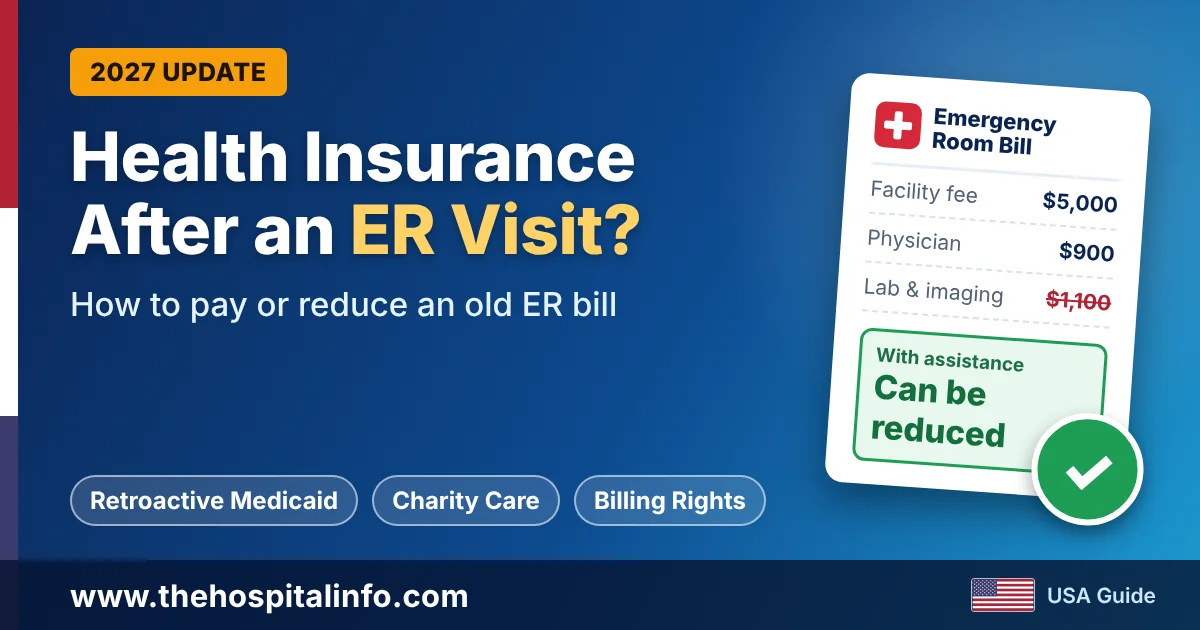
One visit can produce a hospital facility bill, an emergency physician bill, a radiology bill, a lab bill and an ambulance bill, often from different companies. Financial assistance at the hospital doesn’t automatically cover the rest. Contact the physician group, laboratory and ambulance company separately to see whether each has its own program, and check with your insurer whether those doctors were in your network.
One ER visit can produce several separate bills. Consider this example, with invented numbers.
| Charge | Before assistance | After a 60% facility discount |
|---|---|---|
| Hospital facility bill | $5,000 | $2,000 |
| Emergency physician group | $900 | $900 until that group approves you |
| Lab and imaging company | $1,100 | $1,100 until that company approves you |
| Total | $7,000 | $4,000 |
Who can help inside the hospital?
A financial counselor, patient advocate or social worker. They’re usually free and in-house, and they can often start a Medicaid application, explain the FAP and spot billing errors.
How the No Surprises Act Protects You
The No Surprises Act treats insured and uninsured patients differently. First, check whether you have employer coverage, a Marketplace plan, Medicaid or no insurance.
If you have insurance
For emergency care, an out-of-network provider generally can’t bill you more than your in-network cost-sharing (copay, coinsurance and deductible). Limited exceptions exist. If a bill looks like balance billing, call the CMS No Surprises Help Desk or file a complaint. Ground ambulance bills generally do not receive the same federal protection, though air ambulance bills do. Ask your state insurance department or attorney general what applies to ground ambulances where you live.
If you are uninsured or paying on your own
Under the federal rule, providers must give uninsured and self-pay patients a good faith estimate for scheduled care. If care is scheduled 3 to 9 business days ahead, the estimate is due within 1 business day. If it is scheduled 10 or more business days ahead, it is due within 3 business days. A provider must also give one when you ask. An emergency visit isn’t scheduled care, so it usually doesn’t come with one, though follow-up care can.
If one provider’s final bill is at least $400 above that same provider’s estimate, you may be able to use the federal payment dispute process, which must start within 120 days of the initial bill. You also needed to tell the provider before care that you weren’t using insurance. Without an estimate you can’t use the process, but you can submit a complaint to CMS if a provider didn’t give you one.
Check whether you can dispute a bill that runs over an estimate
Estimate vs. Bill Dispute Checker |
| For uninsured and self-pay patients who received a good faith estimate. Check one provider at a time. |
Medical Debt and Your Credit Report
A federal rule that would have removed medical debt from credit reports was struck down by a court in July 2025, so it isn’t in effect. Two protections still matter when a medical bill shows up on your credit report. Equifax, Experian and TransUnion say they no longer list paid medical collections or medical collections under $500. The bureaus also wait one year before listing an unpaid medical collection (TransUnion explains). Those are voluntary company policies, not federal law, so they can change.
Some states have laws of their own, which don’t depend on what the bureaus choose to do.
The National Consumer Law Center tracks state laws on medical debt reporting, and some states also limit interest, lawsuits or wage garnishment. State rules aren’t uniform, and not every one is a full ban. The New York attorney general adds a warning: if you pay a medical bill with a regular credit card, it becomes credit card debt, and that debt can be reported. Some of these state laws face court challenges.
See which states restrict medical debt reporting
NCLC’s list includes California, Colorado, Connecticut, Delaware, Illinois, Maine, Maryland, Minnesota, New Jersey, New York, Oregon, Rhode Island, Vermont, Virginia, Washington and DC. Details differ by state, and some states set thresholds rather than banning reporting outright.
Can You Buy ACA Insurance After a Hospital Visit?
You can buy a Marketplace plan for upcoming care during Open Enrollment. For 2027 coverage, HealthCare.gov lists November 1, 2026 to January 15, 2027. Choose a plan by December 15 and coverage starts January 1. Choose between December 16 and January 15 and it starts February 1. State-run marketplaces set their own schedules, and some open or close on different dates.
Outside that window you need a Special Enrollment Period. Qualifying events include losing coverage, marriage, a birth or adoption, and a move to a new ZIP code or county (not for vacation or medical treatment). You usually have 60 days. Short-term plans start after you sign up, so they won’t pay for past care either. Freelancers and contractors who file 1099s can read our 1099 health insurance guide before picking a plan. If you work in Texas or Illinois, we also cover Texas 1099 health insurance and Illinois 1099 health insurance separately.
How much income must you contribute toward ACA insurance in 2027?
As of November 2026, the enhanced premium tax credits have not been extended for 2027, so under current law the standard schedule applies. For 2027, the IRS applicable percentage table sets how much of your income you’re expected to pay for the benchmark plan. The poverty-line figures in this article come from the 2026 guidelines. Credits generally stop above 400% of the poverty line, about $63,840 for one person using the 2026 guideline. Tax household, employer coverage and immigration status can also change the answer.
A single adult earning $30,000 is at about 188% of the $15,960 guideline ($30,000 divided by $15,960). That sits in the 150% to 200% band, where the expected contribution slides from 4.30% to 6.78%. To find the rate, start at 4.30% for 150% and add (188 − 150) ÷ 50 of the 2.48-point gap to 6.78%. That works out to about 6.2%, or roughly $1,850 a year (about $155 a month) toward the benchmark plan. The premium tax credit then covers the rest of that plan’s price. Your actual credit depends on the plan prices where you live. Gig workers can compare costs and subsidies in our guides to Florida gig worker health insurance and New York gig worker plans and the Essential Plan.
| Household income (% of poverty line) | Expected contribution in 2027 |
|---|---|
| Below 133% | 2.15% |
| 133% to under 150% | 3.23% to 4.30% |
| 150% to under 200% | 4.30% to 6.78% |
| 200% to under 250% | 6.78% to 8.66% |
| 250% to under 300% | 8.66% to 10.22% |
| 300% to 400% | 10.22% |
KFF notes that for 2027, premium tax credits are limited to certain lawfully present immigrant groups, and people who lose Medicaid solely for missing the new work requirements can’t get subsidized Marketplace plans in affected states. Employer coverage counts as affordable at no more than 10.22% of household income in 2027.
Direct Support Channels
| Who | Best for | How to reach them |
|---|---|---|
| Hospital financial counselor or patient advocate | Applications, payment plans, collection holds | Call the number on your bill and ask for patient financial services |
| Your state Medicaid agency | Applying and asking about retroactive coverage | Use the apply links in the state table, or HealthCare.gov’s Medicaid page |
| Marketplace Call Center | Future coverage and special enrollment | 1-800-318-2596, or find free local help |
| CMS No Surprises Help Desk | Balance billing and estimate disputes | 1-800-985-3059 |
| Consumer Financial Protection Bureau | Collection and credit reporting problems | Submit a complaint |
| State attorney general (consumer protection) | Denials, billing practices, state hospital laws | Search “[your state] attorney general consumer complaint” |
| 211 (United Way) | Local help with bills and basic needs | Dial 211 or visit 211.org |
Frequently Asked Questions
Can I get health insurance after an ER visit or hospital admission?
Show the answer
You can enroll for future care if you qualify, either during Open Enrollment or through a Special Enrollment Period. The new plan won’t pay the old bill. For that bill, look at retroactive Medicaid, hospital financial assistance and billing protections.
Can Medicaid pay an ER bill if I apply after discharge?
Show the answer
Possibly. Retroactive coverage can reach back before your application month if you were eligible then. The look-back is up to 3 months through 2026 and 1 or 2 months from January 1, 2027, depending on your group and state.
Can I get Medicaid for an ER bill from 6 months ago?
Show the answer
Usually not through the federal look-back, which is 3 months or less. You can still apply for hospital financial assistance. At a nonprofit hospital the application window runs at least 240 days from the first statement, so check how many days you have left.
Can I apply for Medicaid while I’m still in the hospital?
Show the answer
Yes. See the financial counselor or social worker. Some hospitals can also enroll you temporarily under Hospital Presumptive Eligibility.
Does EMTALA mean my ER visit is free?
Show the answer
No. EMTALA requires screening and stabilizing treatment regardless of ability to pay, but the hospital can still bill you.
Does hospital financial assistance cover the emergency doctor’s bill?
Show the answer
Not always. A policy must list which providers it covers, and independent physician groups, radiologists and ambulance companies are often separate. Contact the physician group, laboratory and ambulance company separately.
Can I get financial assistance if I have a job or insurance?
Show the answer
Having a job or insurance doesn’t rule you out. The policy’s income and household rules decide, and some policies cover deductibles and coinsurance. Self-employed applicants can often use bank statements or a profit-and-loss summary.
Can a hospital forgive an ER bill completely?
Show the answer
It can. Some policies give free care below an income cutoff. A hospital’s policy spells out the income cutoff and discount schedule it uses.
Can I get my money back after Medicaid or financial assistance approves my bill?
Show the answer
Often, yes. Ask the hospital in writing and include your receipts and the approval letter. At a nonprofit hospital, the IRS rules require a refund of excess payments, unless the amount is under $5.
Can a hospital send my ER bill to collections while I apply for financial assistance?
Show the answer
A qualifying nonprofit hospital must wait at least 120 days after the first statement before extraordinary collection actions. If you submit a complete application within 240 days, it must suspend them while it decides.
Can I get hospital financial assistance after the 240-day deadline?
Show the answer
Possibly. The 240 days is the federal minimum for qualifying nonprofit hospitals, and some hospitals accept later applications. Call and find out before you assume it’s too late.
Does Hospital Presumptive Eligibility pay for an ER visit before I applied?
Show the answer
Don’t count on it. That coverage is temporary and lasts until the state decides your Medicaid application. For earlier months, apply for full Medicaid and ask about retroactive coverage.
Does CHIP cover a child’s ER bill retroactively?
Show the answer
It depends on your state. Separate CHIP programs may offer retroactive coverage, but not beyond the second month before the application month. Ask your state CHIP agency.
Does the No Surprises Act protect uninsured ER patients?
Show the answer
Only partly. The good faith estimate and payment dispute process is built for scheduled care, so it usually doesn’t reach the emergency itself. Insured patients have separate balance billing protection.
Can a hospital sue me or put a lien on my house?
Show the answer
In some cases. It depends on state law and the hospital. California, for example, bars hospital liens on real property under AB 2297 and SB 1061.
Does medical debt still hurt my credit?
Show the answer
It can. The 2025 federal rule was struck down. The three bureaus’ own policy skips paid medical collections and those under $500, and some states restrict medical debt reporting.
Can I get hospital financial assistance if I’m undocumented?
Show the answer
Often you can apply. Federal rules don’t make immigration status a requirement for nonprofit hospital assistance, and New York, for example, bars hospitals from considering it. Policies vary, so ask.
Sources
Show the official sources used
Government pages were checked in November 2026. The tools use the 2026 federal poverty guidelines and general federal rules, and they can’t make an eligibility decision. Your state agency and the hospital make that decision. The NCLC and KFF links are nonprofit sources, and none of them replaces your state’s guidance.
- CMS: Section 71112 retroactive coverage bulletin
- Medicaid.gov: Six-month renewals (Section 71107)
- IRS: Billing and collections, Section 501(r)(6)
- IRS: Financial assistance policy, Section 501(r)(4)
- IRS: Requirements for 501(c)(3) hospitals
- IRS: Revenue Procedure 2026-26
- CMS: No Surprises Act payment resolution
- eCFR: 45 CFR 149.610, good faith estimates
- CMS: SMD 26-006, community engagement hold-harmless period
- Texas HHS: Medicaid coverage for months before application
- Pennsylvania DHS: Medicaid changes in January 2027
- California HCAI: AB 1312 and 2026 new legislation
- CFPB: Debt validation notice
- CMS: No Surprises Help Desk
- CMS: Hospital price transparency
- CMS: EMTALA
- CMS: Immigrant eligibility for Marketplace and Medicaid
- Medicaid.gov: Hospital Presumptive Eligibility
- HealthCare.gov: Special Enrollment Period
- HealthCare.gov: Dates and deadlines
- HHS ASPE: 2026 poverty guidelines
- Federal Register: 2026 poverty guidelines
- Minnesota DHS: Retroactive coverage
- California HCAI: Hospital Fair Billing laws
- California DHCS: ACWDL 26-07
- MassHealth: Eligibility Operations Memo 25-14
- Florida AHCA: Retroactive eligibility
- CFPB: Paid and under-$500 medical collections
- New York Attorney General: Hospital financial assistance
Independent and company sources
About The Author
Researched and written by Nurul Islam Chowdhury, ACMA, Associate Member, Institute of Cost and Management Accountants of Bangladesh (ICMAB, Associate Member No. A-1607). He holds a BBA and an MBA from the University of Chittagong. He specializes in financial modeling, cost analysis, tax structures, insurance and policy analysis.
Disclaimer: This article is for general information. It isn’t legal, financial or medical advice. Medicaid, insurance and hospital billing rules vary by state and change often. Confirm the details with your state Medicaid agency, a licensed advisor or the hospital’s financial counseling office. The tools above give rough estimates only and don’t confirm that you qualify for anything.

Hi, I’m Nurul Islam Chowdhury (Imran) — the person behind HospitalInfo.
Associate Member, Institute of Cost and Management Accountants of Bangladesh (ICMAB – Associate Member No: A-1607)
Nurul Islam Chowdhury (Imran) holds a Bachelor of Business Administration (BBA) and a Master of Business Administration (MBA) from the University of Chittagong. As a qualified Cost and Management Accountant (CMA), he specializes in financial analysis, cost management, and tax structures. Every piece of tax and financial data in this article has been personally reviewed and fact-checked by him to ensure technical and calculation accuracy based on standard IRS guidelines and 2026 regulations.
My background is in finance and cost management, but for the past few years my real focus has been something more personal: helping everyday Americans make sense of health insurance and hospital bills.
Here’s the thing about healthcare costs in the US — they’re confusing on purpose, or at least it feels that way. A single ER visit can turn into a stack of paperwork nobody explains clearly. That’s the gap I try to fill on this site. I dig into how PIP and MedPay actually work, what happens when health insurance and auto insurance both claim to cover the same bill, how to negotiate a hospital statement instead of just paying it, and how coverage options change year to year.
I’m not a doctor, and I don’t pretend to be. What I bring is a finance-and-numbers lens — reading policy documents, tracking CMS and state-level rules, and translating them into something you can actually use before you’re stuck on the phone with an insurance rep. Every guide here starts from a real question people are Googling at 11 PM with a bill in front of them, and that’s still how I decide what to write next.