Massachusetts Uber & Lyft Health Insurance Stipend 2026-2027: How to Qualify and Get Paid
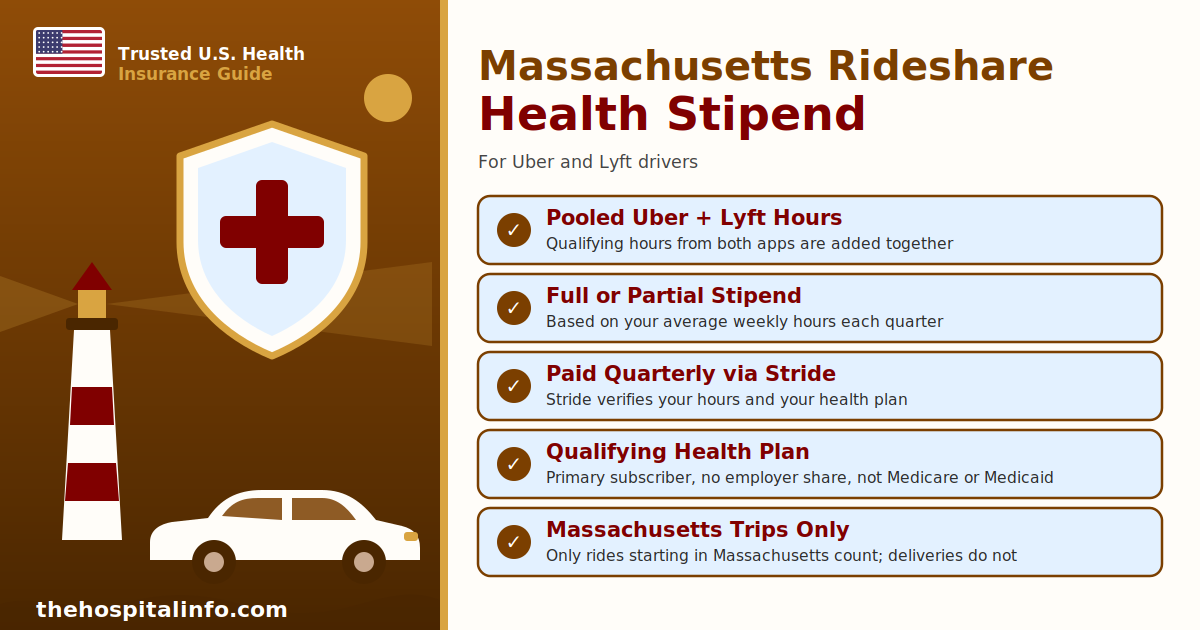
An Uber or Lyft driver in Massachusetts who qualifies for the Massachusetts rideshare health stipend can receive up to $1,215 every quarter toward a qualifying health insurance plan. Your tier depends on your average weekly hours, and the Massachusetts Attorney General’s official guidance sets the cutoffs.
Last updated: October 20, 2026
Massachusetts Quarterly Stipend Summary: 2026-2027
| Massachusetts Rideshare Health Stipend | Amounts (2026-2027) |
|---|---|
| Full stipend | $1,215 per quarter ($405 a month) |
| Partial stipend | $607.50 per quarter ($202.50 a month) |
| Hours for full stipend | An average of 25 or more qualifying hours per week |
| Hours for partial stipend | An average of 15 to less than 25 qualifying hours per week |
| Combined hours | Qualifying Uber and Lyft hours are added together |
| Program administrator | Stride |
| Hours began accruing | April 1, 2025 |
| Frequency | Up to four quarterly stipends per year |
| Open now | Q3 2026 documentation, October 1–31, 2026 |
Massachusetts Rideshare Health Stipend Calculator: Uber + Lyft Hours
| Estimate Only: This calculator provides an estimate based on 2026 guidelines published by Massachusetts and Uber. Final payouts depend on official hours recorded by Uber, Lyft, and Stride, a qualifying health plan, and timely documentation. | |
| Disclaimer: This is a planning calculation based on your average pooled hours over the quarter. Yearly figures assume the same tier all year. It is not Stride’s official eligibility decision. | |
Massachusetts Rideshare Health Stipend Payment Calendar: 2026-2027
| Driving Quarter | Documentation Window | Payment Window |
|---|---|---|
| Q1 (Jan–Mar 2026) | April 1–30, 2026 | May 15–31, 2026 |
| Q2 (Apr–Jun 2026) | July 1–31, 2026 | August 15–31, 2026 |
| Q3 (Jul–Sep 2026) | October 1–31, 2026 (open now) | November 15–30, 2026 |
| Q4 (Oct–Dec 2026) | January 1–31, 2027 | February 15–28, 2027 |
Note: Q4 2026 is paid in February 2027. Stride says each quarter’s deadline is firm and it cannot pay drivers who haven’t finished the steps by then.
Table of Contents (tap to open, then tap a title to jump)
- Massachusetts Rideshare Health Stipend Calculator: Uber + Lyft Hours
- Massachusetts Rideshare Health Stipend Payment Calendar 2026
- Eligibility Checker: Do You Meet the Basic Rules?
- Who Qualifies for the Massachusetts Rideshare Health Stipend?
- Who May Not Qualify
- How Much Is the Massachusetts Uber and Lyft Health Stipend in 2026?
- Catch-Up Hours Planner: How Much Do You Still Need to Drive?
- Can You Combine Uber and Lyft Hours for the Massachusetts Health Stipend?
- Which Stipend Window Is Open Today?
- What Counts as Engaged Hours for the Massachusetts Stipend?
- What Health Insurance Plans Qualify for the Massachusetts Rideshare Stipend?
- Health Insurance Providers Listed by Stride (2026 Plan List)
- How to Get the Massachusetts Rideshare Health Stipend
- Your Claim Progress Tracker
- What Documents Do You Need for the Massachusetts Health Stipend?
- Common Problems With the Massachusetts Health Stipend and Quick Fixes
- Direct Support Channels If Something Goes Wrong
- Is the Massachusetts Rideshare Health Stipend Worth It?
- Other Benefits for Massachusetts Uber and Lyft Drivers in 2026
- More Background for Massachusetts Drivers
- Frequently Asked Questions (FAQ) About the Massachusetts Rideshare Health Stipend
Eligibility Checker: Do You Meet the Basic Rules?
| Disclaimer: This checker is a planning aid based on the rules in this guide. It is not Stride’s official eligibility decision. |
Who Qualifies for the Massachusetts Rideshare Health Stipend?
To qualify for the quarterly payout, you must meet the following three main requirements:
1. Drive in Massachusetts: You must be an active Uber and/or Lyft driver. According to Uber’s Massachusetts benefits page, only Rides trips that begin in Massachusetts count, and delivery trips such as Uber Eats do not. That covers a pickup at Boston Logan Airport as much as one in Worcester or Springfield: the state line matters, not the city.
2. Average 15+ Qualifying Hours a Week: Mass.gov says “active hours,” Uber, Lyft and Stride say “Engaged Hours,” and the apps show “Active Time” (Uber) or “Booked Time” (Lyft), per the Attorney General’s driver presentation. All mean the same trip time, and hours from both apps are combined.
3. Have a Qualifying Health Plan: Per Mass.gov and Stride’s guidelines, your coverage must meet three conditions:
- Primary subscriber: You are the primary policyholder. Dependents on another person’s plan do not qualify.
- No employer coverage: The plan is not employer-sponsored, and no current or former employer contributes to your premium.
- No public insurance: Coverage through MassHealth (Medicaid) or Medicare is excluded.
Qualifying plans are individual plans, and Stride publishes the list of Health Connector plans that qualify. The Massachusetts Health Connector is the state’s official marketplace. To weigh your options first, see our guide to the best health insurance for Uber, DoorDash and Lyft drivers.
Can You Get the Massachusetts Health Stipend With Uber Only?
Yes. Uber-only and Lyft-only drivers qualify when their own hours reach the threshold. Hours pool only if you drive for both.
Who May Not Qualify
- Drive under 15 hours: Average fewer than 15 engaged hours per week.
- Miss a plan rule: You are a dependent, your plan is employer-sponsored or employer-funded, or it is MassHealth or Medicare (see requirement 3 above).
Important: Meeting the qualifying-hour requirement alone does not guarantee the stipend. You must also meet the health-plan requirements and complete Stride’s verification on time.
How Much Is the Massachusetts Uber and Lyft Health Stipend in 2026-2027?
Your average weekly qualifying hours across the whole calendar quarter set your tier. Stride says the dollar amount is tied to the average cost of the lowest-priced Bronze plans on the Massachusetts Health Connector.
| Average Hours / Week | Tier | Per Quarter | Per Month | Max Per Year |
|---|---|---|---|---|
| Under 15 | Not eligible | $0 | $0 | $0 |
| 15 to 24.99 | Partial (50%) | $607.50 | $202.50 | $2,430 |
| 25 or more | Full (100%) | $1,215 | $405 | $4,860 |
Amounts come from Uber’s benefits page and tier details from Stride’s program FAQ. The yearly column is four quarters at that tier, a ceiling. The stipend is paid to you as cash, not to your insurer.
How Many Hours Is That Over a Whole Quarter?
Show the 2026 quarter-hour table
Stride tracks total hours across the quarter, so the weekly average becomes a different hour count depending on the quarter’s length. Stride lists 197.14 and 328.57 hours for the 92-day Q3.
| 2026 Quarter | Days | Partial (15 hrs/wk) | Full (25 hrs/wk) |
|---|---|---|---|
| Q1: Jan–Mar | 90 | 192.86 hrs | 321.43 hrs |
| Q2: Apr–Jun | 91 | 195.00 hrs | 325.00 hrs |
| Q3: Jul–Sep | 92 | 197.14 hrs | 328.57 hrs |
| Q4: Oct–Dec | 92 | 197.14 hrs | 328.57 hrs |
Target Hours Planner: How Much Do You Still Need to Drive?
| Hours shown are pooled Uber and Lyft engaged hours. See what counts as engaged hours. | |
| Disclaimer: Stride judges your average over the whole quarter using the hours Uber and Lyft report. This tool only does the arithmetic from the quarter-hour totals above. Your Stride dashboard is the official record. |
Can You Combine Uber and Lyft Hours for the Massachusetts Health Stipend?
Yes. The settlement lets you pool hours across both platforms, so you do not need 25 hours on one app. Sixteen weekly hours on Uber plus 10 on Lyft make 26 combined hours, enough for the full stipend. Try your own numbers in the calculator.
Stride pools your hours using the driver’s license on your Uber and Lyft profiles, so keep that number current and identical in both apps. Its sign-up page also asks for the phone number you use in the apps.
Which Stipend Window Is Open Today?
| Disclaimer: Dates follow Uber’s published schedule. Your own deadline can differ, so confirm it on your Stride dashboard. Full table: payment calendar. |
What Counts as Engaged Hours for the Massachusetts Stipend?
Under the Mass.gov FAQ, Stride’s Engaged Hours guide and Uber’s benefits page, Engaged Hours run from the moment you accept a trip until you drop off the rider, including the drive to pickup and any wait there. Time online with no accepted trip does not count.
| Driving Moment | Counts? |
|---|---|
| Driving to the pickup after you accept a trip | Yes |
| Waiting at the pickup location for the rider | Yes |
| Driving the rider to the drop-off | Yes |
| Driving before a rider cancels | Yes |
| Driving after you are told a rider cancelled | No |
| Overlapping time on shared Uber rides | Counts once |
| Waiting online with no accepted trip | No |
| Delivery trips (Uber Eats, DoorDash) | No |
| Rides that begin outside Massachusetts | No |
How to Check Your Engaged Hours in the Uber and Lyft Apps
Uber: open the Driver App, go to the Earnings Hub, and tap the MA Benefits Hub tile, as Uber’s benefits page describes. Lyft: check Driving Stats on the Earnings Activity page, or the recap email you get every two weeks. Your pooled total shows on your Stride dashboard. If a number looks wrong, contact Uber or Lyft support first, since each reports its own hours to Stride.
What Health Insurance Plans Qualify for the Massachusetts Rideshare Stipend?
The three plan rules are listed above. Before you enroll, check these details.
Does MassHealth Qualify for the Rideshare Health Stipend?
No. MassHealth is Medicaid, and Medicare is excluded by the same rule. Stride’s qualifying-plans page names WellSense “Clarity Connector” plans as an excluded example, even though its 2026 list does include WellSense Clarity metal-tier plans. Because the names are close, confirm the exact plan name with Stride before you buy, as you should for any ConnectorCare plan: ask Stride Support directly. ConnectorCare is the Health Connector’s income-based option for people between 100% and 400% of the federal poverty level, and Stride’s list does not name it.
Enrolling in a Qualifying Health Plan: 2027 Open Enrollment Dates
Open Enrollment for 2027 coverage runs October 23, 2026 through January 23, 2027, and the Health Connector says it starts earlier than in past years. Enroll by December 23, 2026 for a January 1 start. Signing up on the final day, January 23, 2027, starts coverage on February 1, according to the Massachusetts Health Connector. Outside that window, a qualifying life event, such as losing other coverage, can open a Special Enrollment Period. Current members get a final eligibility notice from mid-October through early November showing the 2027 plan name, premium and financial help. Comparing the marketplace with add-on coverage? See our breakdown of supplemental insurance for gig drivers.
What Could Change About Health Insurance Costs in 2027?
The Division of Insurance approved a 10.8 percent weighted average base rate increase for 2027 in the individual and small-group market. That is an average before age adjustments, and carrier changes range from 6.7 percent at Harvard Pilgrim to 19.2 percent at Fallon. Before you pick a 2027 plan, compare premium, deductible, out-of-pocket maximum and network, and confirm the plan is on Stride’s list.
Free Local Help Comparing Plans in Boston, Worcester and Beyond
Whether you drive in Boston, Worcester, Springfield or anywhere else in Massachusetts, you can get free in-person help choosing a plan. The state says you can find a certified assister near you with the Find Local Help tool on the Health Connector site. In Boston, the Mayor’s Health Line staff are state-certified Navigators, and in Worcester the city lists on-site navigators at the Family Health Center of Worcester, 508-860-7700. Then confirm the plan name with Stride before you enroll.
Can I Get the Stipend If I Don’t Have Health Insurance Yet?
Yes, in some cases. When Stride invites you, choose “I will buy insurance,” then buy a qualifying plan and send proof of enrollment by the date on your dashboard, as Stride’s program FAQ explains.
Health Insurance Providers Listed by Stride (2026 Plan List)
Stride publishes an official list of Health Connector plans that qualify for the stipend. The 2026 examples below are for reference only, since plans and prices change yearly, so check your Stride dashboard before enrolling.
| Carrier (as listed by Stride) | Example 2026 plans on the list |
|---|---|
| Blue Cross Blue Shield (BCBS) | HMO Blue Premium · HMO Blue Value Deductible · HMO Blue Essential |
| Tufts Health Direct | Gold 1000 · Silver 2000 II · Bronze 2850 · Platinum |
| MGB Health Plan | Complete HMO 20/40 · Select HMO 2850 · Complete HMO 2000 25/60 II |
| Harvard Pilgrim (HPHC) | Standard Platinum – Flex · HMO 2000 Value II – Flex · HMO 3500 – Flex |
| Health New England (HNE) | HNE Thrive Bronze · HNE Silver A II · HNE Gold A · HNE Platinum A |
| Fallon | Community Care Connector Platinum · High Gold · Bronze #1 |
| UnitedHealthcare | UnitedHealthcare (UHC) offers plans like Platinum 0, Choice Plus Gold 1000, and Silver 2000-1. |
| WellSense | Clarity Platinum 0 Deductible · Clarity Gold 1000 · Clarity Silver 2000 II |
If your plan is not on this list, or you are not sure it qualifies, follow the instructions in your Stride dashboard or ask Stride Support before you enroll.
How to Get the Massachusetts Rideshare Health Stipend?
- Drive in Massachusetts. Complete rides for Uber and/or Lyft that start in the state.
- Reach 15+ average engaged hours a week across the quarter, with both apps added together.
- Wait for Stride’s invitation. It arrives the month after the quarter closes.
- Log in to Stride and choose an option: “I have insurance” or “I will buy insurance.”
- Let automatic verification run. Stride matches your name, date of birth and member ID with carrier records.
- Upload documents only if asked, then finish before the last day of the invitation month.
- Get paid. Stride says drivers usually receive the stipend 2 to 3 weeks after that end-of-month deadline.
These steps follow Stride’s program FAQ.
Your Claim Progress Tracker
What Documents Do You Need for the Massachusetts Health Stipend?
Stride verifies coverage automatically when it can and otherwise asks for a manual upload. According to Stride’s manual review guidance, accepted proof includes your insurance card (front and back), an enrollment confirmation letter, or a certificate of insurance. Your dashboard shows the exact request.
Your legal name must match your driver profile, and you must appear as the primary subscriber. Manual review takes about two business days, sometimes longer. Need your member ID? See Stride’s guide on finding your member or plan ID.
How Often Do You Reverify Your Plan?
You don’t resubmit proof every quarter. Verification happens at your first successful claim and then once per calendar year, per Stride’s program documentation. Keep your plan active all year.
Common Problems With the Massachusetts Health Stipend and Quick Fixes
Pick Your Problem for a Quick Fix
Direct Support Channels If Something Goes Wrong
Contact these channels if your claim is rejected or your hours look off:
- Massachusetts Attorney General’s Fair Labor Division Hotline: (617) 727-3465, for wage and settlement concerns.
- Massachusetts Health Connector Customer Service: 877-MA-ENROLL (877-623-6765), for plan and enrollment questions.
- Stride Support Portal: support.stridehealth.com or the Stride contact form, for eligibility, uploads and payment status.
- Uber and Lyft in-app support: for corrections to recorded hours, via the Uber and Lyft driver benefit pages.
Note: Check your recorded hours well before the deadline, so any error can be fixed in time.
Is the Massachusetts Rideshare Health Stipend Worth It?
For drivers who already put in the hours, it is real money toward coverage you need anyway. The yearly figures above are maximums, since you must qualify each quarter, and the stipend may not cover your whole premium. California drivers should note that the DoorDash program works differently, as our DoorDash health stipend California guide explains. For the tax side, see our 1099 health insurance and tax deduction guide and our Illinois 1099 health insurance guide. For other states, compare our guides to Texas 1099 health insurance, Florida gig worker health insurance and New York gig worker health insurance costs.
Other Benefits for Massachusetts Uber and Lyft Drivers in 2026-2027
Paid Sick Leave: $21.22 an Hour in 2026
Show sick leave details
You earn one hour of sick pay for every 30 hours of engaged time, up to 40 hours a year with each company. Sick pay has been $21.22 an hour since January 15, 2026, and it is adjusted for inflation every year with a 3 percent cap.
Use it for your own illness or preventive care, or to care for a child, spouse or parent. Uber takes claims in one-hour blocks, up to 8 hours a day, and says payment arrives within 14 days. Up to 40 unused hours carry over, but unclaimed leave expires after 365 days with no active time. Washington drivers follow different rules, covered in our Washington gig worker paid sick leave guide.
Paid Family and Medical Leave Stipend: 0.44% of Earnings
Show PFML stipend details
Since January 30, 2025, Uber and Lyft pay every driver a PFML stipend equal to 0.44 percent of earnings, not counting tips, quarterly or sooner. Uber says the payment arrives whether or not you have opted in, but it does not sign you up, so you still opt in yourself for coverage. Self-employed people who elect PFML coverage pay the full contribution rate, which is 0.88 percent for both 2026 and 2027, so the stipend covers about half.
You must stay enrolled for at least 3 years and file quarterly earnings reports, and benefits require that you paid in for at least 2 of your last 4 completed quarters. To opt in, fill out the Self-Employed Notice of Election and the opt-in request form, then set up an account through MassTaxConnect. See the state’s opt-in page.
Minimum Earnings Rate: $34.48 per Engaged Hour
Show earnings rate details
The floor began at $32.50 on August 15, 2024 and is now $34.48 per hour of engaged time, effective January 15, 2026. Every two weeks, Uber or Lyft compares your average hourly earnings with the floor and pays you the difference if you fell short, and tips do not count. Lyft says it pays the adjustment the following Wednesday.
The floor goes up every January 15 by the lower of 3 percent or the Northeast inflation rate, and it can also rise if the state minimum wage does.
More Background for Massachusetts Drivers
Schedule C vs. Schedule 1 (Line 17): Where Health Insurance Premiums Go
Show the tax form difference
Where the Massachusetts Rideshare Health Stipend Comes From
Show the settlement background
Frequently Asked Questions (FAQ) About the Massachusetts Rideshare Health Stipend
How much is the Massachusetts Uber and Lyft health stipend in 2026?
Show answer
How do I apply for the Massachusetts Uber and Lyft health stipend?
Show answer
Can I get the Massachusetts rideshare stipend without health insurance?
Show answer
Are Uber Eats or DoorDash delivery hours eligible for the Massachusetts stipend?
Show answer
Do rides starting at Boston Logan Airport or outside Boston count toward the Massachusetts health stipend?
Show answer
Can Uber and Lyft hours be combined for the Massachusetts health stipend?
Show answer
Can I qualify for the Massachusetts health stipend if I drive only for Uber or only for Lyft?
Show answer
When will I receive my Massachusetts health stipend payment?
Show answer
What if Stride cannot verify my health insurance?
Show answer
What if my Uber and Lyft hours add up to 25 a week but Stride still shows the partial tier?
Show answer
When does Massachusetts Open Enrollment start for 2027?
Show answer
How much will Massachusetts health insurance premiums rise in 2027?
Show answer
Does ConnectorCare qualify for the Massachusetts rideshare health stipend?
Show answer
Does the Massachusetts rideshare health stipend cover my whole health insurance premium?
Show answer
What happens if I miss my documentation deadline?
Show answer
How much is paid sick leave for Massachusetts Uber and Lyft drivers?
Show answer
Do Uber and Lyft pay for PFML coverage in Massachusetts?
Show answer
What is the minimum earnings rate for Massachusetts Uber and Lyft drivers?
Show answer
Do I deduct health insurance premiums on Schedule C or Schedule 1?
Show answer
Is the Massachusetts rideshare health stipend taxable income?
Show answer
Official Sources
Each figure in this guide traces to one primary source: Uber’s benefits page for 2026 amounts and payment windows, the Attorney General’s settlement FAQ and Stride’s qualifying-plans page for eligibility rules, Lyft for its earnings-adjustment timing, the Health Connector for Open Enrollment dates, the Division of Insurance for 2027 premium rates, and the IRS Form 7206 instructions for tax-form details. Rules, amounts and deadlines can change, so check the latest information before you submit documents.
Written & Reviewed by Nurul Islam Chowdhury, ACMA
Show author details
Nurul Islam Chowdhury is an Associate Member of the Institute of Cost and Management Accountants of Bangladesh (ICMAB), Membership No. A-1607. He holds a Bachelor of Business Administration (BBA) and a Master of Business Administration (MBA) from the University of Chittagong. His professional background includes corporate financial planning, policy analysis, and risk assessment. He applies this experience to researching and explaining complex insurance, tax, and financial topics in clear, practical language for working professionals and independent contractors.
How We Verified This Guide
Show how we verified this guide
Disclaimer: This article is general information, not advice from a licensed insurance broker or tax professional. Confirm current figures on the Mass.gov and Stride pages linked above before making coverage decisions.

Hi, I’m Nurul Islam Chowdhury (Imran) — the person behind HospitalInfo.
Associate Member, Institute of Cost and Management Accountants of Bangladesh (ICMAB – Associate Member No: A-1607)
Nurul Islam Chowdhury (Imran) holds a Bachelor of Business Administration (BBA) and a Master of Business Administration (MBA) from the University of Chittagong. As a qualified Cost and Management Accountant (CMA), he specializes in financial analysis, cost management, and tax structures. Every piece of tax and financial data in this article has been personally reviewed and fact-checked by him to ensure technical and calculation accuracy based on standard IRS guidelines and 2026 regulations.
My background is in finance and cost management, but for the past few years my real focus has been something more personal: helping everyday Americans make sense of health insurance and hospital bills.
Here’s the thing about healthcare costs in the US — they’re confusing on purpose, or at least it feels that way. A single ER visit can turn into a stack of paperwork nobody explains clearly. That’s the gap I try to fill on this site. I dig into how PIP and MedPay actually work, what happens when health insurance and auto insurance both claim to cover the same bill, how to negotiate a hospital statement instead of just paying it, and how coverage options change year to year.
I’m not a doctor, and I don’t pretend to be. What I bring is a finance-and-numbers lens — reading policy documents, tracking CMS and state-level rules, and translating them into something you can actually use before you’re stuck on the phone with an insurance rep. Every guide here starts from a real question people are Googling at 11 PM with a bill in front of them, and that’s still how I decide what to write next.
Pingback: Supplemental Insurance for Gig Drivers (2026-2027): Why & How