Uber Driver Health Insurance Tax Deduction & Schedule C (2026-2027)
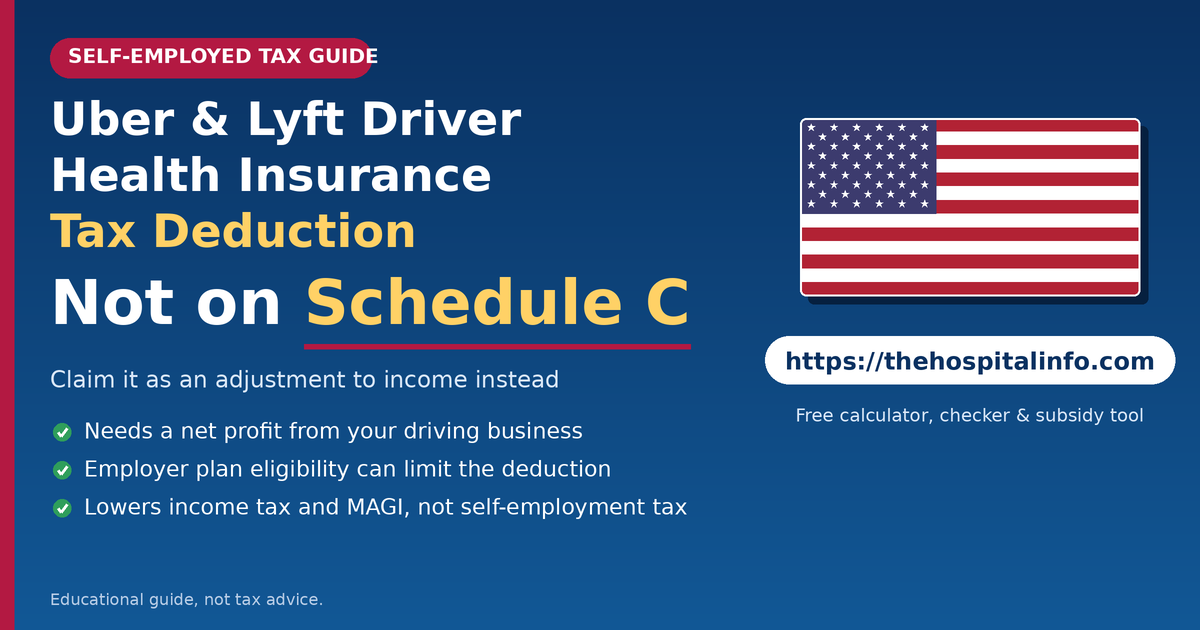
Uber and Lyft drivers can usually deduct the health insurance premiums they pay. But they need to meet two criteria: (1) Their driving business shows a net profit and (2) They were not eligible for certain employer-subsidized coverage in those months.
Last reviewed: October 2026. How we verified this guide
Self-Employed Health Insurance Deduction for Rideshare Drivers Summary (2026-2027)
| Topic | Key Fact |
|---|---|
| Who qualifies | Drivers with a net profit from the business that holds the plan. Employer-subsidized coverage can shrink the deduction (see the eligibility rule) |
| Deduction amount | Qualifying premiums you paid, limited by your net earnings from that business |
| Coverage that counts | Medical, dental, vision, qualified long-term care (with age limits), and voluntary Medicare premiums |
| Loss year | No deduction from a business with no profit. Profit from another business that holds the plan could support one |
| 2026 subsidy line | For 2026 coverage, most households above 400% of the poverty level lose the premium tax credit ($62,600 for one person; see household limits) |
| Self-Employed Health Insurance Deduction Calculator (Form 7206 Estimate)Simplified planning estimate, not a tax-return calculation. | |
| Gross fares and tips ($) | |
| Fees and business expenses ($)Mileage rate or actual vehicle costs, not both | |
| Premiums paid after tax credit ($)Only months without employer-plan eligibility | |
| Retirement contributions ($)SEP, SIMPLE, or solo 401(k) | |
| Your W-2 Box 3 wages ($) | |
| Federal tax bracket | |
Table of Contents (tap to open)
| Am I Eligible? Preliminary Rideshare ScreeningPreliminary screening, not a final eligibility decision. | |
| Did your driving business profit? | |
| Employer plan available to anyone covered?Yours, your spouse’s, or a dependent’s, even if declined | |
| Do you pay the premiums?For you, your spouse, a dependent, or a child under 27 | |
| Plan established under this business? | |
Can Uber and Lyft Drivers Deduct Health Insurance Premium?
Uber and Lyft drivers act as independent contractors, reporting their driving income on Schedule C. You can claim the self-employed health insurance premium deduction, which covers medical, dental, and vision premiums for you, your spouse, and your dependents—including a child under 27 at year-end, even if you do not claim them. While you can deduct qualifying premiums, your actual allowable deduction depends on your business profit, employer-plan eligibility, and premium tax credit.
Which plans and coverage types count?
Marketplace and private medical plans count, along with dental and vision coverage. Qualified long-term care premiums count too, but the IRS caps them by age. For the 2025 form, the caps run from $480 (age 40 or younger) to $6,020 (age 71 or older). The 2026 draft instructions list $500, $930, $1,860, $4,960, and $6,200 for the same age groups. Treat those as unfinal until the IRS publishes the final edition. Voluntary Medicare premiums can count as well. See also IRS Publication 535.
Schedule C vs. Schedule 1 (Line 17): Where to Claim Your Health Insurance Premiums
| Item | Schedule C | Schedule 1 (Form 1040), line 17 |
|---|---|---|
| What it reports | Business income and expenses, ending in a net profit or loss | Adjustments to income, including this deduction |
| Health insurance premiums | Do not list them here | Report the deduction here, figured on Form 7206 |
| Tax effect | Net profit sets your self-employment tax | No effect on self-employment tax, per the Form 7206 instructions. Lowers AGI and MAGI |
- Don’t Mix Expenses: Keep premiums out of your Schedule C costs.
- Above-the-Line Deduction: It adjusts your income before the standard deduction, so you do not need to itemize. The subsidy section explains why MAGI matters.
- Net Profit Limitation: Your profit caps the deduction. Example 4 shows what happens to premiums above the cap.
Driving for Several Apps? Combine Your Net Profit
Drivers who work for Uber, Lyft, DoorDash, and Instacart generally report similar work on one Schedule C, as FreeTaxUSA explains. Add every app’s gross receipts, then subtract all fees and costs once. A different kind of business needs its own Schedule C, and your cap follows the business that holds your plan (Form 7206 instructions).
| Multi-App Net Profit CombinerSimplified planning estimate, not a tax-return calculation. | |
| Uber gross ($) | |
| Lyft gross ($) | |
| DoorDash gross ($) | |
| Instacart gross ($) | |
| Other apps gross ($) | |
| Fees and expenses, all apps ($)Count each expense once | |
Schedule C Health Insurance Deduction Rules (2026-2027): Who Qualifies?
Net Profit Requirement
Show the details
You need a net profit from the business that holds your plan. The plan must be established under that business, and for Schedule C filers a policy in your own name counts. Your deduction cannot top the net earnings from that business. Form 7206 subtracts half of your self-employment tax and any SEP or SIMPLE contributions when it sets the cap. If you run more than one business, you figure each plan’s limit on its own Form 7206, using that business’s profit, as the Form 7206 instructions explain.
Employer Plan Eligibility Rule
Show the details
The deduction may be limited for months when you or a covered family member was eligible for employer-subsidized coverage. The test is eligibility, not enrollment, so passing on the plan does not help. It covers your own employer, your spouse’s employer, and the employer of a dependent or a child under 27, as the Form 7206 instructions explain.
The instructions use the word “subsidized” without defining it. If an employer pays none of the cost, ask a tax professional whether that plan counts in your case. The rule comes from 26 U.S.C. § 162(l).
Independent Contractor Health Insurance Deduction Limits
You take the smallest of three numbers: premiums you paid, your net earnings cap, and premiums for months without employer-plan eligibility.
How the net earnings cap works (tax detail)
Show the details
Self-employment tax runs 15.3% on 92.35% of net profit. The Social Security share stops at the $184,500 wage base for 2026, according to the Social Security Administration. W-2 wages use up part of that base first, so the calculator asks for them. Half of the tax is deductible, and that half lowers your cap.
Form 7206 walkthrough: where each number comes from
Show the details
These line numbers come from the 2025 form, and the 2026 draft appears to keep them (see the year note). Line 1 takes the premiums you paid for coverage under your business, leaving out months you were eligible for an employer plan (long-term care goes on line 2). Line 4 takes the net profit from the business that holds the plan (line 11 for S corporation wages). The form then subtracts half of your self-employment tax and any retirement plan contributions. Line 14 gives your deduction, and it moves to Schedule 1, line 17. For Jake, line 1 takes his $6,000 in premiums, and line 4 takes the $34,000 net profit from Schedule C. The $2,402 half of self-employment tax comes from Schedule SE. With no retirement contributions, the smaller of premiums and cap, $6,000, lands on line 14.
| 2026 Marketplace Subsidy Risk EstimatorPreliminary 400% FPL income screen, not a premium tax credit calculation. | |
| Household size | |
| Expected net profit ($) | |
| Premiums after tax credit ($) | |
| Your W-2 Box 3 wages ($) | |
| Retirement contributions ($)SEP, SIMPLE, or solo 401(k) | |
| Other adjustments ($)For example, HSA contributions | |
| Other household income ($)Include your spouse’s income | |
How the tools work, and what they leave out
| Test case | Inputs | Result |
|---|---|---|
| Jake | $52,000 gross, $18,000 expenses, $6,000 premiums | $34,000 profit, $31,598 cap, $6,000 deduction |
| Loss year | $20,000 gross, $22,500 expenses, $3,000 premiums | $0 deduction |
| Ana | $8,000 gross, $0 expenses, $9,000 premiums | $7,435 cap and deduction |
| Ana with SEP | Same, plus $2,000 SEP contribution | $5,435 cap and deduction |
| High W-2 wages | Jake, plus $200,000 in Box 3 wages | $33,545 cap, $6,000 deduction |
The tools assume one business, 15.3% self-employment tax on 92.35% of net profit, and the $184,500 Social Security wage base for 2026, reduced by the Box 3 wages you enter. The subsidy tool uses the 2025 federal poverty guidelines for the 48 contiguous states and DC. The tools ignore additional Medicare tax, other income adjustments, and the loop between your deduction and your credit. Confirm every result on Form 7206, Form 8962, and Publication 974.
Real-World Examples: How Much Can You Actually Save?
Example 1: A Full-Time Uber Driver
Jake drives full time. He collects $52,000 in fares and tips. Platform fees, mileage at the IRS standard mileage rate, phone costs, and other business expenses total $18,000. After subsidy, his premiums total $6,000. He starts from gross fares and tips, not from his bank deposits, because platform fees come out before the money lands.
| Step | Amount |
|---|---|
| Gross fares and tips | $52,000 |
| Platform fees and other business expenses (Schedule C) | −$18,000 |
| Net profit | $34,000 |
| Self-employment tax ($34,000 × 92.35% × 15.3%) | $4,804 |
| Half of self-employment tax | $2,402 |
| SEP or SIMPLE contributions | $0 |
| Deduction cap (net profit minus the two lines above) | $31,598 |
| Premiums paid after subsidy | $6,000 |
| Health insurance deduction (the smaller amount) | $6,000 |
| Income after the listed adjustments | $25,598 |
| Jake’s income at each stage | |
| Net profit | $34,000 |
| Before deduction | $31,598 |
| After deduction | $25,598 |
Jake lowers his income before other tax adjustments and deductions by $6,000. The figures ignore his other income, so they show the steps, not his full AGI. This is an illustrative federal income-tax estimate, not total tax savings: at an assumed 12% bracket, the deduction cuts federal income tax by roughly $720, and real savings depend on filing status, taxable income, and other factors. His self-employment tax stays the same, because it still applies to the full $34,000.
Example 2: A Part-Time Lyft Driver With an Employer Offer
Maria drives for Lyft. A seasonal warehouse job made her eligible for a subsidized plan from January through March. She paid $400 a month for a private plan all year, or $4,800. She deducts $3,600, the premiums for the nine months without eligibility. That is also the number she types into the calculator.
Example 3: A Driver With a Loss
Tom lost $2,500 on driving and has no other business income. He paid $3,000 in premiums. His deduction is $0. He may count some premiums as medical expenses on Schedule A, but only the amount above 7.5% of AGI counts, per IRS Publication 502.
Example 4: Premiums Above the Cap
Ana nets $8,000 from driving. Her self-employment tax is $1,130, so half is $565, and her cap is $7,435. She paid $9,000 in premiums. She deducts $7,435. The other $1,565 is not part of this deduction. It may count as a medical expense on Schedule A if she itemizes, but only the amount above 7.5% of AGI counts.
How to Claim the Self-Employed Health Insurance Deduction
- Finish Schedule C first. Your net profit sets the cap.
- Collect Form 1095-A if you have Marketplace coverage, plus proof of every payment.
- Complete Form 7206. You must use it if you had more than one source of self-employment income.
- Carry the result to Schedule 1, line 17.
- Reconcile any premium tax credit on Form 8962.
Which Rules Apply to Your Situation?
| Your situation | What to check | Where to go |
|---|---|---|
| Uber or Lyft income and your own health plan | Net profit cap and qualifying premiums | Form 7206 |
| A W-2 job with an employer health plan offer | Employer-plan eligibility, month by month | The eligibility rule |
| A Marketplace plan with advance credits or a claimed credit | Form 1095-A, then your final allowed credit on Form 8962, then the Publication 974 steps | Publication 974 and Form 8962 |
| More than one business, or retirement contributions | A separate Form 7206 for each plan; retirement contributions lower the cap | The Form 7206 instructions |
Using TurboTax, H&R Block, or FreeTaxUSA
Popular tax software walks you through this deduction. Look for the self-employed health insurance question in the business income or adjustments section. Then type your Form 1095-A exactly as printed, because errors there ripple into your subsidy.
Count only premiums you paid during the tax year. Because the deduction lowers your income, it can also lower your estimated tax payments, so review them each quarter and use Form 1040-ES to figure each one.
Reconcile Your Gross Receipts First
Net profit starts with accurate gross receipts. Check these four items before you open your tax software.
- Gather each app’s annual tax summary, plus any Form 1099-K or Form 1099-NEC.
- Count every dollar once. A 1099-K can include income that also appears on another form, as FreeTaxUSA explains.
- Add income that has no form. The IRS expects you to report it anyway.
- Subtract platform fees and other business costs once each, using either the standard mileage rate or actual vehicle costs, not both (Publication 463). You then land on net profit, not bank deposits.
Tips Are a Separate Deduction
Rideshare tips can qualify for a different deduction. Taxi and rideshare drivers appear on the IRS list of tipped occupations, so a driver may deduct up to $25,000 of qualified tips for tax years 2025 through 2028 on Schedule 1-A. The deduction phases out above $150,000 of MAGI ($300,000 if you file jointly), and for self-employed drivers it is also limited by the business’s net income. It is not automatic: your tips must be properly reported and meet the IRS conditions. Tips still count toward self-employment tax, and this deduction is separate from the health insurance deduction.
Coverage Year vs. Tax Return Year
Premiums you pay in 2026 go on your 2026 return, which you file in early 2027. Your 2026 Marketplace credit settles on that same return. The IRS currently lists the 2025 Form 7206 as its current revision. A 2026 draft of the instructions (dated May 26, 2026) is available, but drafts are not for filing, so confirm the final 2026 form and instructions before you file your 2026 return. The draft still reports the deduction on Schedule 1, line 17.
Which records should you keep?
Keep Form 1095-A, bank or card statements, and insurer premium summaries. Save your Uber or Lyft tax summary and your mileage log too, and split the log at July 1, 2026. The business mileage rate rose from 72.5 to 76 cents per mile for miles driven on or after that date (IRS Announcement 2026-11). Hold everything for at least three years.
Health Insurance Marketplace Subsidy for Self-Employed Drivers: The MAGI Connection
The deduction also lowers your MAGI, and a lower MAGI can raise your premium tax credit. For 2026 coverage, the credit ends above 400% of the federal poverty guidelines. For most households, income above the line ends the credit, with no gradual phase-out. Other eligibility rules apply too.
| Household size | 400% line, 2026 coverage | 400% line, 2027 coverage |
|---|---|---|
| 1 person | $62,600 | $63,840 |
| 2 people | $84,600 | $86,560 |
| 3 people | $106,600 | $109,280 |
| 4 people | $128,600 | $132,000 |
The Marketplace uses the poverty guidelines of the prior year: 2025 figures for 2026 coverage and 2026 figures for 2027. The table covers the 48 contiguous states and DC. Alaska and Hawaii use higher guidelines, and larger households should check the HHS tables.
Starting with tax year 2026, no cap limits what you repay if your advance credits run too high, according to the IRS premium tax credit Q&A. You repay the full excess on Form 8962. So update your Marketplace income estimate whenever your driving income changes.
Example 5
Priya buys a Marketplace plan. Her Form 1095-A shows $9,600 in premiums. After she applies the IRS method, her allowed credit is $3,600.
| Marketplace step | Amount |
|---|---|
| Total premiums on Form 1095-A | $9,600 |
| Premium tax credit allowed on Form 8962 | −$3,600 |
| Premiums Priya paid herself | $6,000 |
Priya can base her deduction on the $6,000 she paid herself, up to her profit limit. She cannot deduct the part the credit covers, under Treasury Regulation 1.162(l)-1. The $3,600 is the final allowed credit, not just the advance payments on Form 1095-A.
Example 6
Dev works a W-2 job with no employer health plan and drives for Uber on the side. His W-2 Box 3 wages are $30,000, and his net profit is $20,000. Assume his Box 1 wages are also $30,000, his Marketplace plan costs $7,200, and Form 8962 allows $2,400 in credit, so he paid $4,800. His self-employment tax is about $2,826, half is $1,413, and his cap is $18,587, so he deducts $4,800. His estimated MAGI is about $43,787 ($30,000 + $20,000 − $1,413 − $4,800). The credit and deduction settle together under Publication 974, so treat this as an illustration.
Retirement savings can lower MAGI too. A SEP-IRA or solo 401(k) contribution trims your income further. However, it also shrinks your health deduction cap, so run both numbers first.
HSA Contributions vs. the Premium Deduction
Two separate deductions can apply. Premiums go through Form 7206. A health savings account contribution goes through Form 8889, and you need HSA-eligible coverage to qualify (Publication 969). Both lower AGI, and each has its own limits. Since 2026, Bronze and catastrophic Marketplace plans can count as HSA-compatible for eligible people. The 2026 contribution limits are $4,400 for self-only coverage and $8,750 for family coverage.
Why the deduction and the credit create a loop
Your deduction depends on your credit, and your credit depends on your deduction. Rev. Proc. 2014-41 lets you use either an iterative calculation or an alternative calculation, and Publication 974 walks through the steps. Tax software typically runs one for you. If your income sits near the 400% line, ask a tax professional to check the result.
Uber, Lyft, and DoorDash Driver Health Insurance in Texas, Florida, New York, and More
Shop on HealthCare.gov or your state exchange, and compare the net premium after subsidy, not the sticker price. Only the part you pay after the final allowed premium tax credit counts toward your deduction, within your profit limit (Publication 974).
Texas and Florida drivers shop on HealthCare.gov. New York drivers use NY State of Health, Illinois drivers use Get Covered Illinois, and Massachusetts drivers use the Health Connector. Washington drivers use Washington Healthplanfinder, and California drivers use Covered California.
Texas drivers can compare plans and subsidies in our Texas 1099 health insurance guide. In Florida, the Florida gig worker health insurance guide covers costs and tax tips. New Yorkers will find real prices in our New York gig worker health insurance cost breakdown.
Illinois drivers can see how Schedule C deductions lower MAGI in the Illinois 1099 health insurance guide. In Massachusetts, qualifying Uber and Lyft drivers may receive a quarterly health stipend, which our Massachusetts rideshare health stipend article explains. Washington drivers should also read about paid sick leave rights for gig workers.
Frequently Asked Questions About Rideshare Health Insurance Deductions
Is health insurance 100% tax deductible for Uber and Lyft drivers?
Show the answer
It can be, but the label oversells it. You deduct the qualifying premiums you paid, up to your net earnings limit. Employer-plan eligibility or a premium tax credit can reduce the amount. See the Form 7206 instructions.
Can Uber drivers deduct health insurance on Schedule C?
Show the answer
No. Premiums are not a Schedule C expense. The comparison table shows where they go instead.
Does the deduction reduce my AGI and my self-employment tax?
Show the answer
It reduces AGI and income tax, but not self-employment tax. The comparison table has the details.
Can I deduct vision and dental insurance premiums?
Show the answer
Yes. The Form 7206 instructions list medical, dental, and vision insurance as qualifying coverage. The same profit cap and employer-plan rules apply, and you deduct only premiums you paid.
Can I deduct health insurance if I also use an HSA?
Show the answer
Yes. Premiums for an HSA-eligible plan can qualify like other health plans. HSA contributions follow separate rules, covered in the HSA section.
Can I deduct premiums for only part of the year if I drove for Uber a few months?
Show the answer
The deduction is not tied to the months you drove. It depends on whether the policy was established under your business, the qualifying premiums you paid, employer-plan restrictions, and your annual net earnings cap. If you started mid-year, ask a preparer when your plan counted as established.
What happens if my premiums exceed my net profit?
Show the answer
You deduct only up to your cap, and the excess is not part of this deduction. It may count as a medical expense on Schedule A if you itemize, but only the amount above 7.5% of AGI counts. See IRS Publication 502 and Example 4.
Do I need Form 7206 to deduct my premiums?
Show the answer
Not always. The Form 1040 instructions include a worksheet for simple cases. You must use Form 7206 if you had more than one source of self-employment income, file Form 2555, or include long-term care premiums. Marketplace plans with advance credits follow Publication 974.
What if my Uber business had a net loss this year?
Show the answer
Your driving business gives you no deduction, because the cap rests on net earnings. Example 3 shows the numbers. If another business that holds your plan has a profit, ask a preparer how that changes things.
Can I deduct health insurance if Uber is my side hustle and I also have a W-2 job?
Show the answer
Not for months when you could join a subsidized employer plan, yours or your spouse’s. The eligibility rule has the details. Your W-2 wages also use part of your Social Security wage base.
Can I deduct Medicare premiums if I am self-employed?
Show the answer
Yes, in many cases. Medicare premiums you pay voluntarily in your own name can count, if the coverage resembles qualifying private health insurance. The same profit cap and employer-plan rule apply.
Can I deduct health insurance premiums for months when I received a Marketplace subsidy?
Show the answer
Yes. Deduct only what you paid yourself after the credit, because the credit covers the rest. Reconcile the credit on Form 8962, and see Publication 974 for the coordination rules.
Do Uber and Lyft drivers get health insurance from the company?
Show the answer
Generally no. Drivers work as independent contractors, as the gig economy tax center describes, so most buy their own coverage. Our guide to health insurance for Uber, DoorDash and Lyft drivers compares options.
What can Uber drivers write off on their taxes?
Show the answer
Ordinary and necessary business costs, such as car expenses (mileage or actual costs, see Publication 463), the business share of your phone, and platform fees. These go on Schedule C. Health insurance goes on Schedule 1.
Are Uber and Lyft tips tax-free?
Show the answer
No, but they may qualify for a separate deduction. See the tips section for the limits.
Can DoorDash and Uber Eats drivers claim this too?
Show the answer
Yes. They also work as independent contractors on Schedule C, and the same profit and employer-plan rules apply. If you drive for several apps, see the multi-app guide.
Can I deduct health insurance if I take the standard mileage deduction?
Show the answer
Yes. Mileage is a Schedule C cost, so it lowers the profit that caps your health insurance deduction. Both deductions can stand together.
How do I report my Uber health insurance premiums on my 2026 return?
Show the answer
Use the 2026 Form 7206 and carry the result to Schedule 1, line 17, on your 2026 return, filed in 2027. See the year note for the form edition.
What should I do if my 1099-K shows a higher amount than my actual earnings?
Show the answer
A 1099-K reports gross payments, which can exceed what you took home. If it includes money that was not income, or the amount is wrong, ask the issuer for a corrected form, as the IRS 1099-K guidance explains. If you cannot get one in time, that page also shows how to report the difference on Schedule 1. Deduct real fees and costs on Schedule C, and keep your records.
How do I calculate my Uber net profit from my 1099 and annual tax summary?
Show the answer
Follow the gross receipts checklist. The IRS also points drivers to its gig economy tax center.
How does the health insurance deduction affect my quarterly estimated tax payments (Form 1040-ES)?
Show the answer
It can lower them. The deduction reduces your income tax, so your expected annual tax can drop, but it does not reduce self-employment tax. Use your expected income after the deduction when you figure each payment on Form 1040-ES, and review the payments each quarter (see the claiming section).
What if I switch between the standard mileage rate and actual vehicle expenses mid-year?
Show the answer
Generally, not for the same vehicle within one tax year. The standard mileage rate replaces your actual vehicle costs, and only business parking fees and tolls stay separately deductible, as IRS Topic 510 explains. For a car you own, you must choose the standard rate in the first year it is available for business use, and in later years you can pick either method. If you move to actual expenses after using the standard rate, straight-line depreciation applies. Ask a preparer before switching, because the method changes your Schedule C profit and your health insurance cap.
Your Next Step
Gather Form 1095-A and your payment proofs before you open your tax software, and talk to a tax professional if you run a second business or receive a Marketplace credit. Download the free printable checklist (PDF) and keep it with your tax records.
Need an official answer? Contact the Marketplace call center (1-800-318-2596) or reach the IRS by phone (800-829-1040). Check each page for current hours.
About The Author
How We Verified This Guide
Last reviewed: October 2026. Update log: added the 76-cent mileage rate, the 2026 draft long-term care limits, and the 1099-K answer.
This article is for education only. It is not tax, legal, or insurance advice. Rules change, so confirm details at IRS.gov and HealthCare.gov.

Hi, I’m Nurul Islam Chowdhury (Imran) — the person behind HospitalInfo.
Associate Member, Institute of Cost and Management Accountants of Bangladesh (ICMAB – Associate Member No: A-1607)
Nurul Islam Chowdhury (Imran) holds a Bachelor of Business Administration (BBA) and a Master of Business Administration (MBA) from the University of Chittagong. As a qualified Cost and Management Accountant (CMA), he specializes in financial analysis, cost management, and tax structures. Every piece of tax and financial data in this article has been personally reviewed and fact-checked by him to ensure technical and calculation accuracy based on standard IRS guidelines and 2026 regulations.
My background is in finance and cost management, but for the past few years my real focus has been something more personal: helping everyday Americans make sense of health insurance and hospital bills.
Here’s the thing about healthcare costs in the US — they’re confusing on purpose, or at least it feels that way. A single ER visit can turn into a stack of paperwork nobody explains clearly. That’s the gap I try to fill on this site. I dig into how PIP and MedPay actually work, what happens when health insurance and auto insurance both claim to cover the same bill, how to negotiate a hospital statement instead of just paying it, and how coverage options change year to year.
I’m not a doctor, and I don’t pretend to be. What I bring is a finance-and-numbers lens — reading policy documents, tracking CMS and state-level rules, and translating them into something you can actually use before you’re stuck on the phone with an insurance rep. Every guide here starts from a real question people are Googling at 11 PM with a bill in front of them, and that’s still how I decide what to write next.