Supplemental Insurance for Gig Drivers (2026-2027): Why & How
Gig-Driver-Supplemental-Insurance-Checklist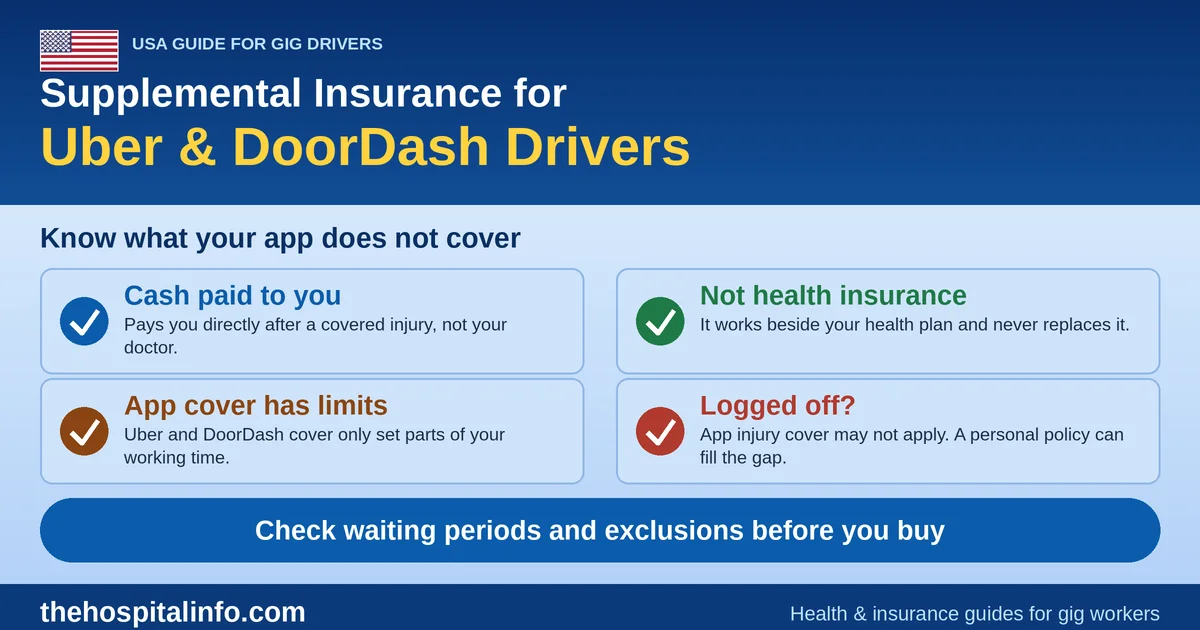
Supplemental insurance pays cash straight to you after an accident or serious illness. It never replaces your health plan. Uber and DoorDash cover you only during set windows, so a standalone policy can fill the gaps. Read each policy’s exclusions before you buy.
Last updated: October 2026
Supplemental Insurance for Uber and DoorDash Drivers Summary (2026-2027)
| Topic | Quick answer |
|---|---|
| What it does | Pays a cash benefit to you after a covered accident or illness. Your health plan pays providers instead. |
| Uber | Optional Injury Protection costs $0.024 per on-trip mile where Uber offers it. California, Massachusetts and Minnesota have Uber-paid occupational accident cover for eligible drivers. |
| DoorDash | Occupational accident cover is automatic during a delivery, with disability pay capped at $500 a week. |
| Instacart | Shopper Injury Protection covers full-service shoppers with medical, disability and survivor benefits. |
| Amazon Flex | Amazon’s policy lists auto liability, UM/UIM and contingent comp and collision. |
| 2026 health plan cap | Marketplace plans limit covered in-network costs to $10,600 for one person ($12,000 in 2027). This is not your deductible. |
| Tax on payouts | Disability benefits may be excluded from income when you pay the whole premium with after-tax dollars, per the IRS. Other cash benefits may need separate review. |
| Claim deadlines | Uber Optional Injury Protection: 20 days. Uber occupational accident claims in Massachusetts and Minnesota: 90 days, in writing. |
Gig Driver Cash Gap Calculator: Could You Cover 30 Days Without Driving?
The tool shows how much cash you would still need after savings and any benefit you actually receive.
| 30-Day Cash Gap Calculator |
| Illustrative estimate only. It ignores when a benefit arrives and any income after 30 days. |
Try $3,200 in bills and $900 in savings, then open the chart in The Hidden Gap section to see how three benefit scenarios change the result.
Table of Contents (tap to open)
- Uber Injury Protection Cost
- Why Health Insurance Alone Falls Short
- What Insurance Gig Drivers Need
- Three Different Coverages: Injury, Liability and Your Car
- Coverage by App Status
- Waiting Period Calculator
- Coverage by State and App
- Supplemental Insurance Options
- Cost and Bronze vs Silver Tool
- Taxes and Payouts
- Policy Trapdoors
- 5 Practical Examples
- How to File a Claim
- FAQ
- Action Checklist and PDF
Uber Driver Injury Protection Cost: What You Pay per Mile
Where Uber offers it, Optional Injury Protection costs $0.024 for each mile you drive on a trip ($0.022 in Washington). Uber says the plan is available in 42 states, so it isn’t everywhere. It stops when you drive for another company or for personal reasons.
| Uber Injury Protection Premium Calculator |
| Count only trip and delivery miles. Rates can change, and Uber notifies enrolled drivers first. |
The Hidden Gap: Why Health Insurance Alone Falls Short for Gig Drivers
Your health insurer pays the hospital. It never replaces your paycheck, and rent doesn’t wait for a broken ankle.
People often mix up the deductible and the out-of-pocket cap. The cap is a yearly limit on what you pay for covered, in-network care, set at $10,600 for one person in 2026. Premiums, services your plan doesn’t cover and most out-of-network bills sit outside it. So a large bill can still drain your savings. Our guide on negotiating hospital bills helps once one arrives, and our best health insurance for Uber, DoorDash and Lyft drivers compares plans.
| Cash Still Missing After About 30 Days Off (USD) | ||||
| No benefit paid | $2,300 | |||
| Partial benefit: $300 a week for 4 weeks | $1,100 | |||
| Maximum benefit: $500 a week for 4 weeks | $300 | |||
| Maximum illustrative benefit, not a guaranteed payout. Assumes $3,200 in bills and $900 in savings. A real payment depends on a covered accident, eligibility, income proof, a waiting period and offsets for other income. | ||||
What Insurance Do Gig Drivers Actually Need in 2026?
Each product solves a different problem, and none replaces another.
| Your problem | Coverage to check |
|---|---|
| Hospital bills | ACA or major medical health insurance |
| Cash after an accident | Accident insurance |
| Months without driving income | Individual disability insurance |
| A hospital stay | Hospital indemnity insurance |
| A serious diagnosis | Critical illness insurance |
| Damage to your own car while working | Delivery-eligible auto or commercial coverage |
Accident vs Disability vs Hospital Indemnity Insurance
Carriers define these products differently, so read the benefit schedule before you compare prices.
| Policy | What triggers it | How it pays | Ask before buying |
|---|---|---|---|
| Accident | A covered injury, such as a fracture or ER visit | Fixed cash amounts from a schedule | Which injuries and treatments qualify? |
| Disability | An injury or illness that stops you from working | Usually a share of reported income, after a waiting period | Elimination period, benefit length and income proof |
| Hospital indemnity | A hospital admission | A fixed amount per stay or per day | Daily amount and maximum days |
| Critical illness | A listed diagnosis | Often a lump sum | Which conditions count? |
Injury Benefits vs Liability vs Your Own Car: Three Different Coverages
A “$1 million” headline can mean medical bills for you, damage you cause to others or neither. Rideshare insurance for Uber Eats drivers and Dashers splits into three separate layers.
| Platform | Injury benefits for you | Liability to other people | Damage to your car |
|---|---|---|---|
| Uber | Up to $1 million medical and up to $500 a week disability with Optional Injury Protection, or Uber-paid occupational accident cover in some states | Separate commercial cover that changes by trip stage. Read Uber’s insurance page. | See Uber’s insurance page and your own policy |
| DoorDash | Up to $1 million medical. Disability pay is 50% of average weekly wage, up to $500 a week, minus other income. Terms apply. | Up to $1 million during an active delivery in most states. Your own policy may pay first. | Not covered by the occupational accident policy |
| Instacart | Up to $1 million for medical expenses, plus disability and survivor benefits | Ask Instacart for current liability terms | Ask Instacart for current terms |
| Amazon Flex | Not listed on Amazon’s safety page. In California, occupational accident cover adds medical benefits and 66% disability pay. | $1 million auto liability and UM/UIM | Contingent comp and collision, subject to terms |
Sources checked October 2026: the platform pages linked above. Policy documents control.
Never read one platform number as one big pool. A $1 million liability limit protects the people you hit, not your ankle.
Does Uber or DoorDash Insurance Cover Me? Coverage by App Status
Your answer changes with the app status and the policy behind it. Our guide on who pays medical bills after a car accident covers the auto side. This table covers injury benefits only.
| App status | Uber with Optional Injury Protection | Uber occupational accident (MA and MN Rides) | DoorDash occupational accident |
|---|---|---|---|
| App off | Not covered | Not covered | Not covered |
| Logged in, no request | Covered if you enrolled and qualify | MA: covered. MN: not covered while you wait. | Not covered. California has separate provisions. |
| Request accepted or on the way | Covered if you enrolled and qualify | Covered | Covered during a delivery, per policy wording |
| Active trip or delivery | Covered if you enrolled and qualify | Covered on Rides trips | Covered, subject to policy terms |
| Delivery or trip complete | Back to the “logged in” row | Back to the “logged in” row | Not covered |
| Personal driving | Not covered | Not covered | Not covered |
Rides and deliveries follow different rules. In Massachusetts, Uber says occupational accident cover applies to Rides, while deliveries use Optional Injury Protection. California and Washington have their own terms, so read each policy document. Sources: Uber injury protection, Uber insurance, DoorDash FAQ. Last verified October 2026.
Waiting Periods Explained: Short Term Disability Elimination Period Calculator
Many disability policies pay nothing during an elimination period. With a seven-day period, the first week brings no money and benefits start on day eight.
| Elimination Period Payout Calculator |
| Illustrative estimate. Some policies pay daily, weekly or monthly, and may cap the benefit period. |
Gig Driver Injury Coverage by State: California, Massachusetts, New York, Washington and Minnesota
Insurance rules vary by state and app platform. While some states require partial coverage, significant protection gaps still remain.
| State | What the rule provides | Effective | Claim notice |
|---|---|---|---|
| California | Uber says occupational accident insurance is paid for by Uber. Prop 22 sets a $1 million medical minimum while you are online. | See sources | Follow the insurer’s instructions |
| Massachusetts | The 2024 attorney general settlement covers Uber and Lyft. Uber pays for occupational accident cover for Rides drivers. | October 1, 2024 | Written notice within 90 days |
| Minnesota | Uber pays for cover for eligible Rides drivers on the way to a pickup and on trips. | January 1, 2025 | Written notice within 90 days |
| Washington | Workers’ compensation can apply to Rides drivers on the way to a pickup and during trips. | See the state source | Ask the state labor department |
| New York | Uber says the Black Car Fund provides workers’ compensation to eligible for-hire drivers. | See the source | Ask the fund or Uber |
Massachusetts drivers can also read our guide to the Massachusetts rideshare health stipend, and New York drivers can check what gig workers pay for health insurance in New York. Washington drivers will find paid sick leave rules for Washington gig workers useful, and California Dashers can see how the DoorDash health stipend in California works.
| State and App Coverage Checker |
| This tool points you to what to check. It does not confirm coverage. Sources: Uber, DoorDash, Amazon Flex, Massachusetts AG. Last verified October 2026. |
California SB 371: Uber UM/UIM Limits Dropped to $60,000
California cut the uninsured and underinsured motorist (UM/UIM) layer that rideshare companies must carry on rides. State law now sets $60,000 per person and $300,000 per incident, and Uber describes the change as starting in 2026. This layer protects people hurt by a driver without enough insurance during a ride. It isn’t a driver’s occupational accident benefit, and it doesn’t run for all your online time.
Supplemental Insurance Options for Independent Contractors: What to Compare
Several carriers and marketplaces sell to self-employed and 1099 workers. Availability and plan details vary by state, and I don’t publish price rankings because premiums depend on your age, health and state.
- Aflac sells accident, critical illness and hospital indemnity policies.
- Stride Health is a marketplace, not a carrier. It lets you compare ACA plans and supplemental options.
- MetLife offers individual disability income policies.
- Combined Insurance builds accident and disability products for people without employer benefits.
Don’t rank them by name. Compare the benefit schedule, waiting period, pre-existing condition rules and whether the policy pays for rideshare or delivery driving.
How Much Does Supplemental Insurance Cost for Gig Workers?
Supplemental insurance premiums vary depending on age, health, benefit amount and carrier. So only a real quote gives you a number. Ask for accident and disability quotes separately, with the same start date.
Estimated Annual Cost Comparison: Bronze Plus Accident vs Silver
A Bronze plan plus an accident policy does not match Silver coverage, because the accident policy pays only for covered events. Silver plans can also carry cost-sharing reductions for some incomes, so use the numbers shown for your own plan. The federal cap covers in-network care, and premiums and non-covered services sit outside it. Our best health insurance in the USA guide covers plan basics. Drivers in Texas, Florida and Illinois can compare local rates in our Texas 1099 health insurance, Florida gig worker health insurance and Illinois 1099 health insurance guides.
| Estimated Annual Cost Comparison |
| Simplified model. It ignores networks and copays, treats the accident benefit as a separate scenario and uses the cap only for covered in-network care. Federal 2026 cap: $10,600 per person. |
Taxes: What the IRS Says About Premiums and Payouts
You can claim standard health premiums through the self-employed health insurance deduction on Schedule 1, not Schedule C. Accident and disability premiums generally don’t fall under that deduction automatically. Whether another deduction applies depends on the policy and your situation.
Disability benefits may be excluded from federal taxable income when you pay the entire premium with after-tax dollars, per the IRS. Employer-paid or pre-tax premiums can change the result, and accident, hospital indemnity and other cash benefits may need a separate tax review.
More tax details (tap to open)
Self-employment tax runs 15.3% on net earnings: 12.4% for Social Security and 2.9% for Medicare. It is a separate calculation from the health insurance deduction.Taking the standard deduction? The IRS says you can’t deduct premiums for policies that replace lost wages or pay a guaranteed weekly amount for sickness, and medical expenses count only if you itemize.Uber takes Optional Injury Protection premiums out of your earnings, so ask a tax professional how to record them. Our guide to the Uber driver health insurance tax deduction and Schedule C walks through the premium deduction step by step, and the 1099 health insurance guide covers other write-offs.Marketplace subsidies use MAGI, which starts from your adjusted gross income. Whether a payout changes it depends on the payout type and how you paid the premium.Keep every 1099, mileage log and expense record organized for Schedule C.
5 Policy Trapdoors to Check Before You Buy
Policy exclusions can void your payout during a claim. So, always read the “Exclusions” section before you buy a policy.
| Trapdoor | Why it matters | Ask this |
|---|---|---|
| Commercial driving exclusion | Some policies skip injuries that happen while you drive for pay | Does it pay for rideshare or food delivery, and for several apps? |
| Pre-existing conditions | An old injury or illness may not qualify | Which conditions are excluded, and for how long? |
| Waiting or elimination period | Benefits can start days or weeks after you stop working | How many days pass before benefits start? |
| Benefit offsets | Another payout can shrink yours | Does another payout reduce mine, and for how long do benefits last? |
| Filing deadline and proof | A late or incomplete claim can lose the benefit | What is the deadline, and which records do you need? |
Also ask whether the benefit is fixed or a share of income, and what the renewal and cancellation terms are.
6 Practical Examples of Gig Driver Injury Coverage
- Waiting period math. A driver breaks a wrist and misses 30 days. With a seven-day elimination period and a $400 weekly benefit, the policy pays for 23 days, about $1,314.
- A partial DoorDash benefit. A Dasher averages $600 a week. DoorDash’s formula gives 50%, or $300 a week, before any reduction for other income.
- Uber premium math. A driver logs 250 trip miles a week. At $0.024 a mile, Optional Injury Protection costs about $26 a month.
- Plan trade-off. On a $12,000 covered bill, the sample Bronze plan leaves $8,850 to pay and the sample Silver plan $5,600. The Bronze premium savings must cover that $3,250 difference first.
- Amazon Flex hit-and-run. Amazon lists UM/UIM in its policy. The driver should ask how it applies before assuming it pays personal medical bills.
- Off-Clock Crash. A car hits the driver from the side on his way home, and he breaks his ankle. He logged off five minutes earlier, so the app’s injury policy may not apply. Six weeks without income and a $7,500 deductible follow. Depending on the policy, a covered fracture could trigger a cash benefit for rent and bills, though the amount and eligibility depend on the policy’s terms.
All six are hypothetical. Real payments depend on policy terms.
How to File a Gig Driver Injury Claim
Deadlines differ by policy, so match yours to the right row. Start with the basics, then use the channel for your platform.
| Step | What to do |
|---|---|
| 1. Get care and records | Keep discharge papers and itemized bills with diagnosis codes. |
| 2. Report in the app | Report the crash the same day. |
| 3. Contact the right insurer | Use the channel in the next table. |
| 4. Send proof | Add the police report, ID and earnings statements. Ask the insurer how many weeks of earnings it wants. |
Where to File: DoorDash and Uber
| Policy | Where and when |
|---|---|
| DoorDash occupational accident | File with Blue Star Claims: online at bluestarclaims.com, by phone at (480) 579-2405 (24/7) or by email at DDintake@bluestarclaims.com. DoorDash’s FAQ lists no filing deadline, so file promptly and keep your claim number. |
| Uber Optional Injury Protection | Call Atlantic Specialty Insurance Company at 1-844-747-6221 within 20 days of the injury. This number applies to Optional Injury Protection only. Uber Support does not handle these claims. |
| Uber occupational accident (MA and MN) | Submit written notice of the loss within 90 days of the accident through Uber’s online form. |
| Uber in California or Washington | Follow the claim steps Uber shows for your state and your policy. Don’t assume the 20-day or 90-day rule applies. |
Claim documents checklist (tap to open)
- Date, time and place of the accident
- Screenshots of your app status and the trip or delivery ID
- Police or accident report
- Medical records and itemized bills
- Earnings history, such as 1099 forms and weekly summaries
- Insurer forms and the contact you spoke with
- Your notice deadline, written on a calendar
The documents and deadlines change by policy, so ask the insurer for its list. Our PDF checklist includes a deadline tracker.
What to do if the insurer denies your claim (tap to open)
- Ask for the denial in writing, with the reason.
- Compare that reason with your policy wording.
- Gather records that answer it, such as medical notes and earnings proof.
- Follow the insurer’s appeal steps and keep every deadline.
- If the insurer won’t budge, contact your state insurance department.
Frequently Asked Questions (FAQ)
Does DoorDash insurance cover me if I’m logged in but haven’t accepted an order?
Show answer
DoorDash’s occupational accident policy covers Dashers while they make a delivery, so signed-in time without an order generally falls outside it. California has separate provisions, so check the schedule of benefits.
Does Uber Optional Injury Protection cover me while waiting for a ride or delivery request?
Show answer
Uber says enrolled and eligible drivers are covered while online, on the way to a pickup and on a trip. Uber charges the premium only on trip or delivery miles, which isn’t the same as when cover applies.
Will DoorDash or Uber pay to repair my car after an accident?
Show answer
Treat three coverages separately. DoorDash’s injury policy does not cover your vehicle, and liability insurance protects other people. For Uber, read its insurance page for comprehensive and collision eligibility and deductibles.
Does Uber insurance cover me when I am offline?
Show answer
Uber’s injury cover applies to trips, deliveries and certain online periods, not personal driving. Your own auto and health policies still apply offline, and rules vary by state.
What happens if I drive for Uber and DoorDash at the same time?
Show answer
Each plan covers only its own platform. Uber’s plan doesn’t apply when you work for another company, and DoorDash’s policy covers DoorDash deliveries only.
Do I need commercial auto insurance for DoorDash or Uber Eats?
Show answer
Not always, but many personal auto policies exclude delivery or rideshare use. Ask your insurer about a delivery endorsement or a business-use policy.
What is the difference between occupational accident insurance and workers’ compensation?
Show answer
Occupational accident insurance is a private policy a company buys. Workers’ compensation comes from state law, and rules differ by state, such as Washington’s rules for Rides drivers. Benefits and eligibility aren’t the same.
What documents do I need to file an occupational accident claim?
Show answer
Expect to send medical records, an accident report, app screenshots, the delivery or trip ID and earnings proof, plus the insurer’s forms. The claim documents checklist above lists them, and deadlines depend on the policy.
Does supplemental accident insurance pay if another driver caused the crash?
Show answer
Many fixed-benefit accident policies pay for a covered injury whoever caused the crash, but wording decides. Platform insurance follows different claim rules, so read both.
Does DoorDash or Uber injury protection pay if I get sick and cannot work?
Show answer
No. Both are built for accident injuries. Disability or critical illness policies may help with illness, depending on their terms.
How much disability insurance can a self-employed delivery driver qualify for?
Show answer
Carriers usually base the benefit on reported income, then apply underwriting, an elimination period and policy limits. Keep combined earnings records from every app.
Can I get supplemental insurance if I have Medicaid or an ACA plan?
Show answer
Yes, a supplemental policy can sit beside either. Check what your current plan already pays, and ask your state Medicaid agency how a cash benefit counts for your program.
Can supplemental insurance pay my rent while I recover?
Show answer
It pays cash to you, not your doctor, so you can use it for rent. Whether it pays at all depends on the covered event and policy terms.
What happens if my insurance claim is denied?
Show answer
Ask for the reason in writing, compare it with your policy and appeal with better records. The denial section above lists the steps.
Are accident insurance benefits taxable for self-employed drivers?
Show answer
Disability benefits may be excluded when you paid the whole premium with after-tax dollars, per the IRS. Accident and hospital indemnity benefits may need a separate review, so ask a tax professional.
Can I deduct supplemental insurance premiums if I take the standard deduction?
Show answer
The IRS lets you include medical premiums only if you itemize, and it excludes premiums for policies that replace lost wages or pay a guaranteed weekly amount. So most gig drivers can’t deduct accident or disability premiums.
Do payouts affect government assistance or ACA subsidies?
Show answer
Subsidies start from MAGI, and tax-free payouts generally stay out of income. Other assistance programs set their own rules, so ask your caseworker.
Does supplemental insurance cover me if Uber or DoorDash deactivates my account while I’m injured?
Show answer
A personal policy typically doesn’t depend on your app account, but check its wording. Platform cover ends when your account no longer lets you work, so a personal plan matters more.
Action Checklist to Pick the Right Supplemental Insurance for Uber Drivers
- Check your health plan. Find your deductible and out-of-pocket maximum.
- Add up monthly bills. Rent, car, insurance, groceries and childcare set your income need.
- Reread your platform terms. Know when coverage starts and stops in your state.
- Request separate quotes. Price accident and disability policies side by side.
- Save your records. Keep every 1099, earnings summary and receipt in one folder.
Free download: Printable Gig Driver Supplemental Insurance Checklist (PDF)
Think About Supplemental Insurance
You didn’t start driving to end up broke over a broken wrist. Spend five minutes today comparing your plan’s deductible with an accident or disability quote. It might be the difference between paying rent on time and falling behind.
About This Guide
Nurul Islam Chowdhury, ACMA, is an Associate Member of ICMAB (Membership No. A-1607). He holds a BBA and an MBA from the University of Chittagong. He focuses on financial planning, policy analysis and risk assessment, and turns insurance and tax rules into plain advice for independent contractors.
How We Verified This Guide
Last verified October 2026. We checked platform figures against pages from Uber, DoorDash, Instacart and Amazon Flex. We checked tax points against IRS pages, the health plan cap against HealthCare.gov, Massachusetts rules against the state attorney general and California SB 371 against the state code. Policies change often, and some rules vary by state, so confirm current terms with each carrier.
Disclaimer: This article is general education only. It is not tax, legal or insurance advice. Insurance terms, premiums and platform policies change often. Confirm details with the carrier or platform and consult a licensed agent or tax professional.

Hi, I’m Nurul Islam Chowdhury (Imran) — the person behind HospitalInfo.
Associate Member, Institute of Cost and Management Accountants of Bangladesh (ICMAB – Associate Member No: A-1607)
Nurul Islam Chowdhury (Imran) holds a Bachelor of Business Administration (BBA) and a Master of Business Administration (MBA) from the University of Chittagong. As a qualified Cost and Management Accountant (CMA), he specializes in financial analysis, cost management, and tax structures. Every piece of tax and financial data in this article has been personally reviewed and fact-checked by him to ensure technical and calculation accuracy based on standard IRS guidelines and 2026 regulations.
My background is in finance and cost management, but for the past few years my real focus has been something more personal: helping everyday Americans make sense of health insurance and hospital bills.
Here’s the thing about healthcare costs in the US — they’re confusing on purpose, or at least it feels that way. A single ER visit can turn into a stack of paperwork nobody explains clearly. That’s the gap I try to fill on this site. I dig into how PIP and MedPay actually work, what happens when health insurance and auto insurance both claim to cover the same bill, how to negotiate a hospital statement instead of just paying it, and how coverage options change year to year.
I’m not a doctor, and I don’t pretend to be. What I bring is a finance-and-numbers lens — reading policy documents, tracking CMS and state-level rules, and translating them into something you can actually use before you’re stuck on the phone with an insurance rep. Every guide here starts from a real question people are Googling at 11 PM with a bill in front of them, and that’s still how I decide what to write next.