Illinois 1099 Health Insurance Guide in 2026–2027: Rates, Subsidies & Tax Deductions
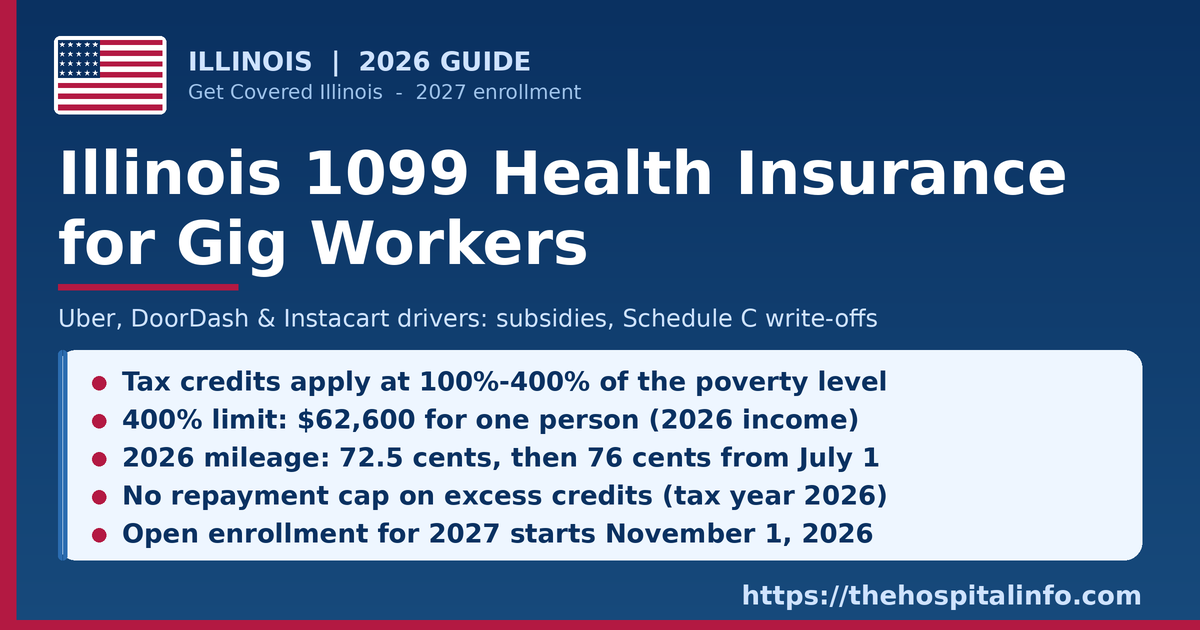
Illinois gig workers can cut their Illinois gig worker health insurance bill by claiming every legitimate Schedule C deduction. A smaller net profit means a lower MAGI, and a lower MAGI can raise your premium tax credit on Get Covered Illinois.
Illinois 1099 Health Insurance Summary
| Topic | Answer |
|---|---|
| Where to enroll | Get Covered Illinois |
| 2027 open enrollment | Starts November 1, 2026; scheduled to end January 15, 2027 |
| Income range for tax credits | For most applicants, 100% to 400% of the poverty level; limited exceptions apply below 100%. Single adult: $62,600 on 2026 income |
| Income that counts | Net profit after business expenses, not gross pay |
| 2026 mileage rate | 72.5 cents through June 30, then 76 cents |
| Repayment cap | None for tax year 2026 |
| Premium deduction | Form 7206, reported on Schedule 1 of Form 1040 |
| 2026 HSA limit | $4,400 self-only; $8,750 family |
| Insurers leaving | Cigna and Molina, after December 31, 2026 |
Illinois Health Insurance Subsidy Calculator for 1099 Workers
The meter below shows how close you are to reaching the 400% line.
| Illinois Gig Worker Subsidy Estimator |
| Enter your numbers above and tap the button. |
| Planning tool, not an official eligibility determination. It uses a simplified self-employment tax calculation, so it may over- or under-estimate MAGI for workers with high self-employment income or other Social Security-taxed wages. It also ignores the self-employed health insurance deduction, and 2027 results are estimates. |
Disclaimer
- It does not decide your official premium tax credit eligibility.
- It does not find the exact second-lowest-cost Silver plan in your ZIP code.
- It does not fully handle complex self-employment tax situations.
- It does not replace the Get Covered Illinois eligibility determination.
Eligibility Criteria?
- You live in Illinois and are a citizen, national, or lawfully present.
- For most applicants, household income falls between 100% and 400% of the poverty level. Limited exceptions apply below 100%, mainly for some lawfully present immigrants.
- You are not eligible for Medicaid or an affordable employer plan.
- You file a federal return and file with Form 8962.
Who May Not Qualify?
- Households above 400% of the poverty level.
- People eligible for Medicaid, or for an affordable employer plan that meets minimum value.
- People enrolled in Medicare, and most married people filing separately.
- From 2027, some lawfully present immigrants, such as people with Temporary Protected Status, lose tax-credit access.
Table of Contents (tap to open)
- Subsidy Calculator
- Income Projector
- Why Premiums Are Rising
- Illinois Insurers
- City and County Hospital Checker
- ZIP Code Search
- Premium Factors
- How MAGI Works
- Income Limits
- Spouse Coverage
- Schedule C Write-Offs
- Chicago Comparison
- Naperville, Rockford, Springfield
- HSA and Bronze Plans
- Premium Deduction
- Short-Term Plans
- Bronze, Silver, Gold
- Accident Coverage
- Enrollment Dates
- Income Changes
- Checklist
- Claim Problems
- Support Channels
- FAQs
Income Projector: Where Will Your Year End?
Fluctuations like lower income in spring and higher earnings in December can push your income over the 400% line. Enter your net income so far and the number of months worked to estimate your total yearly income.
| Mid-Year Income Projector |
| Enter what you have netted so far and tap the button. |
Illinois Health Insurance Cost in 2026 – 2027?
In 2026, the IRS strictly caps Marketplace premium tax credits at 400% of the federal poverty line. Insurers also raised Illinois rates an average 30.1% for 2026. Illinois launched its own marketplace, Get Covered Illinois, for 2026.
| Illinois Marketplace Snapshot | Figure |
|---|---|
| 2026 plan selections during open enrollment | 448,568 |
| Average monthly subsidy (enrollees with advance credits) | $688 |
| Average monthly premium after subsidy (same group) | $142 |
| Enrollees paying under $10 a month | 22% |
| Initial proposed 2027 increases, continuing insurers | 9.2% to 14.9% Proposed – Not Final |
Note: This range excludes Molina’s 1.8% filing, as Molina is exiting the market after December 31, 2026. Driving for Uber, DoorDash, or Lyft? Read our best health insurance for Uber, DoorDash and Lyft drivers guide.
Illinois Health Insurance Companies List
Five of seven insurers continue in 2027, while Cigna and Molina leave after December 31, so anyone on those plans must pick a new one.
No insurer sells everywhere. Premiums vary by county, age, household size, and tobacco use.
Illinois Health Insurance by City and County: Chicago, Naperville, Rockford
| City Hospital Checker |
| Choose a city to see the hospitals and systems to check. |
| City | County | Hospitals to Check | Local Detail to Verify |
|---|---|---|---|
| Chicago | Cook | Northwestern Medicine, Rush, UChicago Medicine | A hospital can be in network while your specialist is not, so look up both. |
| Naperville | DuPage and Will | Endeavor Health Edward Hospital | Edward serves both counties, so the county on your address matters. |
| Aurora | Kane and nearby counties | Rush Copley Medical Center | Aurora spills over several county lines, so your ZIP decides which plans you see. |
| Joliet | Will | Prime Healthcare Saint Joseph Medical Center | Older directories may still list a former name. |
| Rockford | Winnebago | OSF Saint Anthony, UW Health SwedishAmerican, Mercyhealth Javon Bea | Plans may include only some of these systems. |
| Springfield | Sangamon | Springfield Memorial Hospital, HSHS St. John’s Hospital | Look for both hospitals in every plan you compare. |
| Peoria | Peoria | OSF Saint Francis Medical Center, Carle Health Methodist Hospital | Methodist may still appear as UnityPoint in old directories. |
| Champaign | Champaign | Carle Foundation Hospital | The main hospital sits in Urbana. |
| Waukegan | Lake | Northwestern Medicine Lake Forest, Advocate Condell | Both hospitals are just outside Waukegan, so read the network before you pick. |
| Crystal Lake | McHenry | Northwestern Medicine McHenry Hospital | Formerly Centegra; old directories may use that name. |
Find Illinois Health Insurance Plans by ZIP Code
Plan options and premiums depend on your residential county and ZIP code, not where you drive. Your home ZIP code and county shape the plans, prices, and networks you see, and Cook, DuPage, Lake, Will, Kane, McHenry, Winnebago, Peoria, Sangamon, and Champaign counties can all differ. Enter your ZIP on Get Covered Illinois before you compare anything.
What Affects Your Illinois Health Insurance Premium?
Networks vary by plan. So open each provider directory before you enroll. Your health insurance premium depends on only a few factors: (1) your age, (2) your ZIP code and county, (3) tobacco use, (4) household size, and (5) the plan’s metal tier
How MAGI Works for Self-Employed Health Insurance in Illinois
For self-employed workers, Marketplace income generally starts with net profit, not gross 1099 receipts. Your modified adjusted gross income, or MAGI, is your adjusted gross income plus a few add-backs. Eligible business expenses reduce your profit, and that lowers the income used for Marketplace help.
| Income Item | MAGI Treatment |
|---|---|
| Net Schedule C profit | Counts, after business expenses |
| W-2 wages, unemployment, and other household income | Generally included when they apply to the tax household |
| Half of self-employment tax | Subtracted |
| HSA, SEP-IRA, or Solo 401(k) contributions | Subtracted, if eligible |
| Tax-exempt interest | Added back |
| Social Security benefits | Taxable part counts; nontaxable part added back |
The IRS applicable percentage table below sets how much of your income goes toward a Standard Silver plan. The credit covers the rest.
| Income as % of Poverty Level | 2026 Share of Income | 2027 Share of Income |
|---|---|---|
| Under 133% | 2.10% | 2.15% |
| 133% to under 150% | 3.14% to 4.19% | 3.23% to 4.30% |
| 150% to under 200% | 4.19% to 6.60% | 4.30% to 6.78% |
| 200% to under 250% | 6.60% to 8.44% | 6.78% to 8.66% |
| 250% to under 300% | 8.44% to 9.96% | 8.66% to 10.22% |
| 300% to 400% | 9.96% | 10.22% |
| Over 400% | No premium tax credit | |
Illinois Income Limits for Subsidies: 2026 vs. 2027
The Marketplace uses last year’s poverty guidelines: 2025 figures for 2026 coverage, 2026 figures for 2027.
| Household Size | 400% Line, 2026 Coverage | 400% Line, 2027 Coverage |
|---|---|---|
| 1 person | $62,600 | $63,840 |
| 2 people | $84,600 | $86,560 |
| 3 people | $106,600 | $109,280 |
| 4 people | $128,600 | $132,000 |
Spouse Has Employer Health Insurance? How It Affects Your Tax Credit
An affordable job offer that meets minimum value can make the employee ineligible for the premium tax credit, even if they decline it. For 2026, affordable means the employee’s self-only share costs 9.96% of household income or less. For 2027, the IRS raises that limit to 10.22%. Minimum value means the plan covers at least 60% of costs.
For an employee, affordability generally uses the self-only premium. For a spouse or dependent, the test uses the employee’s share of the family premium. So if your spouse has a job offer, price the family option before you assume your credit is gone.
Schedule C Tax Write-Offs for Uber, DoorDash, and Instacart Drivers
You can deduct actual business costs which are ordinary, necessary, and properly documented. Only claim legitimate expenses to lower your MAGI.
Mileage Deduction: 72.5 vs. 76 Cents Per Mile
The IRS set the 2026 rate at 72.5 cents per mile, then raised it to 76 cents for miles driven July 1 through December 31. Your mileage log needs dates: an October run to O’Hare earns the higher rate.
Phone, Supplies, Tolls, Parking, and Car Washes
Deduct the business share of your phone bill. Illinois Tollway charges and trip parking are deductible on top of the mileage rate. Car washes qualify only under the actual-expense method, since the mileage rate already covers upkeep.
Records That Hold Up
Log each trip’s date, route, and purpose. The IRS Gig Economy Tax Center collects the official rules for gig workers.
Chicago Uber Driver Health Insurance Cost: A Real-Number Comparison
Two hypothetical single drivers each gross $58,000 in 2026, with a $600 Standard Silver premium for illustration. The math uses the 2026 applicable percentages and the 2025 poverty guideline of $15,650.
| Metric | Driver A (No Mileage Log) | Driver B (Full Records) |
|---|---|---|
| Gross 1099 earnings | $58,000 | $58,000 |
| Documented deductions | $5,000 | $25,275 |
| Net Schedule C profit | $53,000 | $32,725 |
| Estimated MAGI | $49,256 | $30,413 |
| Percent of poverty level | 315% | 194% |
| Estimated monthly premium credit | $191 | $440 |
| Estimated monthly cost of Standard plan | $409 | $160 |
Monthly Cost of the Same $600 Standard Plan
Note: Driver B logged 15,000 miles at the 72.5-cent rate and 15,000 at the 76-cent rate ($22,275) plus $3,000 in expenses. Estimates come before the self-employed health insurance deduction.
By properly documenting your actual business expenses, you can save $249 a month—which is around $3,000 a year.
Illinois 1099 Health Insurance Examples: Naperville, Rockford, Springfield
Naperville. A full-time DoorDash driver nets $68,000, putting her MAGI near $63,196, which is $596 over the 400% line. She gets no credit. After she finds $700 in missed tolls and phone costs, her MAGI drops to about $62,545. On a $600 standard plan, that earns roughly $81 a month in savings.
Rockford. A part-time Instacart shopper’s gross income is $24,000. After deducting eligible expenses, her MAGI comes to approximately $17,500, which is around 112% of the federal poverty level. Illinois expanded Medicaid, so adults below 138% (about $22,000 for one person) may qualify. She should ask the state first.
Springfield. A driver also earns $14,000 at a seasonal W-2 job. Both incomes count toward MAGI, so forgetting the W-2 job can mean owing money back at tax time.
HSA for Self-Employed Illinois Workers: Can Bronze Plans Qualify?
Since January 1, 2026, Bronze and catastrophic Exchange plans can be treated as HSA-compatible for eligible individuals. The 2026 limit is $4,400 for self-only coverage and $8,750 for family coverage. Contributions lower your AGI and can raise your credit.
Self-Employed Health Insurance Deduction: Form 7206 and Schedule 1
Self-employed people can deduct health premiums above the line. Use Form 7206 to calculate the allowable deduction, then report it on the applicable line of Schedule 1 of Form 1040 for the tax year you are filing.
Three limits apply. The deduction cannot exceed your net business profit, excludes months you could join a subsidized employer plan (including a spouse’s), and shrinks by any premium tax credit you claim.
It reduces income tax, not self-employment tax. Illinois starts from federal AGI, so the deduction generally carries through. The credit and the deduction depend on each other, and IRS Publication 974 shows how to solve the circular math.
Short-Term Health Insurance in Illinois: Is It Still Allowed?
No. Illinois law bars insurers from issuing, delivering, amending, or renewing short-term, limited-duration plans for residents on and after January 1, 2025. For ACA-compliant individual coverage and premium tax credits, Get Covered Illinois is the main route.
Bronze vs. Silver vs. Gold Health Plans in Illinois
| Tier | Plan Pays on Average | Premium | Deductible |
|---|---|---|---|
| Bronze | About 60% | Lowest | Highest |
| Silver | About 70% | Moderate | Moderate |
| Gold | About 80% | Higher | Lower |
Extra Silver cost-sharing help applies at or below 250% of poverty.
- Choose Bronze for the lowest premium, low expected medical use, or an HSA strategy.
- Consider Silver if your income qualifies for cost-sharing reductions.
- Consider Gold if you see doctors often and want lower out-of-pocket exposure.
Your credit is sized to the standard Silver plan, and everyone owes at least 2.10% of income toward it in 2026. So a $0 premium usually means Bronze or another cheaper plan.
Do Uber and DoorDash Provide Health Insurance? Accident Coverage Explained
| Feature | Marketplace Plan | App Accident Policy |
|---|---|---|
| Illness and routine care | Covered | Not designed for it |
| Injuries on the job | Covered | Covered during active work, with limits |
| Premium tax credit | Yes | No |
Terms vary by app; DoorDash’s accident policy FAQ is one example.
More reading: supplemental insurance for gig drivers.
Get Covered Illinois Open Enrollment 2027 Dates
| Date | What Happens |
|---|---|
| November 1, 2026 | Open enrollment begins |
| December 15, 2026 | Usual deadline for a January 1 start (last year the state extended it to December 31) |
| December 31, 2026 | Cigna and Molina coverage ends |
| January 15, 2027 | Scheduled end of open enrollment |
Note: Official dates are subject to change. So confirm on the official marketplace (Get Covered Illinois) before enrolling.
What If Your 1099 Income Changes Mid-Year?
Holiday weeks can double a delivery driver’s pay. Update your income within 30 days of a big change, and re-run the projector above when your pace shifts.
Everyone must repay excess advance credits, and there is no repayment cap for 2026. Out of state? See New York gig worker costs or Texas 1099 coverage.
Illinois 1099 Health Insurance Printable Checklist
| Illinois 1099 Health Insurance Checklist |
Prefer a file for your phone or your car’s glovebox? Download the Illinois 1099 health insurance checklist (PDF). New to plan types? Read our 1099 health insurance guide.
Common Health Insurance Claim Problems and How to Appeal in Illinois
- Out-of-network care: Your plan may pay less or nothing, so check the directory first.
- Missing prior authorization: Some services need approval first.
- Deductible not met: You may owe more until you reach it.
- Billing or coding errors: Check bills against your Explanation of Benefits, and ask the state for help if they do not match.
If your insurer denies a claim, start with an internal appeal. Illinois also offers independent external review through the Office of Consumer Health Insurance.
Direct Support Channels If Something Goes Wrong
| Problem | Official Help |
|---|---|
| Marketplace application, enrollment, or credit | Get Covered Illinois, 1-866-311-1119. Free local help is available. |
| Health insurance complaint, appeal, or external review | Illinois Department of Insurance, 877-527-9431; external review line 877-850-4740 (IDOI) |
| Medicaid or All Kids | Illinois Department of Healthcare and Family Services |
| Federal tax or Form 8962 question | IRS, 1-800-829-1040 |
Illinois 1099 Health Insurance FAQs
Can Chicago gig workers get $0 premium health insurance?
Show answer
Can I get health insurance if my 1099 income changes every month?
Show answer
Is health insurance 100% tax-deductible for Uber drivers in Illinois?
Show answer
Can Illinois Uber drivers qualify for Medicaid?
Show answer
How does 1099 mileage deduction lower my health insurance premium in Illinois?
Show answer
What happens if my 1099 income exceeds 400% FPL at tax time in 2026?
Show answer
Can I switch from Cigna or Molina to another plan on Get Covered Illinois?
Show answer
Reviewed for 2026: October 2026. Primary sources: IRS, CMS, Get Covered Illinois, Illinois Department of Insurance. Last verified: October 2026.
Disclaimer: This guide is educational, not tax, legal, or insurance advice. The author is not a U.S.-licensed insurance agent or tax preparer. Figures reflect October 2026 sources, and proposed 2027 rates may change.

Hi, I’m Nurul Islam Chowdhury (Imran) — the person behind HospitalInfo.
Associate Member, Institute of Cost and Management Accountants of Bangladesh (ICMAB – Associate Member No: A-1607)
Nurul Islam Chowdhury (Imran) holds a Bachelor of Business Administration (BBA) and a Master of Business Administration (MBA) from the University of Chittagong. As a qualified Cost and Management Accountant (CMA), he specializes in financial analysis, cost management, and tax structures. Every piece of tax and financial data in this article has been personally reviewed and fact-checked by him to ensure technical and calculation accuracy based on standard IRS guidelines and 2026 regulations.
My background is in finance and cost management, but for the past few years my real focus has been something more personal: helping everyday Americans make sense of health insurance and hospital bills.
Here’s the thing about healthcare costs in the US — they’re confusing on purpose, or at least it feels that way. A single ER visit can turn into a stack of paperwork nobody explains clearly. That’s the gap I try to fill on this site. I dig into how PIP and MedPay actually work, what happens when health insurance and auto insurance both claim to cover the same bill, how to negotiate a hospital statement instead of just paying it, and how coverage options change year to year.
I’m not a doctor, and I don’t pretend to be. What I bring is a finance-and-numbers lens — reading policy documents, tracking CMS and state-level rules, and translating them into something you can actually use before you’re stuck on the phone with an insurance rep. Every guide here starts from a real question people are Googling at 11 PM with a bill in front of them, and that’s still how I decide what to write next.