New York Gig Worker Health Insurance Cost in 2026: What You’ll Pay and How to Save
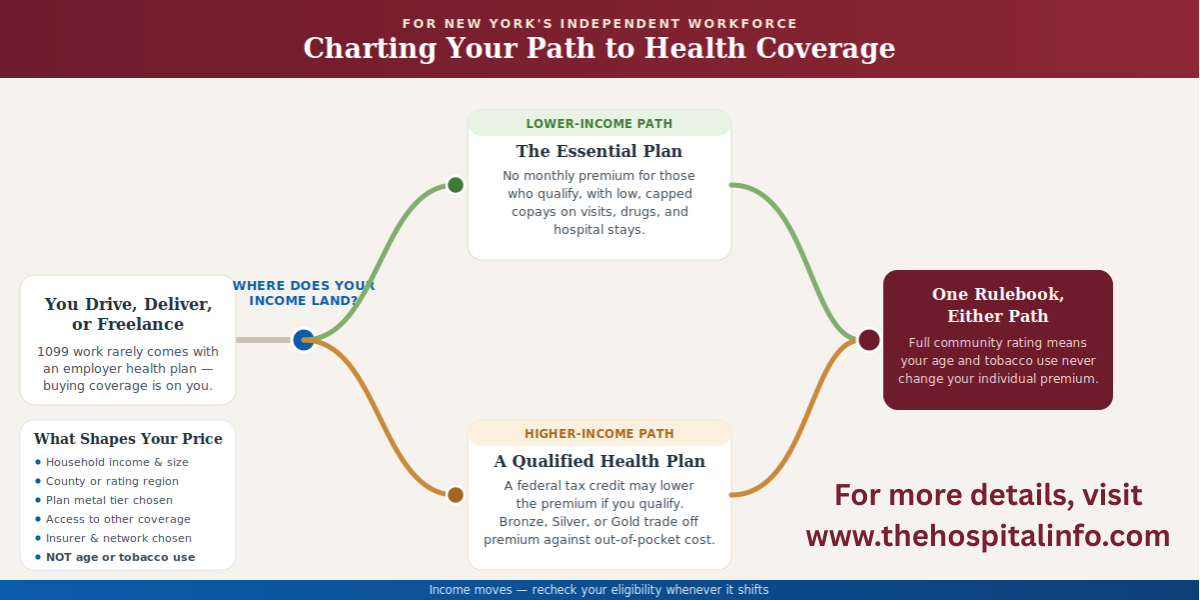
Unlike many W-2 jobs, 1099 work usually does not come with employer-sponsored health coverage. There’s no HR department to walk you through open enrollment. If you drive for Uber, deliver for DoorDash, or freelance across the five boroughs, buying health coverage is largely on you.
This guide explains what gig workers in New York actually pay for health insurance this year. It covers the two policy shifts behind the jump, along with a verified Essential Plan copay breakdown, an interactive income estimator, and the self-employed health insurance tax deduction.
Last updated: September 2026. Reviewed against current NY State of Health, NY Department of Health, NY Department of Financial Services, and IRS guidance.
Quick Summary: What NY Gig Workers Need to Know for 2026
- Single adults earning up to $31,920 (200% FPL) may qualify for the Essential Plan. If eligible, the monthly premium is $0.
- Above that, you’d shop for a Qualified Health Plan. A federal premium tax credit may reduce the premium — generally available up to about $62,600 for a single person.
- New York rolled the Essential Plan’s income ceiling back from 250% to 200% FPL on July 1, 2026. The change affected roughly 450,000 people, according to the NY State Department of Health.
- New York uses full community rating — your age and tobacco use do not affect your individual-market premium.
- Self-employed New Yorkers may be able to deduct eligible health insurance premiums using IRS Form 7206.
- Use the free income estimator below for a ballpark figure. Then get your real, personalized number at NY State of Health.
📋 Table of Contents
- Why Your 2026 Premium Looks Different
- How Many New Yorkers This Actually Touches
- What Health Insurance Actually Costs in NY in 2026
- Example: A Single Gig Worker Earning $40,000
- 2026 Coverage Path Examples by Income
- What Determines Your Actual Premium?
- Essential Plan Copay Breakdown (Verified)
- Essential Plan vs. Bronze vs. Silver
- Quick Check: Estimate Your Own Business Income
- Does Your Borough or County Change the Price?
- Lost Essential Plan Eligibility? What To Do Next
- Where to Actually Buy Coverage
- Self-Employed Health Insurance Tax Deduction
- Ways to Reduce Your Health Insurance Cost
- Frequently Asked Questions
Why Your 2026 Premium Looks Different
Two separate policy changes affected New York Marketplace coverage during the same twelve-month period.
Federal Premium Tax Credits Expired
The enhanced federal premium tax credits had kept Marketplace coverage more affordable for millions of independent workers. Those credits expired on December 31, 2025. Congress created them under the American Rescue Plan Act in 2021. Lawmakers extended them through the Inflation Reduction Act, but did not renew them before the deadline.
Coverage purchased for 2026 now runs on the older, less generous credit formula. NY State of Health warned this would push premiums higher for subsidized consumers.
New York’s Essential Plan Rolled Back.
New York State recently scaled back the free, $0-premium Essential Plan. Federal funding shifts ended the state’s temporary expansion to 250% FPL, leading New York to cap the program back at its original 200% FPL limit on July 1, 2026.
The New York State Department of Health confirmed that roughly 1.3 million residents earning under 200% FPL keep their $0-premium coverage. However, about 450,000 New Yorkers earning between 200% and 250% FPL lost eligibility. Most now qualify for Qualified Health Plans, where monthly premiums and out-of-pocket costs are higher.
This shift directly impacts gig workers whose 1099 income shifts above the 200% mark from year to year. See what to do if this affects you.
How Many New Yorkers This Actually Touches
Unlike many W-2 jobs that may offer employer-sponsored coverage, 1099 work generally does not include an employer health plan. You might have coverage available through a spouse’s job, Medicaid, Medicare, or another program. If so, your options are broader than what’s described here.
This guide focuses on the common case where Marketplace coverage is your primary path. If you’re a gig worker in New York, your 2026 health insurance cost depends mainly on your income, household size, and plan choice. It also depends on your eligibility for financial assistance — not on your occupation. If rideshare driving is your main gig, check our separate guide to health insurance for Uber, DoorDash, and Lyft drivers. It walks through app-based stipends that sometimes stack on top of Marketplace coverage.
What Health Insurance Actually Costs in NY in 2026
Your monthly health insurance cost depends heavily on where your income lands relative to the federal poverty level (FPL). Household size, rating region, plan tier, and access to other coverage also factor in. For a quick estimate, think of 2026 coverage in three broad income ranges. The actual premium tax credit calculation uses a more detailed sliding scale, but these ranges give you a starting point.
What a 2026 NY Health Insurance Premium Can Look Like
Exact premiums require a personalized quote based on your county and household size. Still, state data from the NY Department of Financial Services and NY State of Health shows what single filers at different income tiers generally face in 2026:
| Single Adult Scenario | Reported Income | Coverage Path | Estimated Monthly Premium |
| Driver A | Up to $31,920 | Essential Plan | $0 / month if eligible ($0 deductible) |
| Driver B | $40,000 | Qualified Health Plan (QHP) | Personalized quote required; PTC may reduce the premium |
| Driver C | Above $62,600 | Full-Pay QHP | Unsubsidized full rate (varies by region & metal tier; check NYSOH quote) |
Statewide context, not a personal quote: New York projected the average monthly premium for subsidized Marketplace enrollees to rise to about $414 after enhanced federal credits expired. This is a statewide average, not what any specific $40,000 earner will pay. To see your exact monthly premium with federal tax credits applied, get a personalized quote at NY State of Health.
Below 200% FPL — the Essential Plan
For a single adult, that means annual income up to $31,920 in 2026, with a $0 monthly premium if eligible. It’s one of the lowest-cost coverage options available in New York.
Because gig income moves month to month, recheck your eligibility every time you report new earnings. The tier you qualified for last year isn’t guaranteed this year.
Above the Essential Plan Limit — Qualified Health Plans
If your income is above the Essential Plan limit, you may qualify for a Qualified Health Plan. If otherwise eligible, you may also get a federal premium tax credit. The enhanced premium tax credits that applied through 2025 are no longer available. The 2026 premium tax credit uses the regular statutory formula under Internal Revenue Code Section 36B.
Whether you qualify, and for how much, depends on household size and tax-filing status. It also depends on access to affordable employer coverage through a spouse — not on income alone. Bronze plans generally carry lower premiums and higher out-of-pocket costs. Silver and Gold plans generally carry higher premiums and lower cost-sharing.
Quick Reference: 2026 Income and Coverage Path
| 2026 Single-Person Income | Possible Coverage Path |
| Up to $31,920 | Essential Plan may be available ($0 premium) |
| $31,921 – $62,600 | Qualified Health Plan; federal premium tax credit may be available if otherwise eligible |
| Above $62,600 | Qualified Health Plan; federal premium tax credit generally unavailable |
Note: NY uses 2026 guidelines for the Essential Plan, while federal tax credits rely on 2025 FPL standards per IRS rules. Actual eligibility depends on household size, tax-filing status, and other criteria — confirm your exact numbers at NY State of Health.
Example of this for two single filers: a gig worker with $30,000 in reported income falls under the Essential Plan limit. If otherwise eligible, their monthly premium is $0, with copays as shown in the table below. A gig worker with $45,000 in reported income falls above the Essential Plan limit and below the premium-tax-credit ceiling. They’d shop for a Qualified Health Plan and may qualify for a premium tax credit.
What About a Single Gig Worker Earning $40,000?
A single gig worker earning $40,000 falls into the middle-income bracket — exceeding eligibility for the $0-premium Essential Plan but remaining under the threshold for federal subsidies. Depending on household size and coverage access, they may qualify for a Premium Tax Credit under IRS rules to lower Qualified Health Plan (QHP) costs. Exact pricing requires a personalized quote via NY State of Health, as the statewide $414 figure is only a projected average.
Because New York enforces full community rating in its individual market, insurers cannot adjust premiums based on age, gender, occupation, health status, or tobacco use.
Note: If you plan to open a Health Savings Account, verify that your chosen Bronze or Silver plan is officially HSA-eligible before enrolling.
Coverage Path Examples by Income in 2026
The table below maps common income scenarios to a likely coverage path. It does not show actual dollar premiums, since real QHP premiums vary by county, age, and carrier. For an exact number, use the NY State of Health quote tool linked in each row’s coverage path.
What Determines Your Actual Premium?
The following factors play an important role in determining your premium:
What the Essential Plan Actually Charges You
Monthly premium isn’t the only number that matters. If you qualify for the Essential Plan, your out-of-pocket costs are capped by income tier. The official 2026 cost-sharing chart and insurer certification requirements come from NY State of Health. Here’s the verified copay breakdown for a single individual:
| Service Type | Essential Plan 2 (>138%–150% FPL: $22,025–$23,940) |
Essential Plan 1 (>150%–200% FPL: $23,941–$31,920) |
| Monthly Premium | $0 | $0 |
| Primary Care Visit | $0 | $15 |
| Specialist Visit | $0 | $25 |
| Emergency Room | $0 | $75 |
| Generic Drugs (Tier 1) | $1 | $6 |
| Inpatient Hospital Stay | $0 | $150 per admission |
| Annual Out-of-Pocket Max | $200 | $360 |
A covered inpatient hospital admission carries just a $150 copay under Essential Plan 1. The Essential Plan 1 annual out-of-pocket maximum is $360 for covered services.
Essential Plan vs. QHP: Which One Applies to Me?
Use this quick decision guide to find your primary coverage path on the Marketplace. It’s based on official NY State of Health guidelines:
| Your Current Situation | Coverage Path | Key Action Needed |
| Single income up to $31,920 (≤200% FPL) | Essential Plan | Apply for $0-premium coverage if eligible |
| Single income between $31,921 – $62,600 | Qualified Health Plan (QHP) | Shop plans & claim Premium Tax Credits (PTC) |
| Have access to employer/spouse health insurance | Employer Plan / QHP | Check if employer plan meets IRS affordability tests before claiming subsidies |
| Lost Essential Plan eligibility after July 2026 rollback | Special Enrollment Period (SEP) | Select a new QHP within your SEP window |
| Gig income fluctuated mid-year | Update your income and financial assistance | Update earnings immediately at NYSOH to adjust subsidies |
Essential Plan vs. Bronze vs. Silver
If you’re right on the edge of eligibility, here’s how the tiers compare structurally:
| Coverage | Essential Plan | Bronze | Silver |
| Monthly premium | $0 if eligible | Generally lower | Generally higher |
| Deductible | Very low or none | Often high | Moderate, plan-specific |
| Copays | Low, capped by tier | Plan-specific | Plan-specific |
| Premium tax credit | Not applicable | Possible | Possible |
| Cost-sharing reduction | Not applicable | Not available | Can apply, lowering out-of-pocket costs further |
Keep in mind: your total annual health-care cost is premium plus deductible plus copays and coinsurance, not premium alone. A plan with the lowest monthly premium doesn’t always produce the lowest total annual cost. It depends on how much care you actually use.
How Insurer Choice Affects Your Price
The carrier you choose can also affect your available premium, network, and cost-sharing options. Premiums can vary among carriers and rating regions. Network design and covered providers can also differ by plan. Rather than rely on a generic price list — which can be inaccurate for your specific situation — pull a real, personalized quote. Get one for every carrier available in your county at NY State of Health.
Top Health Insurance Carriers in New York for 2026
Your choice of insurance carrier determines which doctors, clinics, and hospitals are in-network. While availability varies by county, key carriers in the NY Marketplace include:
- Fidelis Care: Wide statewide network; top choice for Essential Plan enrollees and budget-conscious freelancers.
- Healthfirst: Strong Downstate coverage with deep ties to NYC and Long Island medical centers.
- MetroPlusHealth: Cost-effective option for NYC residents, offering direct access to the NYC Health + Hospitals system.
- EmblemHealth (HIP/GHI): Established provider network across NYC, Long Island, and Westchester.
- Excellus BlueCross BlueShield: The leading regional network for Upstate NY freelancers (Rochester, Syracuse, Central NY).
- UnitedHealthcare / Oxford: Higher premiums, but offers broad access to top-rated specialists and nationwide networks.
Note: Always use the “Find a Doctor” tool on NY State of Health to confirm your doctors are in-network before enrolling.
Real Driver Experience: Why Tracking “Dead Miles” Matters for Health Costs
“With gas prices so high, I started strictly tracking everything—especially ‘dead miles’ driven between drop-offs and new ride offers. Racking up miles between trips adds up fast, but properly logging eligible business miles reduces your net self-employment income. For NY gig workers, accurately tracking IRS-eligible business miles lowers your net business earnings, which can help you qualify for the $0-premium Essential Plan or higher Marketplace subsidies.”
— Inspired by an Uber driver’s mileage tracking discussion on r/uberdrivers on Reddit
Quick Check: Estimate Your Own Business Income
Because gig income fluctuates, most freelancers don’t have an exact number for what they’ll report at renewal time. Use the calculator below for a ballpark figure. It applies both of the IRS’s 2026 standard mileage rates. Use 72.5 cents per mile for trips taken January through June. Use 76 cents per mile for trips taken July through December. Enter your mileage for each half of the year separately.
Important: This tool only subtracts mileage and the expenses you enter from your gross income. It does not calculate your real Marketplace MAGI (modified adjusted gross income) or subsidy eligibility. Your Marketplace household income can include the income of other tax-family members. It can also include other deductions this calculator doesn’t account for, plus household size and filing status — this tool doesn’t see any of that. If you use the IRS standard mileage method, do not also deduct the same vehicle operating costs separately — that would double-count the expense. Treat the result as a rough starting point only, and get your actual eligibility from NY State of Health.
Quick Income Estimator for NY Gig Workers
This calculator uses only the expenses you enter. It does not calculate net earnings or Marketplace MAGI for tax purposes.
Gross 1099 income ($)
Business miles driven Jan 1 – Jun 30, 2026 (72.5¢/mi)
Business miles driven Jul 1 – Dec 31, 2026 (76¢/mi)
Other deductible business expenses ($) — not vehicle costs already claimed above
Does Your Borough or County Change the Price?
New York uses geographic rating regions to determine baseline health insurance costs. Under official NY State of Health rating region guidelines, all five New York City boroughs belong to the same rating region. Those are Bronx, Kings, New York, Queens, and Richmond. Location alone does not create a price difference between boroughs for the same plan.
Outside the five boroughs, premiums can differ by rating region, while provider networks can also vary by plan. Check the provider directory before assuming your usual doctor is covered. Also keep accurate, current business-expense records — the income you report to the Marketplace should reflect your actual business deductions.
Lost Essential Plan Eligibility? What To Do Next
The Essential Plan's income ceiling decreased from 250% to 200% FPL on July 1, 2026. If you lost coverage because of this change, NY State of Health treats it as a qualifying life event. Losing Essential Plan coverage may qualify you for a Special Enrollment Period. The enrollment deadline depends on your circumstances and the applicable SEP rules. If you missed the 2026 transition window, contact NY State of Health promptly to confirm whether another enrollment opportunity applies to you. The Freelancers Union also published a step by step guide to help gig workers through the process.
If you've just lost Essential Plan eligibility, you should:
- Read the renewal or eligibility notice from NY State of Health carefully.
- Update your household income estimate on your Marketplace account.
- Compare available Qualified Health Plans in your county and rating region.
- Use your Special Enrollment Period to enroll — you don't have to wait for open enrollment.
Where to Actually Buy Coverage
NY State of Health. This is New York's official Marketplace — the only place to access premium tax credits, cost-sharing reductions, the Essential Plan, or Child Health Plus. Check nystateofhealth.ny.gov directly for confirmed 2027 open-enrollment dates closer to the fall.
Freelancers Union. This nonprofit offers health-benefit resources for freelancers. It may connect members with available benefit partners, plus bundled retirement or other benefits infrastructure. Check its current offerings directly before enrolling, since specific partners can change.
COBRA. Federal COBRA generally allows eligible former employees to continue group coverage for up to 18 months. This applies after they recently left W-2 work. It can cost more than Marketplace coverage, since you may have to pay the full group-plan premium yourself. But it can preserve your existing provider network while you sort out longer-term options.
Self-Employed Health Insurance Tax Deduction
Self-employed New Yorkers — sole proprietors, partners, and more-than-2% S corporation shareholders — may be able to deduct eligible health insurance premiums as an adjustment to income. This is subject to IRS rules and limitations, even without itemizing.
The IRS calls this the self-employed health insurance deduction. You calculate it on IRS Form 7206 and report the result on Schedule 1, line 17 of Form 1040. See the official Form 7206 instructions for the full worksheet. It can cover medical, dental, and qualified long-term care premiums for you, your spouse, and your dependents.
Several limits apply. The deduction is subject to an earned-income limitation. It also does not apply for any month you had access to a subsidized employer-sponsored plan — including one available through a spouse's job. If you also receive a premium tax credit, special rules affect how much you can claim. Review the calculation carefully, or work with a tax professional before you file. See our 1099 health insurance guide for how the two interact.
Important 2026 Tax Reminder: Excess Premium Tax Credit Repayment
If you receive advance payments for your health insurance subsidy, keep a close eye on your earnings. Starting with tax year 2026, previous repayment caps no longer apply. If your advance Premium Tax Credit exceeds what you actually qualify for based on your final year-end income, you must repay the full excess amount when filing your federal return.
To avoid a surprise tax bill, update your income promptly on NY State of Health whenever your earnings shift, and reconcile your advance payments accurately using IRS Form 8962.
Ways to Reduce Your Health Insurance Cost
- Report income changes immediately. A drop in earnings could increase the financial assistance you qualify for. This updates once NY State of Health processes your new eligibility.
- Check Essential Plan eligibility before assuming you need a paid plan. Roughly 1.3 million New Yorkers remain within the Essential Plan's income range. That range carries a $0 monthly premium if eligible — and checking your own eligibility costs nothing.
- Compare more than the sticker price. Weigh premiums, deductibles, copays, and coinsurance. Balance these against the out-of-pocket maximum and how much care you expect to use.
- Check whether you qualify for the self-employed health insurance deduction each year.
- Check for a driver stipend if you work for a rideshare or delivery app. Some platforms contribute toward driver health costs — see our guides on supplemental insurance for gig drivers and rideshare health stipends.
Final Takeaways for NY Gig Workers
Managing health insurance when your gig income changes from month to month isn't easy. But New York gives you strong legal protections. Under NY Department of Financial Services rules, insurance companies cannot deny you coverage for pre-existing conditions or charge higher premiums based on your age or tobacco use.
Even with recent policy shifts, roughly 1.3 million New Yorkers still qualify for $0-premium coverage under the Essential Plan. Make sure to update your current net income on NY State of Health so you get every subsidy and dollar of savings you deserve.
Frequently Asked Questions (FAQ)
How much is health insurance for a gig worker in New York in 2026?
It depends on your income tier. If you qualify for the Essential Plan (under the 200% FPL limit), your monthly premium is $0. Above this threshold, you enter the Qualified Health Plan (QHP) market, where subsidies scale down as your income increases up to the 400% FPL limit. Beyond that, enrollees pay full market rates. Check NY State of Health for a personalized quote, as exact costs vary by household and county.
Does New York offer health insurance specifically for gig workers?
Not a separate program. Gig workers generally use the same NY State of Health Marketplace as other New Yorkers. Other private or association-based options, such as Freelancers Union's resources, may also exist.
What's the cheapest health insurance option for a NY freelancer in 2026?
If you're eligible, the Essential Plan offers a $0 monthly premium for individuals earning under 200% FPL ($31,920 for a single adult).
If your income is above the Essential Plan limit, you may qualify for a Qualified Health Plan along with a federal Premium Tax Credit to lower your monthly costs. Compare Bronze, Silver, and Gold plans before choosing the best option. Make sure to check both monthly premiums and potential out-of-pocket costs.
Do NYC borough and upstate New York premiums really cost the same?
Within the five boroughs, they share one rating region. So the region itself doesn't create a price difference between boroughs for the same plan. Upstate counties sit in different rating regions, so prices can differ there.
Can I deduct my health insurance premiums as a 1099 worker in New York?
Many self-employed New Yorkers can deduct eligible health insurance premiums using IRS Form 7206. This is subject to IRS limits, including a cap tied to net self-employment income. There's also an exclusion for any month you had access to a subsidized employer plan.
When is open enrollment for 2027 coverage in New York?
NY State of Health has not yet published an official 2027 schedule as of this writing. Check nystateofhealth.ny.gov directly closer to the fall for confirmed dates.
Can I get health insurance if my gig income changes every month?
Yes. Report your projected annual income when applying on NY State of Health. If your earnings fluctuate, estimate your yearly net income based on current trends. Update your profile whenever your income shifts, to adjust your subsidies in real time.
Does my spouse's income count for Marketplace eligibility?
Yes. Eligibility is based on total household income. If you file jointly, your spouse's earnings count toward your total. Per IRS rules, if your spouse has affordable employer coverage, it may also affect your Marketplace tax credits.
Written & Reviewed by Nurul Islam Chowdhury, ACMA
Nurul Islam Chowdhury is an Associate Member of the Institute of Cost and Management Accountants of Bangladesh (ICMAB), Membership No. A-1607, and a Manager at Titas Gas Transmission and Distribution PLC. He holds a Bachelor of Business Administration (BBA) and a Master of Business Administration (MBA) from the University of Chittagong. His professional background includes corporate financial planning, policy analysis, and risk assessment. He applies this experience to researching and explaining complex insurance, tax, and financial topics in clear, practical language for working professionals and independent contractors.
How We Verified This Guide
Last reviewed: September 2026. The figures, thresholds, and policy details in this guide were checked directly against several sources. Those include the New York State Department of Health, NY State of Health, the New York Department of Financial Services' community rating rules, and IRS 2026 guidance. We also verified against the official Essential Plan cost-sharing and rating-region documents linked throughout. This guide draws primary factual claims only from government and official sources — third-party reporting is used solely for illustrative context, clearly labeled as such.
Disclaimer: This article is for general informational purposes and reflects publicly available data as of September 2026. It is not personalized insurance or tax advice. For guidance specific to your situation, consult a licensed New York health insurance navigator or a tax professional.

Hi, I’m Nurul Islam Chowdhury (Imran) — the person behind HospitalInfo.
Associate Member, Institute of Cost and Management Accountants of Bangladesh (ICMAB – Associate Member No: A-1607)
Nurul Islam Chowdhury (Imran) holds a Bachelor of Business Administration (BBA) and a Master of Business Administration (MBA) from the University of Chittagong. As a qualified Cost and Management Accountant (CMA), he specializes in financial analysis, cost management, and tax structures. Every piece of tax and financial data in this article has been personally reviewed and fact-checked by him to ensure technical and calculation accuracy based on standard IRS guidelines and 2026 regulations.
My background is in finance and cost management, but for the past few years my real focus has been something more personal: helping everyday Americans make sense of health insurance and hospital bills.
Here’s the thing about healthcare costs in the US — they’re confusing on purpose, or at least it feels that way. A single ER visit can turn into a stack of paperwork nobody explains clearly. That’s the gap I try to fill on this site. I dig into how PIP and MedPay actually work, what happens when health insurance and auto insurance both claim to cover the same bill, how to negotiate a hospital statement instead of just paying it, and how coverage options change year to year.
I’m not a doctor, and I don’t pretend to be. What I bring is a finance-and-numbers lens — reading policy documents, tracking CMS and state-level rules, and translating them into something you can actually use before you’re stuck on the phone with an insurance rep. Every guide here starts from a real question people are Googling at 11 PM with a bill in front of them, and that’s still how I decide what to write next.