Car Accident Medical Bills in 2026: Does Health Insurance or Auto Insurance Pay First?
Who Pays Medical Bills After a Car Accident in 2026? A Complete U.S. Guide to PIP, MedPay, Health Insurance and Liability Claims
Table of Contents
- Quick Answer: Who Pays Medical Bills After a Car Accident?
- The 7 Questions That Determine Who Pays Your Medical Bills
- PIP: When Your Own Auto Insurance May Pay
- MedPay: Another Way Auto Insurance Can Pay Medical Expenses
- No-Fault vs. At-Fault States
- Does Health Insurance Pay After a Car Accident?
- 2026 Medical Cost-Sharing Figures Relevant to Car Accident Injuries
- Why Your Health Insurance May Ask About the Car Accident
- What Does “Primary Payer” and “Secondary Payer” Mean?
- Emergency Room Bills After a Car Accident
- Does the No Surprises Act Protect Car Accident Medical Bills?
- Does the At-Fault Driver Pay the Hospital Directly?
- What If the At-Fault Driver Has No Insurance?
- What If the At-Fault Driver Has Not Enough Insurance?
- What Happens When Medical Bills Exceed PIP or MedPay Limits?
- Medicare After a Car Accident: Who Pays First?
- Medicaid After a Car Accident
- Health Insurance Subrogation
- Medical Liens After a Car Accident
- What Should You Do If the Hospital Sends You a Large Bill?
- What If You Cannot Afford the Medical Bill?
- What If Your Insurance Denies the Claim?
- What Should You Tell the Hospital After a Car Accident?
- What Documents Should You Keep?
- A Practical Example: Three Insurance Companies Are Involved
- What Happens If You Are a Passenger?
- What If You Were Hit as a Pedestrian?
- What If the Accident Was Your Fault?
- What If Both Drivers Were Partly at Fault?
- Can You Get Medical Treatment Before the Insurance Claim Is Settled?
- Should You Pay a Medical Bill Before the Insurance Claim Is Finished?
- 10 Mistakes to Avoid After a Car Accident
- A Step-by-Step Medical Bill Strategy After a Car Accident
- State-Specific Rules Matter
- Frequently Asked Questions
- Final Answer: Who Really Pays After a Car Accident?
- Official Sources and Consumer Resources
A sudden car accident creates a confusing financial situation immediately. You will receive an emergency-room bill, an ambulance bill, diagnostic charges, doctor bills, prescription costs, or follow-up treatment expenses. So, you have to know which insurance company is responsible for paying the bill.
I’ve seen this play out again and again: someone gets into a fender-bender, ends up with a stack of bills from three different providers, and has no idea who’s supposed to pay what. It’s confusing even for people who’ve been through it before — and that confusion is exactly why this guide exists.
Important: This article provides general consumer information, not individualized legal, medical, financial, or insurance advice. State laws, insurance policies, health-plan rules, and government-program requirements can differ.
Quick Answer: Who Pays Medical Bills After a Car Accident?
There are several possible sources of payment:
- Personal Injury Protection (PIP)
- Medical Payments coverage (MedPay)
- Your health insurance
- The at-fault driver’s bodily injury liability insurance
- Uninsured Motorist (UM) coverage
- Underinsured Motorist (UIM) coverage
- Medicare
- Medicaid
- Other applicable coverage under state law or your policy
Your auto insurance does not automatically pay every medical bill first, and your health insurance does not automatically pay every accident-related bill second.
The 7 Questions That Determine Who Pays Your Medical Bills
If you have been injured in a car accident, start with these questions:
1. What state did the accident happen in?
State law can determine whether PIP is required, whether the state uses a no-fault system, and what other auto insurance coverages are required or available.
2. Do you have PIP?
If applicable, PIP can provide benefits for covered accident-related expenses regardless of who caused the crash, depending on state law and policy terms.
3. Do you have MedPay?
Medical Payments coverage can help pay medical treatment for an injured driver or passengers, depending on the policy and state requirements.
4. Who caused the accident?
If another driver was responsible, their bodily injury liability coverage may become relevant to your claim. Bodily injury liability coverage is designed to cover medical expenses and other damages for people injured in an accident caused by the insured driver.
5. Do you have health insurance?
Your health plan may process eligible medical treatment according to its own coverage and cost-sharing rules.
6. Do you have Medicare or Medicaid?
These programs have specific coordination and third-party-liability rules that are different from ordinary private health insurance.
7. Do you have UM/UIM coverage?
Uninsured and underinsured motorist coverage can become important when the responsible driver has no insurance or not enough insurance to cover the damages.
PIP: When Your Own Auto Insurance May Pay for Your Injuries
What Is Personal Injury Protection?
Personal Injury Protection, or PIP, covers medical expenses and, in many states, lost wages and funeral expenses too. That makes PIP different from ordinary bodily injury liability coverage.
Example:
Imagine that you are injured in a collision and the other driver immediately says: “The accident wasn’t my fault.”
If you have PIP, you can access benefits under your own policy without first proving the other driver’s fault. However, PIP does not mean that every expense is automatically covered. Your state’s rules, policy limits, covered benefits, exclusions, and other conditions still matter.
Not sure what PIP costs? You can compare cheap auto insurance quotes in the USA to find a policy with the right PIP limits.
What Can PIP Pay For?
PIP typically covers:
- Medical treatment
- Hospital expenses
- Rehabilitation
- Lost wages
- Replacement services
- Funeral expenses
- Other covered economic losses
The exact benefits are not identical nationwide.
This is why a statement such as “PIP always covers all medical bills” would be inaccurate.
The correct approach is to check the policy and the law in the state where the accident occurred.
MedPay: Another Way Auto Insurance Can Pay Medical Expenses
What Is Medical Payments Coverage?
Medical Payments coverage, commonly called MedPay, pays medical expenses for injuries from a covered automobile accident.
The NAIC identifies medical payments coverage as one of the auto insurance coverages that help pay for treatment for injured drivers and/or passengers. It’s required in some states, optional in others.
MedPay is generally more narrowly focused on medical expenses than PIP. PIP often covers lost income while MedPay focuses strictly on medical treatment. Your policy determines the actual benefits and limits.
PIP vs. MedPay: A Practical Comparison
| Question | PIP | MedPay |
|---|---|---|
| Can it cover medical expenses? | Yes | Yes |
| Can it cover lost income? | May, depending on state/policy | Generally not |
| Is it available everywhere? | No | No |
| Is it particularly important in no-fault states? | Yes | It may also be available |
| Does it require proving the other driver was at fault? | Generally no for covered PIP benefits | Generally no for covered MedPay benefits |
| Are benefits identical nationwide? | No | No |
PIP and MedPay limits vary by state.
No-Fault vs. At-Fault States: Why This Changes the Answer
One of the biggest reasons car accident medical-bill questions are complicated is that the United States does not use one uniform auto-insurance system.
Some states use no-fault systems, while others primarily use fault-based systems. State insurance laws also differ in their PIP requirements and other coverage rules. The NAIC’s auto insurance database documents these state-by-state differences.
How a No-Fault System Works
In a no-fault system, your own applicable auto insurance generally provides benefits for certain economic losses resulting from your injuries, regardless of who caused the crash.
PIP is the coverage commonly associated with no-fault insurance.
However, “no-fault” does not necessarily mean that the other driver can never be held responsible.
State laws can provide circumstances under which an injured person can pursue a claim against the at-fault driver, including rules involving serious injuries or other statutory requirements.
Because those thresholds differ by state, readers should check the law applicable to their accident.
How an At-Fault Insurance System Works
In a fault-based system, the driver who caused the accident may be legally responsible for the injured person’s damages.
The driver’s bodily injury liability coverage may then provide compensation for covered injuries and damages.
The NAIC describes bodily injury liability coverage as coverage that helps pay medical expenses and other damages for people injured in an accident caused by the insured driver.
But there is an important practical difference:
A liability claim is not necessarily an immediate medical-bill payment system.
The liability insurer may need to investigate:
- How the accident happened
- Whether its insured caused the accident
- Whether the claimed injuries are related to the accident
- Medical treatment
- The amount and nature of damages
- Applicable policy limits
That process takes time. Therefore, an injured person may need to use another applicable source of coverage while a liability claim is being investigated or resolved.
Does Health Insurance Pay After a Car Accident?
Yes, health insurance can cover eligible accident-related treatment
A car accident does not automatically make your health insurance unusable.
If the treatment is covered by your health plan, the plan can process the medical claim according to its terms.
But you may still have financial responsibility through:
- Deductibles
- Copayments
- Coinsurance
- Other applicable cost-sharing
HealthCare.gov explains that emergency care can still be subject to applicable plan cost-sharing, including deductibles, copayments, or coinsurance.
Important distinction
“My health insurance paid the claim” does not necessarily mean “I owe nothing.”
Your EOB may show that your insurer paid part of the claim while you remain responsible for the applicable patient portion.
If you’re still choosing a plan, it helps to first compare health insurance plans available in the USA before an accident happens.
Medical Cost-Sharing Figures Relevant to Car Accident Injuries in 2026
| Medical Cost / Coverage | 2026 Amount | What It Means After a Car Accident | Official Government Source |
|---|---|---|---|
| Medicare Part A – Inpatient Hospital Deductible | $1,736 per benefit period | This is the beneficiary’s share of costs for the first 60 days of Medicare-covered inpatient hospital care following an accident-related admission. | CMS — 2026 Medicare Parts A & B Premiums and Deductibles |
| Medicare Part A – Hospital Coinsurance (Days 61–90) | $434 per day | Daily coinsurance a beneficiary owes if an accident-related hospital stay extends from the 61st through the 90th day of a benefit period. | CMS — 2026 Medicare Parts A & B Premiums and Deductibles |
| Medicare Part A – Lifetime Reserve Days | $868 per day | Daily coinsurance a beneficiary pays once lifetime reserve days are used for an extended hospitalization. | CMS — 2026 Medicare Parts A & B Premiums and Deductibles |
| Medicare Part B – Annual Deductible | $283 per year | The amount a beneficiary pays before Medicare cost-sharing applies to covered physician and outpatient services, such as follow-up care after a crash. | CMS — 2026 Medicare Parts A & B Premiums and Deductibles |
| Marketplace Health Plan – Individual Out-of-Pocket Maximum | $10,600 per year | The federal maximum an enrollee pays for covered in-network services under a 2026 ACA Marketplace individual plan. | HealthCare.gov — Out-of-Pocket Maximum/Limit |
| Marketplace Health Plan – Family Out-of-Pocket Maximum | $21,200 per year | Federal maximum a family pays for covered in-network services under a 2026 ACA Marketplace family plan. | HealthCare.gov — Out-of-Pocket Maximum/Limit |
Sources: Centers for Medicare & Medicaid Services (CMS) and HealthCare.gov. These figures reflect official 2026 Medicare deductible/coinsurance amounts and ACA Marketplace out-of-pocket limits. They are not average hospital, emergency-room, or ambulance charges, and they do not represent what every accident victim will actually pay — actual costs depend on the specific plan, coverage, and treatment received.
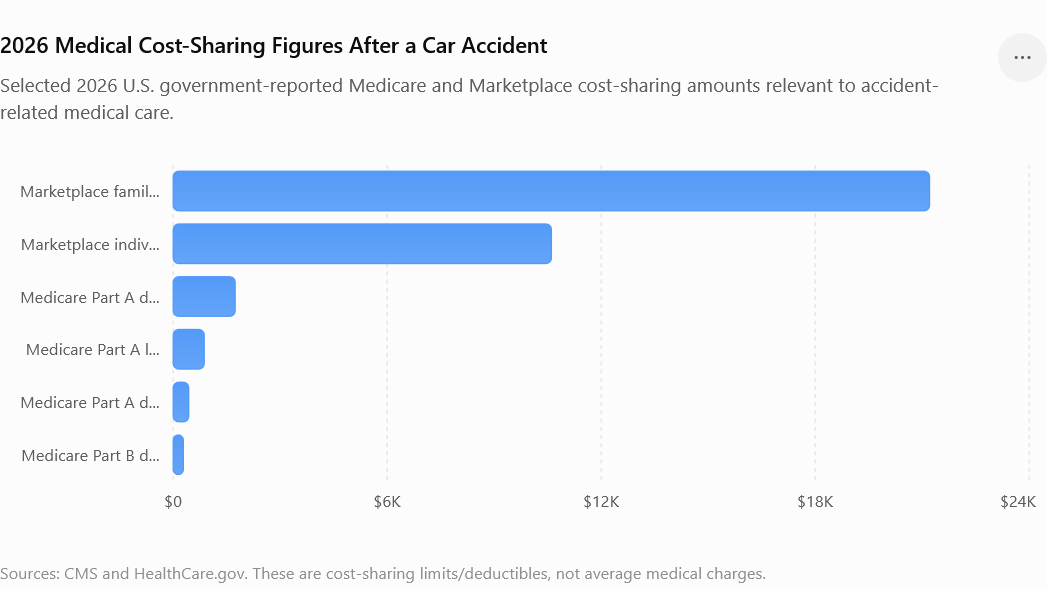
Sources: CMS and HealthCare.gov. These figures represent 2026 Medicare deductibles/coinsurance and Marketplace out-of-pocket limits; they are not average hospital, emergency-room, or ambulance charges.
Why Your Health Insurance May Ask About the Car Accident
Suppose your health insurer receives a $15,000 hospital claim.
The insurer may ask: “Was this injury caused by an automobile accident?”
That question matters because another insurance company may have legal responsibility for some or all of the medical expense.
For example, another potentially responsible payer might be:
- Your PIP coverage
- Your MedPay coverage
- The at-fault driver’s liability insurance
- Another automobile policy
Government health programs explicitly recognize automobile and liability insurance as potential third-party resources in appropriate circumstances. Medicaid, for example, specifically identifies automobile and liability insurance among third parties that may be legally responsible for medical costs.
What Does “Primary Payer” and “Secondary Payer” Mean?
These terms are important when more than one insurance source may be involved.
Primary payer
The primary payer is generally the insurance that pays first according to the applicable coordination rules.
Secondary payer
The secondary payer may pay eligible costs left after the primary payer processes the claim, subject to the secondary coverage’s rules.
Medicare explains that the primary payer pays up to the limits of its coverage, while a secondary payer only pays costs that remain after the primary payment, subject to its own rules.
However, do not automatically apply this terminology to every private auto/health insurance situation. The actual order depends on the applicable laws and policies.
Emergency Room Bills After a Car Accident
If you are experiencing a true medical emergency, do not wait to determine which insurer will pay before getting appropriate care.
HealthCare.gov says that in an emergency you should go to the closest hospital that can provide the necessary care, and you do not need to obtain prior approval from your insurer before receiving emergency room services from an out-of-network hospital.
CMS also explains that, when the federal protections apply, emergency services generally cannot be billed at a higher out-of-network cost-sharing level simply because the emergency provider or facility is out of network.
But emergency care is not necessarily free
Even when surprise-billing protections apply, the patient may still owe normal plan cost-sharing such as a deductible, copayment, or coinsurance.
For coverage gaps after a hospital visit, see how to get emergency medical insurance after a hospital visit.
Does the No Surprises Act Protect Car Accident Medical Bills?
The No Surprises Act can be extremely important after a car accident.
For health plans subject to the federal law, CMS says patients generally have protections against many unexpected out-of-network bills for emergency services.
For example, if you are taken to an emergency department after a collision and receive covered emergency services from an out-of-network provider, the federal law may limit what you can be charged.
But the law has important limitations.
Ground ambulance is a major exception
Federal No Surprises Act billing protections generally do not cover ground ambulance services. CMS specifically states that ground ambulance services are generally outside these federal billing protections, although state law may provide additional protections.
This is especially relevant to car accident victims because an ambulance may transport them from the crash scene to the hospital.
Therefore:
Do not assume that an emergency-room bill and a ground ambulance bill receive identical federal protection.
What About Air Ambulance?
The federal No Surprises Act treats air ambulance services differently.
CMS explains that when the federal protections apply, out-of-network air ambulance providers generally cannot balance bill a patient for covered services, and the patient’s cost-sharing is generally limited to the applicable in-network level.
That distinction matters:
Emergency room ≠ ground ambulance ≠ air ambulance
The billing rules are not identical.
Does the At-Fault Driver Pay the Hospital Directly?
Not necessarily.
If another driver caused your accident, their bodily injury liability insurance may ultimately compensate you for covered damages.
But that does not mean the insurer must function like your hospital’s immediate billing department.
The insurer may first need to investigate liability and the damages being claimed.
This is why a person can receive medical bills even while an insurance claim against the at-fault driver is still open.
The NAIC identifies bodily injury liability coverage as coverage for medical expenses and other damages to people injured in an accident caused by the insured driver.
What If the At-Fault Driver Has No Insurance?
This is where Uninsured Motorist (UM) coverage may become important.
UM/UIM coverage pays costs when the at-fault driver has no insurance or not enough insurance.
In most states, UM coverage also applies to hit-and-run accidents.
The exact rules differ by state.
What If the At-Fault Driver Has Insurance but Not Enough?
Suppose another driver has liability insurance, but the available coverage is insufficient for your damages.
That driver may be considered underinsured for purposes of your claim.
Your UIM coverage provides additional protection when you have it.
The NAIC recognizes UM/UIM coverage as protection against situations involving uninsured or insufficiently insured drivers.
Example
Imagine:
- Your covered accident-related damages: $100,000
- Other driver’s available liability coverage: $50,000
- Your applicable UIM coverage: $100,000
Your own UIM coverage may need to be evaluated.
The actual amount available depends on the policy, state law, offsets, limits, and the facts of the claim.
What Happens When Medical Bills Exceed PIP or MedPay Limits?
This is one of the most misunderstood parts of car accident insurance. Suppose your applicable PIP or MedPay coverage has a limited amount, but your treatment becomes much more expensive. You should not automatically conclude: ‘My PIP is exhausted, so now I personally owe every remaining medical bill. Other coverage may potentially be involved.’ Depending on the circumstances, the remaining expenses could involve:
- Health insurance
- Liability insurance
- UM/UIM coverage
- Medicare
- Medicaid
- Other applicable coverage
The exact coordination depends on the circumstances and applicable law.
Example: A $50,000 Medical Bill
Consider a hypothetical accident. John suffers serious injuries and receives: Total medical charges: $50,000
John has:
- PIP
- Health insurance
- UM/UIM coverage
The other driver is insured.
What happens?
There is no universal formula that says:
PIP → health insurance → other driver’s insurance → John pays the rest.
Instead, the applicable state law and policy terms determine how the different coverages interact.
John’s PIP may provide applicable first-party benefits. His health insurance may process eligible medical services. The liability claim against the other driver may seek compensation for covered damages. If the other driver’s insurance is insufficient, UIM coverage may become relevant.
This example illustrates why accident victims should identify all available coverage rather than assuming there is only one payer.
Medicare After a Car Accident: Who Pays First?
When no-fault or liability insurance is involved, that insurance pays first for accident-related services — Medicare pays second. Medicare specifically includes automobile liability insurance within its coordination rules.
What if the insurance company does not pay?
If the insurer doesn’t pay promptly, Medicare makes a conditional payment and later recovers it.
Medicare can later seek recovery of amounts that the primary insurer should have paid.
This is important because:
A Medicare payment does not necessarily mean the other insurer’s responsibility has disappeared.
Medicare Example
Imagine Mary, age 70, is injured in an automobile accident. She has Medicare and there is a liability claim against another driver. Her doctor knows about the liability claim. If the liability insurer does not pay promptly, Medicare may make a conditional payment and later seek recovery. Therefore, Mary should not simply tell the hospital: “I have Medicare, so bill Medicare and forget about the accident”.
She should provide accurate information about the accident and other insurance.
Medicare itself advises beneficiaries to tell healthcare providers when they have other insurance so bills can be sent to the appropriate payer.
Medicaid After a Car Accident
Medicaid operates differently from ordinary private health insurance. Federal Medicaid rules require states to identify legally responsible third parties and pursue payment from them.
Medicaid.gov explains that all other available third-party resources must meet their legal obligation to pay claims before Medicaid pays for care covered by the Medicaid program.
The federal Medicaid program specifically identifies automobile insurance and liability insurance as potential third-party resources.
Example
Suppose David has Medicaid and is injured because another driver caused a crash.
If the other driver’s liability insurance is responsible for medical expenses, Medicaid treats it as a third-party resource.
The state Medicaid program may seek payment from that responsible third party.
This is why Medicaid beneficiaries should accurately report accident and insurance information.
Health Insurance Subrogation: Why Your Insurer May Want Money From Your Settlement
Suppose your health insurance company pays $25,000 in covered medical expenses after your accident.
Later, you recover money from the at-fault driver’s insurance.
Depending on your health plan and applicable law, the health plan may have contractual or legal rights to seek reimbursement for certain payments it made.
This concept is commonly called subrogation or reimbursement.
The U.S. Department of Labor discusses healthcare subrogation as a mechanism through which health plans may seek recovery where another party is responsible for medical expenses. (dol.gov)
Why this matters
Suppose you receive a $75,000 settlement.
It would be dangerous to assume:
$75,000 settlement = $75,000 available to spend
There may be:
- Medical bills
- Health-plan reimbursement claims
- Medical liens
- Attorney fees
- Other legally enforceable claims
The actual financial result depends on the claim and applicable law.
Medical Liens After a Car Accident
A medical lien is different from health insurance. A lien can give a healthcare provider or another legally authorized party a legal claim against settlement or judgment proceeds. The important point for a U.S. reader is this: medical lien law is primarily state-specific. Therefore, you should not publish a blanket statement such as: “Hospitals can always put a lien on your car accident settlement.” That is too broad.
Whether a provider can assert a lien, what type of lien is available, how it must be filed, and what priority it has can depend on state law and the circumstances.
If a reader receives a lien notice after a serious accident, obtaining advice from an attorney licensed in the relevant state can be appropriate.
What Should You Do If the Hospital Sends You a $20,000 Bill?
This is where practical information can make your article genuinely useful to readers.
Do not simply ignore the bill. But also do not assume that the amount on the first hospital statement is necessarily the amount you ultimately owe.
If the amount still seems too high after checking your EOB, you can negotiate hospital bills with your insurer directly.
Step 1: Ask for an itemized bill
The Consumer Financial Protection Bureau recommends asking for an itemized bill when reviewing medical debt.
An itemized bill can help identify:
- Services you did not receive
- Duplicate charges
- Incorrect dates
- Incorrect procedures
- Amounts already paid
- Other potential billing errors
Step 2: Compare the bill with your Explanation of Benefits
Your health insurer’s Explanation of Benefits (EOB) can help you understand how the claim was processed.
CMS recommends comparing the provider bill with the EOB and checking the amount shown as the patient’s responsibility.
For example:
Hospital bill: $20,000
Insurance allowed/processed amount: $8,000
Insurance payment: $6,000
Patient responsibility: $2,000
The patient should investigate why the hospital is demanding a different amount if the bill does not match the EOB.
The numbers above are only an illustration, not a typical national charge.
What Medical-Bill Errors Should You Look For?
When reviewing an accident-related bill, look for:
Duplicate services
Did you receive the same service twice on the bill?
Services you never received
Does the bill contain a procedure, medication, or service you do not recognize?
Incorrect dates
Does the bill list a service on a date when you were not treated?
Insurance payments missing from the bill
Did your insurer already make a payment that the provider failed to credit?
Wrong network status
Does the bill appear to treat an emergency service as out-of-network when federal or state protections may apply?
The CFPB and CMS both recommend carefully reviewing medical bills and comparing them with insurance information.
What If You Cannot Afford the Medical Bill?
The CFPB advises consumers to first determine whether they actually owe the bill, check the charges, request an itemized bill, and contact the provider if something appears incorrect.
Depending on the provider and your circumstances, you can also ask about:
- Financial assistance
- Charity-care programs
- Payment plans
- Billing adjustments
- Insurance claim corrections
The availability and eligibility requirements vary by provider.
What If Your Insurance Denies the Claim?
A denied claim does not necessarily mean you must immediately pay the entire bill. First determine why the claim was denied. Possible reasons can include:
- Incorrect insurance information
- Missing accident information
- Coding problems
- Coordination-of-benefits issues
- Lack of required documentation
- Coverage exclusions
- Prior authorization issues where applicable
- The insurer believes another payer is responsible
Ask the insurer for the denial reason and instructions for appealing the decision.
HealthCare.gov notes that consumers have rights relating to health insurance claims and appeals, depending on their coverage.
What Should You Tell the Hospital After a Car Accident?
At registration or billing, provide accurate information about:
- Your health insurance
- Your auto insurance
- PIP, if applicable
- MedPay, if applicable
- The other driver’s insurance
- The accident date
- The claim number, if available
Do not provide inaccurate information simply because you are unsure which insurer will eventually pay.
Instead, tell the provider that the injury resulted from a motor vehicle accident and provide the insurance information you have.
This helps the billing department identify potentially responsible payers.
What Documents Should You Keep?
Create one accident folder—physical or digital. Keep the following documents:
- Police report
- Crash photographs
- Insurance information
- Claim numbers
- Witness information
Medical documents
- Emergency-room records
- Ambulance records
- Hospital bills
- Doctor bills
- Imaging bills
- Prescription receipts
- Physical therapy records
Insurance documents
- Auto insurance declarations page
- PIP/MedPay information
- Health insurance EOBs
- Claim-denial letters
- Correspondence with insurers
Financial documents
- Lost-wage documentation
- Medical payment receipts
- Settlement documents
- Medical lien notices
- Reimbursement/subrogation letters
Good documentation can make it much easier to understand what has been billed, what insurance has paid, and what remains disputed.
The Insurance Declarations Page Is Extremely Important
If you are trying to understand your auto coverage, locate your declarations page.
It typically identifies important policy information, including coverage and limits.
Look specifically for:
- Bodily injury liability
- Property damage liability
- PIP
- Medical payments
- Uninsured motorist
- Underinsured motorist
The NAIC identifies these as important auto insurance coverage categories.
If you do not understand a coverage listed on your declarations page, contact your insurer and ask what it means for your state and policy.
A Practical Example: Three Insurance Companies Are Involved
Imagine Lisa is injured in a collision.
She has:
Auto insurer: PIP + UM/UIM
Health insurer: Employer-sponsored health plan
Other driver: Bodily injury liability insurance
Lisa goes to an emergency room.
What should she do?
First: Get the necessary medical care.
Second: Provide the hospital with accurate insurance and accident information.
Third: Notify her auto insurer and determine whether PIP or MedPay applies.
Fourth: Notify her health insurer that the treatment resulted from an automobile accident.
Fifth: Provide the other driver’s insurance information if a liability claim is being made.
Sixth: Keep the EOBs and compare them with provider bills.
Seventh: Before accepting a final settlement, determine whether any reimbursement claims or liens exist.
This approach is more useful than assuming that one insurance company will automatically handle everything.
What Happens If You Are a Passenger?
Being a passenger does not necessarily mean that the driver’s insurance automatically pays every medical bill. Depending on the circumstances, potentially relevant coverage can include:
- The driver’s PIP
- The driver’s MedPay
- Your own applicable auto coverage
- Your health insurance
- The at-fault driver’s liability insurance
- UM/UIM coverage
- Medicare or Medicaid
Medicare’s official guidance even provides an example involving a passenger whose medical treatment was covered through another person’s MedPay/no-fault automobile coverage before Medicare was billed.
This illustrates why the passenger’s own coverage and the driver’s coverage should both be identified.
What If You Were Hit as a Pedestrian?
A pedestrian injured by a vehicle may have different insurance options depending on the state and circumstances. Potential sources can include:
- The driver’s bodily injury liability insurance
- The pedestrian’s applicable auto coverage, where state law permits
- PIP
- Health insurance
- UM/UIM
- Medicare
- Medicaid
Because pedestrian claims can involve state-specific insurance rules, readers should not assume that the rules are identical to those for a person driving a vehicle.
What If the Accident Was Your Fault?
You may still have medical coverage.
Depending on your state and policy, PIP or MedPay can provide first-party medical benefits without requiring another driver to be at fault.
Your health insurance may also cover eligible medical treatment.
But if you are seeking compensation from another driver’s liability insurance, your own fault may become important under the state’s applicable liability rules.
This is another reason why fault and medical-payment coverage are separate questions.
New drivers face extra challenges here — see how new drivers in Texas can get cheap auto insurance
What If Both Drivers Were Partly at Fault?
In some states, more than one driver can share responsibility for an accident.
The effect of partial fault depends on the state’s negligence and insurance laws.
For example, the rules determining whether an injured person can recover damages—and how much—can differ among states.
Therefore, a national article should not give one percentage formula and claim that it applies throughout the United States.
For a serious disputed accident, state-specific legal advice may be appropriate.
Can You Get Medical Treatment Before the Insurance Claim Is Settled?
Yes, you can seek necessary medical treatment before a liability claim is finally resolved. Emergency care should not be delayed simply because the responsible insurer has not yet accepted liability.
HealthCare.gov advises people experiencing a true emergency to go directly to an appropriate hospital rather than waiting for insurer approval. The important financial question is not:
“Can I get treatment before settlement?”
It is:
“Which coverage should process the treatment, and what portion may ultimately remain my responsibility?”
Should You Pay a Medical Bill Before the Insurance Claim Is Finished?
There is no universal answer.
You should not simply ignore a bill because you expect an insurance company to pay it.
At the same time, you should review the bill and insurance processing before assuming that the full amount is your responsibility. A good approach is:
- Request the itemized bill.
- Review the EOB.
- Confirm which insurer processed the claim.
- Ask whether another payer should be billed.
- Dispute errors promptly.
- Ask about financial assistance if necessary.
The CFPB specifically recommends checking whether a bill is accurate, whether insurance payments were properly credited, and whether the services listed were actually received.
10 Mistakes to Avoid After a Car Accident
1. Assuming the other driver’s insurer pays everything immediately
Liability claims can require investigation and resolution.
2. Assuming health insurance always pays second
The actual coordination rules depend on the insurance involved.
3. Assuming PIP works the same in every state
PIP requirements and benefits are state-dependent.
4. Ignoring your declarations page
Your coverage limits matter.
5. Ignoring an Explanation of Benefits
The EOB can help you determine what the health insurer actually processed.
6. Paying an incorrect bill without checking it
Request an itemized bill and compare it with your EOB.
7. Assuming the No Surprises Act covers ground ambulance bills
Generally, federal No Surprises Act protections do not cover ground ambulance services.
8. Forgetting about UM/UIM coverage
Your own policy may provide protection if the other driver has no insurance or insufficient coverage.
9. Ignoring Medicare or Medicaid reporting requirements
Government programs can have specific coordination and recovery rules.
10. Signing a major settlement without understanding outstanding claims
Medical bills, reimbursement claims, and liens can affect the final financial result.
A Step-by-Step Medical Bill Strategy After a Car Accident
Use this process if you are dealing with multiple insurers.
Step 1: Get treatment
Take care of the injury first.
Step 2: Identify every insurance policy
Write down every potentially relevant insurer.
Step 3: Find your auto declarations page
Identify PIP, MedPay, UM and UIM limits.
Step 4: Report the accident
Notify the appropriate insurers.
Step 5: Tell the health insurer
Explain that the medical treatment resulted from a motor vehicle accident.
Step 6: Collect every bill
Do not rely only on the hospital’s first statement.
Step 7: Compare the bill with the EOB
Look at the insurer’s “patient responsibility” amount.
Step 8: Dispute errors
Contact the provider and insurer promptly.
Step 9: Track reimbursement claims
Watch for subrogation or reimbursement letters.
Step 10: Review liens before settlement
If a serious personal-injury claim is involved, determine whether any valid medical lien or other claim exists.
State-Specific Rules Matter More Than Most Readers Realize
A major weakness of many car-accident articles online is that they explain U.S. insurance as though all 50 states use one system. They do not.
The NAIC’s state-by-state auto insurance data shows differences in required coverages and insurance structures. For example, the NAIC database identifies different PIP and liability requirements among states.
Therefore, readers should use this article to understand the general framework, then verify the rules for the state where the accident occurred. This is especially important for:
- PIP requirements
- No-fault rules
- MedPay
- UM/UIM
- Medical liens
- Comparative fault
- Lawsuit deadlines
- Settlement procedures
Frequently Asked Questions
Who pays medical bills after a car accident?
Several sources can pay — PIP, MedPay, health insurance, the at-fault driver’s insurance, UM/UIM, Medicare, or Medicaid — depending on your state and policies.
Does auto insurance pay hospital bills?
Yes, through PIP or MedPay if you carry either coverage.
Does health insurance cover car accident injuries?
Yes, but tell your insurer it’s accident-related — you’ll still owe your normal deductible or copay.
Does the at-fault driver’s insurance pay my medical bills?
The at-fault driver’s bodily injury liability insurance may compensate you for covered damages if the driver is legally responsible.
Who pays first in a no-fault state?
PIP pays first in no-fault states, though limits and rules differ by state.
What if I don’t have PIP?
Depending on your state and circumstances, health insurance, MedPay, liability insurance, UM/UIM, or other coverage may be relevant.
What if the other driver has no insurance?
UM coverage may provide protection if it applies under your policy and state law.
What if the other driver does not have enough insurance?
UIM coverage may provide additional protection where applicable.
Does Medicare pay for car accident injuries?
Medicare pays second — liability or no-fault insurance pays first.
Does Medicaid pay car accident medical bills?
Medicaid pays last — it requires other responsible insurers to pay first.
Does the No Surprises Act protect emergency-room bills?
Yes, for plans covered under the federal law.
Does the No Surprises Act protect ground ambulance bills?
No — ground ambulance is a major exception, though some states fill the gap.
Should I ask for an itemized medical bill?
Yes. The CFPB recommends asking for an itemized bill and checking whether the charges are accurate and whether insurance payments have been properly reflected.
What if my medical bill is higher than my EOB?
Call the provider’s billing office and ask why the amounts don’t match your EOB.
Can my health insurer recover money from my settlement?
Depending on the plan and applicable law, a health plan may have reimbursement or subrogation rights after paying accident-related medical expenses.
Can a hospital put a lien on my settlement?
Possibly, depending on state law and the circumstances. Medical-lien rules are not uniform nationwide.
Final Answer: Who Really Pays After a Car Accident?
The most accurate answer is:
It depends on your state, your insurance coverage, your health plan, the circumstances of the accident, and whether another person is legally responsible.
Your medical bills may involve several different sources of payment:
PIP → MedPay → Health Insurance → Liability Insurance → UM/UIM → Medicare/Medicaid
But this should not be interpreted as a universal payment sequence.
The correct payer depends on the applicable rules.
If you have been injured, your best first steps are to:
- Get necessary medical treatment.
- Identify every applicable insurance policy.
- Find your auto declarations page.
- Report the accident.
- Tell your health insurer that the injury resulted from a car accident.
- Keep every medical bill and EOB.
- Request itemized bills.
- Check for insurance-payment errors.
- Track any reimbursement or subrogation claims.
- Understand any medical liens before settling a serious claim.
For serious injuries or disputed liability, consider speaking with a qualified attorney licensed in the state where the accident occurred.
If there’s one thing to take away from all this, it’s that no single insurer is going to sort out your bills for you automatically. The people who come out ahead after an accident are usually the ones who ask questions, keep their paperwork organized, and don’t assume the first bill they see is the final word.
Official Sources and Consumer Resources
For readers who want to verify the information themselves, these are the primary resources used for this guide:
- National Association of Insurance Commissioners — Auto Insurance
- NAIC — Auto Insurance Database Report
- Medicare.gov — Who Pays First?
- Medicaid.gov — Coordination of Benefits & Third Party Liability
- CMS — Know Your Rights About Medical Bills
- CMS — Using Health Insurance and Emergency Care
- HealthCare.gov — Getting Emergency Care
- Consumer Financial Protection Bureau — Medical Bills and Itemized Charges
- U.S. Department of Labor — Healthcare Subrogation Research
Last Updated: August 2026
Disclaimer: This article is general educational information and is not legal, medical, financial, or individualized insurance advice. Insurance requirements, PIP and no-fault rules, liability laws, medical-lien laws, and health-plan provisions vary by state and individual circumstances.

Hi, I’m Nurul Islam Chowdhury (Imran) — the person behind HospitalInfo.
Associate Member, Institute of Cost and Management Accountants of Bangladesh (ICMAB – Associate Member No: A-1607)
Nurul Islam Chowdhury (Imran) holds a Bachelor of Business Administration (BBA) and a Master of Business Administration (MBA) from the University of Chittagong. As a qualified Cost and Management Accountant (CMA), he specializes in financial analysis, cost management, and tax structures. Every piece of tax and financial data in this article has been personally reviewed and fact-checked by him to ensure technical and calculation accuracy based on standard IRS guidelines and 2026 regulations.
My background is in finance and cost management, but for the past few years my real focus has been something more personal: helping everyday Americans make sense of health insurance and hospital bills.
Here’s the thing about healthcare costs in the US — they’re confusing on purpose, or at least it feels that way. A single ER visit can turn into a stack of paperwork nobody explains clearly. That’s the gap I try to fill on this site. I dig into how PIP and MedPay actually work, what happens when health insurance and auto insurance both claim to cover the same bill, how to negotiate a hospital statement instead of just paying it, and how coverage options change year to year.
I’m not a doctor, and I don’t pretend to be. What I bring is a finance-and-numbers lens — reading policy documents, tracking CMS and state-level rules, and translating them into something you can actually use before you’re stuck on the phone with an insurance rep. Every guide here starts from a real question people are Googling at 11 PM with a bill in front of them, and that’s still how I decide what to write next.